Planetary system dynamics studies the orbital evolution of planets, planetesimals, and dust under gravity, radiation, collisions, and dissipative forces.
Orbit crossing occurs when two geometrical orbital paths intersect. It permits collisions or close encounters when bodies also reach the intersection at compatible times; crossing alone does not imply a collision. For nearly circular coplanar nested orbits, a useful local test follows by differentiating their radial positions at fixed longitude.
For a cold coplanar disk with complex eccentricity , the first-order radial shape is . Infinitesimally neighboring orbits first cross when . Under secular forcing by a distant outer planet, , and , so the secular phase gradient gives . The finite-neighbor version requires the accumulated phase difference to remain small when replacing a difference by a derivative.
Isotropic stellar mass loss changes the central gravitational parameter while preserving the central direction of the force, provided the escaping material causes no recoil or drag on the orbiting body. The relative equation is . Specific angular momentum remains exactly constant; specific orbital energy obeys . Orbital expansion is adiabatic only when the mass-loss law varies slowly on the orbital period.
Time averaging over a Kepler orbit gives , as follows from and . Consequently slow isotropic stellar mass loss preserves the secular orbital eccentricity. Conserved specific angular momentum then gives , so pericentre, apocentre and semimajor axis expand inversely with the remaining gravitational parameter.
The signed instantaneous contribution of apsidal precession to azimuthal motion during isotropic stellar mass loss is . Its maximum absolute magnitude is small when , where near a circular orbit and as . The low-orbital eccentricity coordinate singularity can be avoided by evolving the eccentricity vector.
For isotropic stellar mass loss the eccentricity vector obeys . With true anomaly and , this gives and . The osculating pericentre satisfies , hence cannot decrease during mass loss and is instantaneously stationary at pericentre. The vector form is nonsingular at a circular orbit.
Anisotropic thermal radiation produces recoil that changes the semi-major axis of a rotating solid body. Finite thermal inertia provides the temperature lag. Large bodies have small acceleration per unit mass, while very small bodies become nearly isothermal. The Yarkovsky effect can supply bodies to dynamical escape regions.
Drift driven by the Yarkovsky effect can carry a body out of a belt or into an unstable orbital region. A useful two-limit removal law is , with slow escape at both large and small diameters.
A population supplied at differential number rate and surviving externally for a size-independent time has . Its differential number slope changes by the negative of the removal-time exponent, unless the belt is already removal-dominated, in which case it reflects the fragment injection spectrum.
For , the ratio has its minimum at . Removal beats collisions somewhere exactly when , provided the relevant diameters are present. This criterion uses the collision-only cascade as a reference.
The law for positive has a minimum at with value . This size differs from the minimum of the ratio of removal and collision times.
A passing star perturbs a planetary or cometary system through its differential Newtonian gravitational field. A distant encounter is predominantly tidal; a sufficiently close one can substantially change specific orbital energy and angular momentum, eject a comet, or shift its periapsis into or out of the planetary region.
Planetary migration changes a planet's orbital semimajor axis through torques from a disc or exchanges of energy and angular momentum with other bodies, often followed by tidal dissipation. Short-period giant planets, eccentric progenitors, resonant architectures, and stellar obliquity provide complementary constraints rather than one unique migration diagnostic.
For a fixed mass on a Keplerian circular orbit, has derivative . The torque on the satellite is minus the torque on the disk. This gives the displayed drift law. In the density-slope satellite torque model, .
The stellar obliquity is the angle between a star's spin and a planet's orbital angular momentum. The Rossiter-McLaughlin effect constrains the angle between the sky projections of those two axes, rather than a component of . If the orbital and stellar-spin inclinations to the line of sight are and , then ; alone generally does not determine . Large misalignments constrain formation and planetary migration, but can also reflect a tilted birth disc.
A transiting body hides different velocity regions of a rotating stellar disc and causes an anomalous measured Doppler shift. Its time dependence constrains the sky-projected spin-orbit angle, which is not generally the full stellar obliquity.
Tidal locking settles a body's spin into a sustained relation with its orbital motion through tidal forces and tidal dissipation. The simplest case is synchronous rotation, a spin-orbit resonance. On an ideal circular orbit, with spin axis perpendicular to the orbital plane, the body keeps the same face toward its companion, as the Moon approximately does toward Earth. [ref].
This article retains the broader sense of tidal locking as capture into a spin-orbit resonance; the term is also commonly used specifically for synchronous rotation. Tidally evolved rotation need not be : Mercury has a spin-orbit resonance with the Sun, turning three times in two orbital periods. The distinction matters when inferring illumination or climate from a spin period. [ref].
Tidal deformation is the change in a body's shape caused by differential gravity across it, that is, by a tidal force. The familiar two-bulge picture represents an elongated response along the companion direction, rather than a separate force pulling only the nearest surface. If spin and orbital motion differ, the forcing sweeps through the body's material. With tidal dissipation, the response is out of alignment with the instantaneous forcing, allowing a net torque. [ref].
A secular tidal torque is the torque remaining after averaging the changing tidal interaction over fast orbital and rotational motion. The misaligned tidal deformation lets the companion's gravity change the spin angular momentum; the orbit receives the opposite torque. Tidal dissipation converts mechanical energy into heat, while total angular momentum is conserved in an isolated system. Thus the spin-orbit coupling exchanges angular momentum rather than destroying it. [ref]
https://link.springer.com/article/10.1007/s11214-024-01055-4. Fuller, Guillot, Mathis and Murray (2024): tidal dissipation in giant planets
.For intuition near synchronous rotation on a circular orbit, hold mean motion and moment of inertia fixed and adopt the illustrative linear dissipative lawHere is spin angular velocity, is a marked surface direction in an inertial frame, and is a response coefficient, not a universal material constant. A faster spin is slowed and a slower prograde spin is accelerated. The solution and the associated mechanical power loss areThe orbital contribution to this power is , and the spin contribution is ; their sum becomes heat. Holding fixed is a local approximation to the coupled evolution. Actual secular tidal torque depends on the deformation response and orbital eccentricity, so this simple law does not establish which spin-orbit resonance an eccentric body captures into.
A prograde spin-orbit resonance relates mean spin angular velocity to mean motion by a ratio of small positive integers, : the body makes turns in orbital periods. Synchronous rotation is ; Mercury's spin-orbit resonance is nonsynchronous. The relevant combination of spin and orbital angles must stay bounded around a preferred orientation, not merely have a near-integer frequency ratio. For an elongated body on an eccentric orbit, the companion's gravitational torque on the permanent shape can sustain the resonance while tidal dissipation permits capture. [ref].
Synchronous rotation means one prograde turn about the body's own axis per orbital period, measured against fixed directions in an inertial frame. This spin-orbit resonance approximately describes the Moon's synchronous rotation toward Earth. [ref].
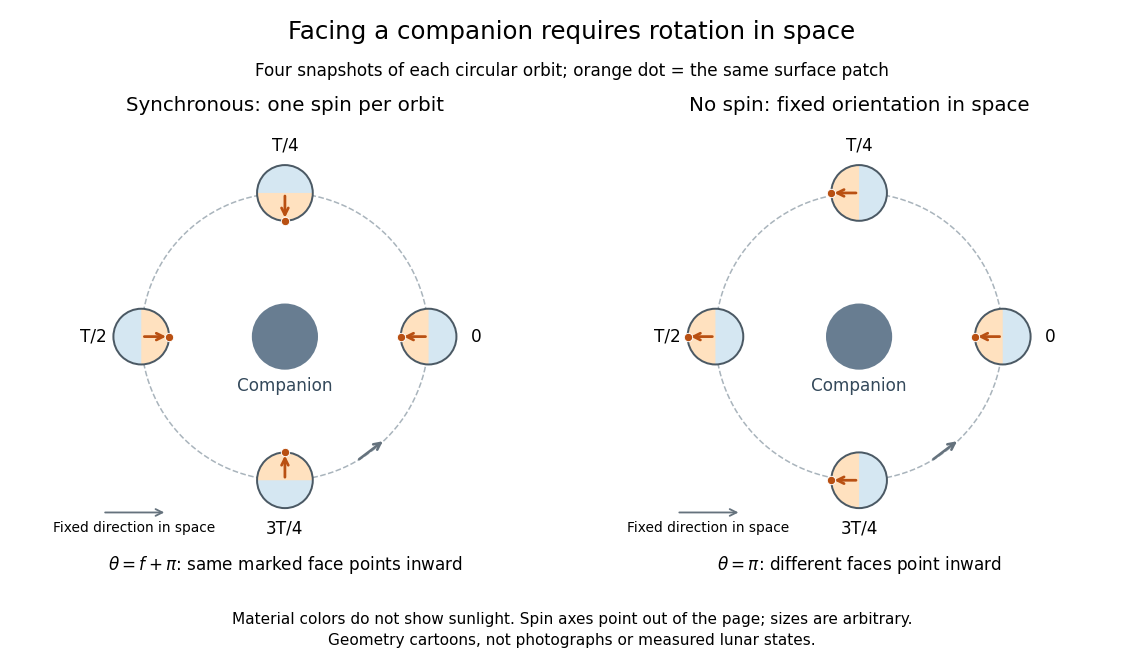

The striking geometric idea is that one turn in space can keep one face toward the companion: a fixed orientation in the frame turning with the orbit is a changing orientation in an inertial frame. This distinction helps us predict illumination: a synchronously rotating exoplanet orbiting its illuminating star can have persistent day and night hemispheres, whereas the Moon, synchronized to Earth, receives changing illumination from a different body, the Sun.
View a circular orbit along its perpendicular spin axis. Let be the orbital angle measured from a fixed direction, choosing an arbitrary zero for the circular limit of true anomaly, and let be the direction of an outward arrow painted on the body, measured from the same fixed direction. The direction from the body to its companion is . Thus an inward-facing arrow satisfiesMore generally synchronous rotation keeps constant; its particular value selects which surface direction faces the companion. Over one orbital period , both and the unwrapped increase by . This is the short geometric explanation for one turn per orbit. For a nonspinning body, instead, and the companion direction sweeps through all surface longitudes. On an eccentric orbit, mean spin does not force to stay exactly constant: true anomaly advances nonuniformly, producing the longitudinal component of libration.
Facing a companion and facing the source of light are different relations. The Moon keeps its near side of the Moon approximately toward Earth, while the direction to the distant Sun is nearly fixed during the idealized orbit shown below. A fixed surface patch therefore turns toward, across and away from sunlight. The far side of the Moon has day and night too; its name does not mean permanent darkness. [ref]
https://science.nasa.gov/moon/facts/. NASA: changing lunar illumination
.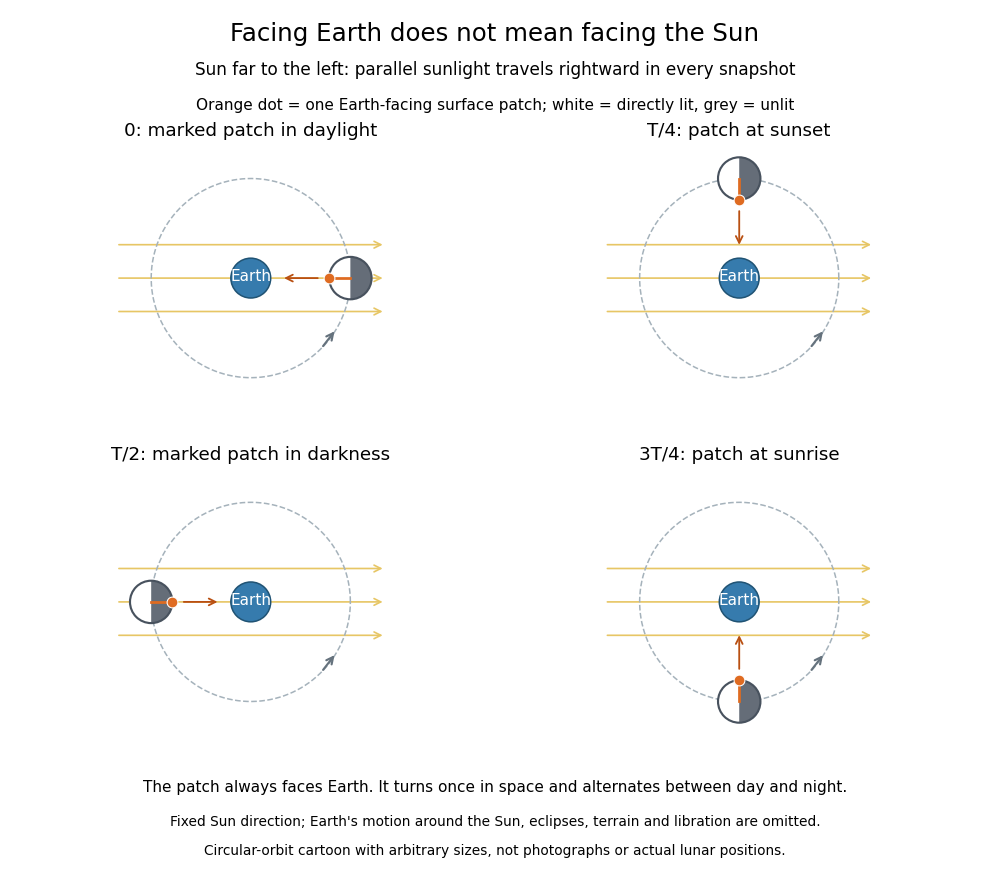

If the Sun direction has fixed angle and the marked surface patch has outward normal vector at angle , its direct illumination is proportional to . With synchronous rotation, , so the patch goes through day and night even though it always faces Earth. In reality the Earth-Moon system advances around the Sun: the lunar spin and orbital cycle relative to distant stars is about Earth days, while the lunar phase cycle has a synodic period of about Earth days. These numbers describe the actual system, not the fixed-sunlight cartoon. [ref]
https://starchild.gsfc.nasa.gov/docs/StarChild/questions/question32.html. NASA StarChild: sidereal and synodic lunar periods
.For a synchronously rotating exoplanet whose orbital companion is itself the illuminating star, the direction to the star turns with the orbit. On an ideal circular orbit, with perpendicular spin axis and no additional oscillations, this direction is fixed relative to the surface, giving persistent day and night hemispheres. Day-night heat redistribution then helps determine the nightside temperature; permanent lack of direct starlight does not imply zero temperature. Orbital eccentricity and departures from this ideal spin geometry modify that simple picture.
Tidal heating converts mechanical energy of tidal deformation into internal heat through tidal dissipation. Sustained orbital eccentricity or a spin axis tilted relative to the orbital plane's perpendicular can maintain changing tidal deformation and heat an exoplanet interior. Thus synchronous rotation alone does not eliminate tidal heating.
Tidal dissipation converts mechanical energy associated with a time-varying tidal deformation into heat. It can reduce orbital eccentricity, drive synchronous rotation, and contribute deep planetary heating. A circular orbit with exact synchronous rotation, perpendicular spin axis and no additional forcing has a static tidal deformation in the body's frame and need not sustain substantial tidal heating.
An astronomical conjunction occurs when two orbiting bodies have the same apparent longitude as viewed from their primary or from an observer.
For two uniform angular motions with , an inner exoplanet transit at zero and next outer exoplanet transit at , the next conjunction solves . Hence its longitude modulo isFor an eccentric outer body this is only an approximation. Let be its line-of-sight anomalies and . Exact true alignment instead requires . The correction follows directly from uniform mean anomaly and nonuniform true anomaly.
Keplerian shear is differential orbital motion caused by : neighboring material at smaller semi-major axis advances in longitude relative to material farther out.
Phase mixing disperses an initially localized ensemble because its members have slightly different orbital frequencies, causing their phases to spread with time.
A planetesimal is a solid body in a young or evolved planetary system whose collisions and gravitational interactions help build or erode larger bodies.
For an impactor number density per size , relative speed , and collision cross-section , the differential collision rate of one target is .
The specific impact energy is an impactor's kinetic energy divided by the target mass. For equal-density spherical bodies,
A binary planetesimal is a gravitationally bound pair of planetesimals. Its internal two-body problem and its centre of mass orbit respond differently to external forces, including gas drag.
For linear gas drag with aerodynamic stopping times , masses , total mass , and relative velocity , defineIf is the gas velocity relative to the centre of mass, the relative drag acceleration is . The first term dissipates internal specific orbital energy; the second is a differential headwind that vanishes for equal aerodynamic stopping times.
For a weakly perturbed circular binary planetesimal, the constant differential headwind does zero work averaged over the unperturbed orbit. Orbit-averaged drag work givesWith constant aerodynamic stopping times, . This averaging assumes drag is slow compared with the orbital period and does not appreciably distort the circular orbit within one period.
For a nearly circular stellar orbit of radius in gas moving at times the local circular speed, the averaged tangential gas drag on the centre of mass is . Orbit-averaged drag work givesIf and aerodynamic stopping time scales as , , then . Internal contraction can outpace stellar migration. Tightly gas-coupled drift requires solving radial and azimuthal motion together instead of this weak-drag approximation.
For a small body with orbital elements relative to a planet on a circular orbit of semi-major axis , the Tisserand parameter is approximatelyIt is derived from the Jacobi constant and is approximately conserved across separated weak encounters in the circular restricted three-body problem.
For bound planet-crossing Kepler orbits, , with the planet radius taken as one. At fixed , is maximized by and . For this gives . This form remains regular at . It is an invariant-based accessibility bound, not a guarantee that a scattering history attains it; for it gives no positive universal pericentre floor.
In units where a circular planet has orbital radius and speed one, the particle's relative speed outside a close encounter satisfies , to leading order in the planet-to-star mass ratio. This follows from the vis-viva equation and at the encounter radius. A short conservative encounter changes the direction of this relative velocity while preserving its magnitude.
The disturbing function is the perturbing part of the gravitational potential used to derive the evolution of orbital elements in celestial mechanics.
For a particle far inside a planet's stellar orbit, the planet-centred disturbing function is . Expanding the first term cancels its dipole against the indirect disturbing function. Dropping the spatially constant monopole leaves , where is the angle between the two offset vectors. The omitted instantaneous terms are . The gradient of the retained expression is the leading differential stellar tidal acceleration.
For two circular Kepler orbits with mutual inclination , independently average the stellar quadrupole disturbing function over both mean anomalies. A circular ring with unit normal has . Contracting the two ring tensors gives , proving the displayed exact angular factor. For small orbital inclinations relative to a common plane, . Thus the secular angular factor is . This potential generates the slow stellar contribution to satellite nodal precession.
The Lagrange planetary equations express changes of osculating orbital elements in terms of derivatives of a disturbing function. Their small-eccentricity secular limit becomes a linear equation for complex eccentricity.
If retained Lagrange planetary equations have and , then . Thus is constant. A resonantly oscillating orbital eccentricity–semi-major axis trajectory retraces one curve rather than enclosing area in that projection.
For disturbing function , , the leading planar Lagrange planetary equations give . The derivative with respect to holds the other osculating orbital elements fixed. If one writes , its literal derivative includes ; the physical mean-longitude equation cannot be obtained by silently dropping that term. A consistent accumulated-phase parametrization uses .
For perturbing acceleration on an osculating orbital element system with fixed central parameter ,To prove it, differentiate the specific orbital energy , obtaining . Substitute , and . Here is the true anomaly; a normal perturbing acceleration does no instantaneous work.
The direct disturbing function is the gravitational potential of the perturbing body evaluated at the disturbed body. In heliocentric coordinates it is proportional to the inverse separation of the two bodies.
The indirect disturbing function accounts for the acceleration of a non-inertial origin, such as a star-centered coordinate frame accelerated by a perturbing planet.
The D'Alembert characteristic constrains each disturbing-function harmonic so that the integer coefficients of its angular arguments sum to zero, with corresponding parity and eccentricity-inclination order restrictions imposed by rotational symmetry.
A Laplace coefficient is the Fourier coefficientIt packages the radial dependence of a disturbing-function expansion.
A short-period orbital perturbation is driven by rapidly varying orbital-angle combinations and usually averages to zero over many conjunctions away from resonance.
A resonant orbital perturbation has a slowly varying angular argument because a nearly integer relation between orbital frequencies prevents successive conjunction effects from averaging away.
A secular perturbation survives averaging over fast orbital phases and drives slow precession and exchange of eccentricity or inclination.
For a quantity on a periodic Kepler orbit, its orbit average is . Equal increments of true anomaly are not equal increments of time. Eccentric anomaly gives the weight , which yields . Slow orbital perturbations can be averaged using elements held fixed over a single orbital period.
The difference between the angular momentum of circular coplanar orbits at fixed semi-major axes and the system's actual angular momentum along the reference normal. With circular momenta it is . For small planar orbital eccentricities its quadratic part is . Its conservation in requires .
The proper eccentricity is the magnitude of the homogeneous part of the complex eccentricity in linear secular perturbation theory. It remains constant in conservative theory, while its proper longitude of periapsis advances at the free precession frequency.
Laplace-Lagrange secular theory linearizes the orbit-averaged disturbing function to second order in eccentricities and inclinations. It represents planetary eccentricity evolution by a constant matrix.
For a test particle interior to a distant eccentric planet, write . The leading Laplace coefficients are and . Thus its forced eccentricity is and its secular frequency is . More distant inner particles have larger forced orbital eccentricities and faster secular precession, producing a growing gradient of complex eccentricity.
If both precession and forcing in share a common mass factor while stays fixed, then . The Argand diagram circle is unchanged; only its traversal speed varies. With , the phase is .
The eigenvalues of the Laplace-Lagrange secular matrix are apsidal precession frequencies, and its eigenvectors give the relative eccentricities and apsidal phases of the corresponding normal modes.
The complex eccentricity packages eccentricity and longitude of periapsis as , turning linear secular dynamics into a complex linear system.
With a fixed planetary pericentre, the linear secular equation has solution . An initially circular orbit follows , a counterclockwise circle in the complex plane centered at the forced eccentricity , with free eccentricity amplitude . Its maximum orbital eccentricity is and its phase-averaged mean orbital eccentricity is .
A secular eigenmode is a normal mode in which all complex eccentricities precess at one eigenfrequency with fixed amplitude ratios and relative apsidal phases.
For a real two-planet Laplace-Lagrange secular matrix with negative off-diagonal entries, the upper secular eigenmode has anti-aligned apsides and the lower has aligned apsides. Their positive planet-1 to planet-2 amplitude ratios obey . Under the conventional angular momentum deficit normalization this is .
Complex inclination packages small orbital inclination and longitude of ascending node . It differs from complex eccentricity. Linear Laplace-Lagrange secular theory gives , whose matrix exponential solution decomposes into nodal secular eigenmodes.
The particular, forced part of a complex inclination solution. For a fixed, circular, inclined inner planet and an exterior test ring, linear Laplace-Lagrange secular theory gives , so and . The ring describes a circle about the planetary tilt in an Argand diagram; relative to the planet, its mutual inclination stays constant while its ascending node precesses.
For circular planetary orbits with angular momenta , the inclination matrix has positive off-diagonal entries, zero row sums, and . Positive diagonal symmetrization of a matrix with makes a symmetric matrix. Moreover,All eigenvalues are real and nonpositive. The zero eigenvalue is a common tilt of every orbital plane; nonzero modes describe relative nodal precession.
If two nearby inner planets couple much more strongly to each other than to a distant third planet, their slow secular eigenmode has a common complex inclination. With , the effective inner-to-outer coupling isAngular momentum balance makes the reverse coupling . The reduced matrix has eigenvalues and . If , the nonzero frequency is approximately , while the fast inner differential mode has frequency .
The forced eccentricity is the particular secular response of a small body to planetary eigenmodes, as distinct from its freely precessing homogeneous eccentricity.
A secular resonance occurs when a small body's free precession frequency equals a planetary secular eigenfrequency. Undamped linear theory then predicts resonant eccentricity growth.
Changing planetary masses or other system parameters move the frequencies of secular eigenmodes. A particle can cross a secular resonance when its free precession frequency meets a forcing frequency. Passage can change its free eccentricity and mix modes; a single scalar phase replacement generally cannot describe the response.
Linear eccentricity damping contributes to the complex-eccentricity equation, exponentially suppressing the free mode and regularizing a secular resonance.
Linear eccentricity damping on one planet changes to . For a nondegenerate, weakly damped two-planet matrix, let . The modal damping rates are . Both secular eigenmodes damp even though only one planet is directly affected; the coupling shares the dissipation.
A secular torque is the orbit-averaged gravitational torque that changes orbital orientation or shape after fast orbital phases have been averaged out.
In a hierarchical orbital system, the quadrupole approximation keeps the first nontrivial term beyond the monopole in the orbit-averaged expansion in the ratio of inner to outer separation.
A binary star of total mass , reduced mass and separation vector has far-field potential functionwhere is the angle between and . The dipole term vanishes in centre of mass coordinates. Averaging a circular coplanar binary over its fast phase gives .
For a distant coplanar circular orbit about a binary star, the averaged quadrupole potential of a circular binary givesAt fixed outer radius , the quadrupole shortens the period relative to the monopole result. If the inner binary evolves slowly, the outer specific angular momentum stays constant in the axisymmetric averaged potential, but the outer energy can change. The outer radius must then be allowed to adjust when computing a period derivative.
Nodal precession is the gradual rotation of an orbit's line of nodes, usually driven by a nonspherical or external gravitational torque.
Differential nodal precession occurs when neighboring orbits precess at different rates, winding a flat collection of rings into a warp or a phase-mixed thick structure.
An inclined inner planet causes exterior debris disk rings to undergo nodal precession at different rates. In the quadrupole approximation, . Rings that have precessed appreciably tilt away from their original orbital plane, whereas distant rings remain near it, making an evolving warp. Conservative secular perturbations alone do not damp every ring into the planet's plane; unresolved phase mixing can instead produce a thick inner disk whose mean normal is near the forced plane.
The Laplace plane is the local equilibrium orbital plane about which a satellite or disk annulus precesses under competing secular torques.
The Laplace radius is the satellite distance where the small-tilt nodal precession contributions from a planet's axisymmetric quadrupole and the stellar tide have equal magnitudes. In the circular hierarchical limit those rates are and . Equating them proves the displayed fifth-root expression. Inside this radius the planetary quadrupole coefficient controls the preferred plane; outside it the double-averaged circular tidal potential dominates. When equator and planetary orbit are inclined to one another, their balance determines the local Laplace plane.
Apsidal precession is the gradual rotation of an orbit's line of apsides, equivalently a change in its longitude of periapsis.
The Kozai–Lidov mechanism exchanges eccentricity and inclination in a hierarchical gravitational system while preserving a component of angular momentum in the quadrupole limit.
Planetary scattering is the alteration of a smaller body's orbital energy and angular momentum by close encounters with a planet. Repeated encounters can eject, accrete, or detach the body.
For a nearly radial Kepler orbit, , so modest changes in specific angular momentum can strongly change pericentre. A planetary torque acting for a reference orbital time gives . Coherent kicks change by order itself after orbital-scale encounters, whereas uncorrelated kicks require an order- random-walk count. Both estimates are conditional on encounter geometry: a close encounter with a smaller impact parameter can give a much larger kick.
Model successive uncorrelated planetary kicks as a random walk in inverse semi-major axis , proportional to negative specific orbital energy. If the root mean square kick per periapsis passage is and the initial value is , the characteristic number of passages to reach the escape scale is . For and passage interval ,The quantity has inverse-length units, not the units of a variance-per-time diffusion coefficient. With , that coefficient is . This estimate assumes many independent encounters; changing orbital periods and resonant correlations can invalidate the clock. It is not an exact mean first-passage time.
At fixed stellar mass , planetary mass density , age and initial ratio , the order-unity Safronov number comparison and comet energy diffusion give boundariesTheir logarithmic slopes in planetary mass versus radius are and . Above both, strong kicks and a short estimated diffusion time favour ejection; below the escape boundary, repeated weak encounters favour collision statistically. Below the age boundary, the stated diffusion mechanism has not completed on its characteristic clock. Collision lifetimes require additional cross-section and encounter-rate information, so this map alone cannot establish retention or accretion within the age.
For a planet on a circular stellar orbit, a common convention is . The escape-to-orbital-speed ratio measures the size of a strong gravitational assist relative to the stellar binding energy of a nearby comet. Large values tend to favour ejection over collision; small values favour repeated weak encounters with more collision opportunities. This is a statistical comparison, dependent on the initial orbit and encounter geometry, rather than a universal outcome threshold.
A gravitational assist ejects a weakly bound comet when the increase in its specific orbital energy exceeds its binding energy. For near-parabolic coplanar encounters, the weak-deflection ejection impact parameter scales as . Combining this with the phase-mixed comet surface density gives a one-encounter ejection time proportional to , within the local two-body encounter approximation.
For a particle initially having semimajor axis one and encountering a circular planet at radius one, the incoming stellar-frame speed is one. A conservative encounter at planet-relative speed changes the stellar-frame velocity by at most . Since stellar escape requires speed , a necessary bound is . Retaining the outgoing relative-velocity geometry sharpens the necessary bound to . Neither inequality by itself guarantees a realizable deflection at a specified impact parameter.
The geometric collision cross-section in a coplanar calculation is a length , rather than an area. For one comet with local surface probability and relative velocity , the rare-event rate is . Without gravitational focusing, the resulting mean collision time scales as for deep planet-crossing orbits at fixed stellar mass and planetary mass density.
For a population with randomized vertical phases, orbital inclination , and , the effective volume probability near the planetary plane is proportional to . The collision time then scales as , at fixed stellar mass and planetary mass density. An individual inclined Kepler orbit whose orbital nodes do not intersect the planet's orbit need not collide at all.
Articles by others on the same topic
There are currently no matching articles.