The Chebyshev theta function is one of the two Chebyshev functions and is the natural logarithm of the primorial:where both the sum and the product range over prime numbers.
A prime power is a positive integer of the form , where is a prime number and is a nonnegative integer.
A prime factor of a nonzero integer is a prime number satisfying . For , the distinct prime factors are , while counting repeated factors gives six prime entries. A prime factorization retains their multiplicities: knowing only the distinct prime factors does not distinguish from . A negative integer has the same prime factors as its absolute value.
Every integer is a product of prime numbers, uniquely up to reordering the factors. More precisely, there are unique distinct prime numbers and unique positive integer exponents such thatIn the header's displayed form, is the prime valuation, the exponent of in this prime factorization; it is zero when does not divide . Reordering or regrouping the prime factors does not give a different prime factorization.
For , repeated division gives , , , then , , and . ThusIts nonzero prime valuations are , and . Recording only the distinct prime factors would lose the difference between and .
This turns divisibility into coordinatewise comparison of nonnegative exponents. A positive divisor of chooses an exponent from for , from for , and from for , giving positive divisors. The greatest common divisor takes the smaller exponent at each prime number; the least common multiple takes the larger. The theorem is a structural description, not an assertion that finding the factors of every large integer is computationally easy.
In general, for positive integers , the exact divisibility criterion isFor example, divides , with quotient , whereas does not: it requires four factors of two, but supplies only three. Both use only prime factors of , so membership in that list alone does not establish divisibility. Every positive divisor of is uniquely with , , . Sorted, all 24 positive divisors areThus the divisor function gives . These include divisors that are composite numbers, as well as the prime factors and one.
For another positive integer , the prime valuations give exact formulas for the greatest common divisor and least common multiple:With and , their prime valuations at are and . The smaller exponents give , and the larger give , henceIndeed, , , and . The same rules also explain : the smaller and larger exponents sum to the two original exponents. Here .
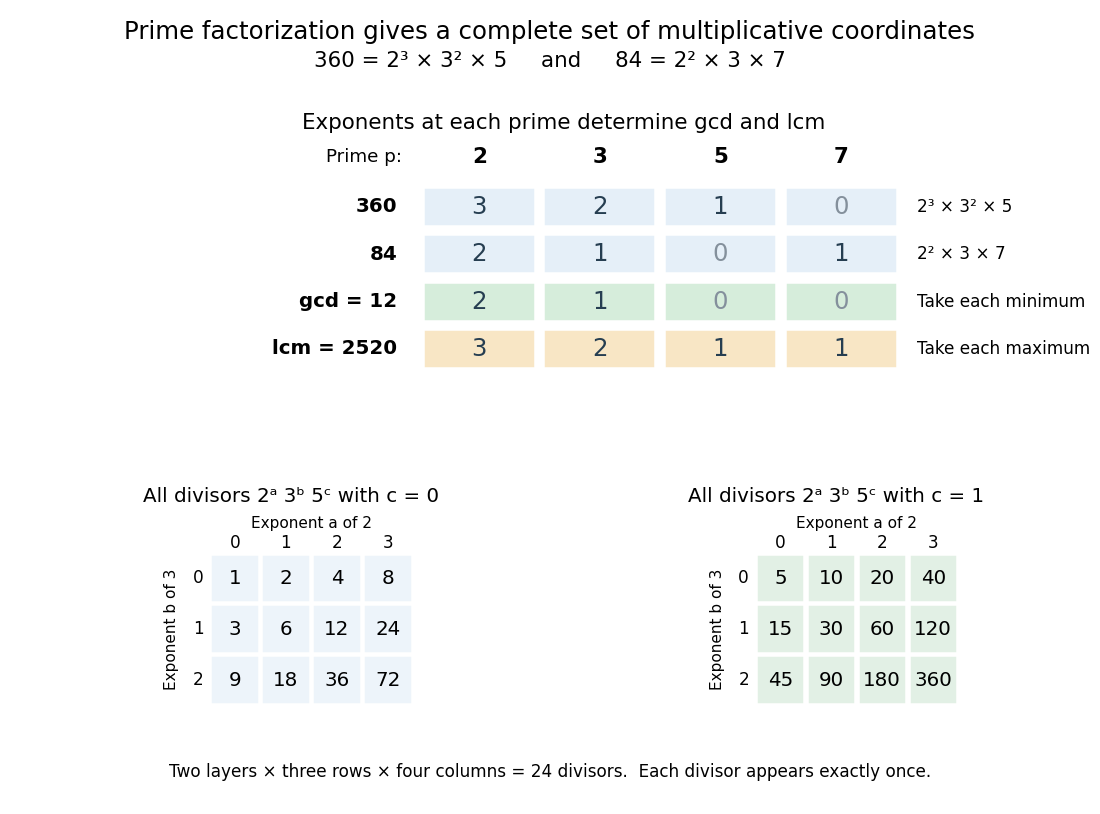
Prime valuations compute the greatest common divisor, least common multiple and all 24 positive divisors of 360
. The upper table compares exponents at the prime numbers for and , then takes their columnwise minimum and maximum. The lower tables enumerate for and ; each cell gives one positive divisor. Details.The useful change of viewpoint is that multiplication becomes addition of prime valuations, , and divisibility becomes comparison. Many different-looking calculations therefore share one representation. The prime valuations are coordinates for multiplication, rather than digits in positional notation: they do not turn ordinary addition of integers into coordinatewise addition.
Different intermediate splits lead to the same prime ingredients. Starting with gives and ; starting with gives and . Continuing to split the composite numbers produces the same multiset of prime factors: three twos, two threes, and one five. The factorization tree records choices in the calculation, while the prime factorization records the invariant result.
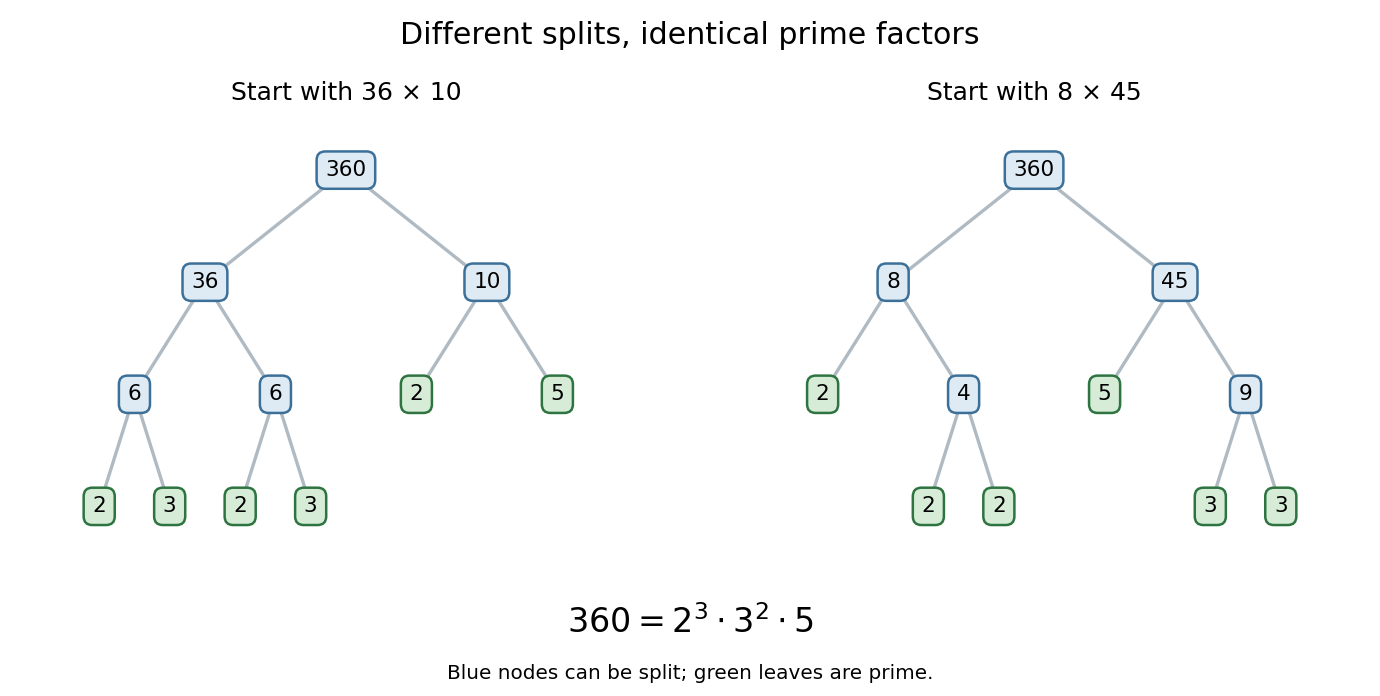


The proof outline explains the uniqueness. Existence follows by splitting a composite number into smaller factors until only prime numbers remain. For uniqueness, Euclid's lemma says that a prime factor of one product must divide one factor of any other prime product equal to it. That factor must be the same prime number; cancel it and repeat. The crucial divisibility step appears in Book VII, Proposition 30 of Euclid's Elements. [ref]
https://mathcs.clarku.edu/~djoyce/java/elements/bookVII/propVII30.html. Euclid, Elements VII.30: a prime divisor of a product
The ancient text supplies specific precursors to the modern statement: Book VII, Proposition 31 establishes that every composite number has a prime factor, and Book IX, Proposition 14 excludes any new prime factor from the least common multiple of given prime numbers. These are the propositions being cited, rather than the complete modern exponent formulation of the fundamental theorem of arithmetic. [ref]
https://mathcs.clarku.edu/~djoyce/java/elements/bookVII/propVII31.html. Euclid, Elements VII.31: every composite number has a prime divisor
[ref]https://mathcs.clarku.edu/~djoyce/java/elements/bookIX/propIX14.html. Euclid, Elements IX.14: prime divisors of a least common multiple of primes
Excluding one from the prime numbers keeps uniqueness meaningful: otherwise would give different collections of supposed prime factors. For , the natural convention is the empty product, equal to one, with no prime factors and all prime valuations zero.
A Fermat prime is a Fermat number that is also a prime number:The defining form alone does not imply primality. For example, is a Fermat prime, while is a Fermat number with proper divisors. For , every Fermat prime is one modulo four and two modulo three. Pépin's test gives an exact primality testing criterion for these candidates, rather than relying on their form.
Prime-counting upper bound from a primorial estimate by  Codex 0 Created 2026-09-24 Updated 2026-10-05
Codex 0 Created 2026-09-24 Updated 2026-10-05If for every , where , thenfor . Every prime in contributes at least to the primorial, soTaking logarithms, using , and observing that for proves the claim.
A surface gravity wave is a free-surface oscillation restored by gravity. In inviscid deep water its angular frequency and horizontal wavenumber satisfy .
Inviscid flow between closing hinged plates is a quadratic potential flow that expels fluid radially.
For radial flow outside a sphere, incompressible flow makesindependent of radius. Its velocity potential is .
Quantum tunnelling is transmission through a potential barrier even when the particle energy is below the barrier height.
The wavefunction penetrates the classically inaccessible region; matching it to an outgoing scattering state on the far side gives a nonzero transmission probability. For a real, time-independent potential barrier, the transmitted energy equals the incident energy: quantum tunnelling does not require a temporary violation of conservation of energy. A tunnel junction turns this small transmission probability into a measurable electric current, whose sensitivity to separation makes the scanning tunnelling microscope possible.
Glacial isostatic adjustment is the broader solid-Earth and sea-level response to growth and retreat of ice sheets.
A trapping region is a compact region across whose boundary the vector field points inward. It is positively invariant and confines every forward trajectory that enters it.
A reproducing-kernel Hilbert space is a Hilbert space of functions in which point evaluation is continuous and satisfies .
Orthogonal decomposition in a positive-definite metric by Codex 0 Created 2026-09-24 Updated 2026-09-24
Codex 0 Created 2026-09-24 Updated 2026-09-24A positive-definite matrix defines the inner product , allowing decomposition into a chosen direction and its -orthogonal complement.
Velocity is the vector giving the rate of change of position with time, measured in a specified reference frame. For a differentiable path , its instantaneous velocity and its average velocity between two times areThe displacement in the numerator retains direction. In Cartesian coordinates, each vector component is a derivative, for example ; its sign tells whether the corresponding coordinate is increasing or decreasing. The SI unit of velocity is . [ref]
https://openstax.org/books/university-physics-volume-1/pages/3-2-instantaneous-velocity-and-speed. Ling, Sanny and Moebs, University Physics Volume 1, section 3.2: instantaneous velocity and speed
For a concrete reversal, let for . Its signed velocity is : at it is , at it is zero, and at it is . The opposite endpoint velocities describe opposite directions, although the endpoint speeds agree. The position moves from to and back to .
Recovering displacement from a measured velocity is an integration problem: , with the integral taken component by component. In the reversal example, : the negative and positive contributions cancel. This distinction is useful in navigation, where the final position depends on direction as well as speed.
These are the planar polar coordinates; the general coordinate-system definition and transformations belong to that canonical concept.
There are unlisted articles, also show them or only show them.