
An area of mathematics groups related concepts and methods. The glossary of areas of mathematics collects terminology for these fields.
A finite family of pairwise commuting diagonalizable operators on a finite-dimensional complex vector space is simultaneously diagonalizable. In particular, commuting Hermitian operators admit an orthonormal common eigenbasis.
If a primitive polynomialhas a rational root in lowest terms, then and . In particular, a monic integer polynomial can have only integer rational roots dividing its constant term.
A quasi-steady approximation neglects a field's time derivative because that field relaxes much faster than the variables that drive it. The rapidly adjusting field then satisfies a steady equation with the slow variables treated as instantaneous parameters.
The nilradical of a commutative ring is its ideal of nilpotent elements, equivalently the radical of an ideal applied to its zero ideal.
For an element of a group , its conjugacy class is its orbit of a group action under the conjugation action:Thus conjugate group elements describe the same operation after a change of labels. In a symmetric group, conjugation renames the entries of every permutation cycle:For example, with and the transposition , this gives . Products use function composition of permutations, with the rightmost factor applied first. The complete six-element example is conjugacy classes of the symmetric group on three letters.
The conjugacy classes form a partition of a set of , since conjugacy is an equivalence relation. In a symmetric group, two permutations lie in the same conjugacy class precisely when they have the same cycle type: renaming preserves the lengths of permutation cycles, and matching equal-length permutation cycles constructs a renaming in the other direction. This compresses many labelled permutations into a few structural types. See McKernan, Conjugation in Sn, lemma 6.2 and proposition 6.6.
The stabilizer subgroup of under the conjugation action is its centralizer . Consequently the orbit-stabilizer theorem givesThe counting mechanism is the bijection from left cosets onto the conjugacy class: two choices of give the same result exactly when they differ on the right by an element of the centralizer. A large centralizer means many choices of labels leave the operation unchanged, hence a small conjugacy class. A conjugacy class has size one precisely when its element belongs to the center of a group. The class equation counts these orbits of a group action together.
The Chinese remainder theorem says that remainders modulo pairwise coprime positive integers can be specified independently. For pairwise coprime and , every prescribed list determines one congruence class modulo satisfying for all . It determines a class, rather than one unrestricted integer: adding a multiple of preserves every remainder.
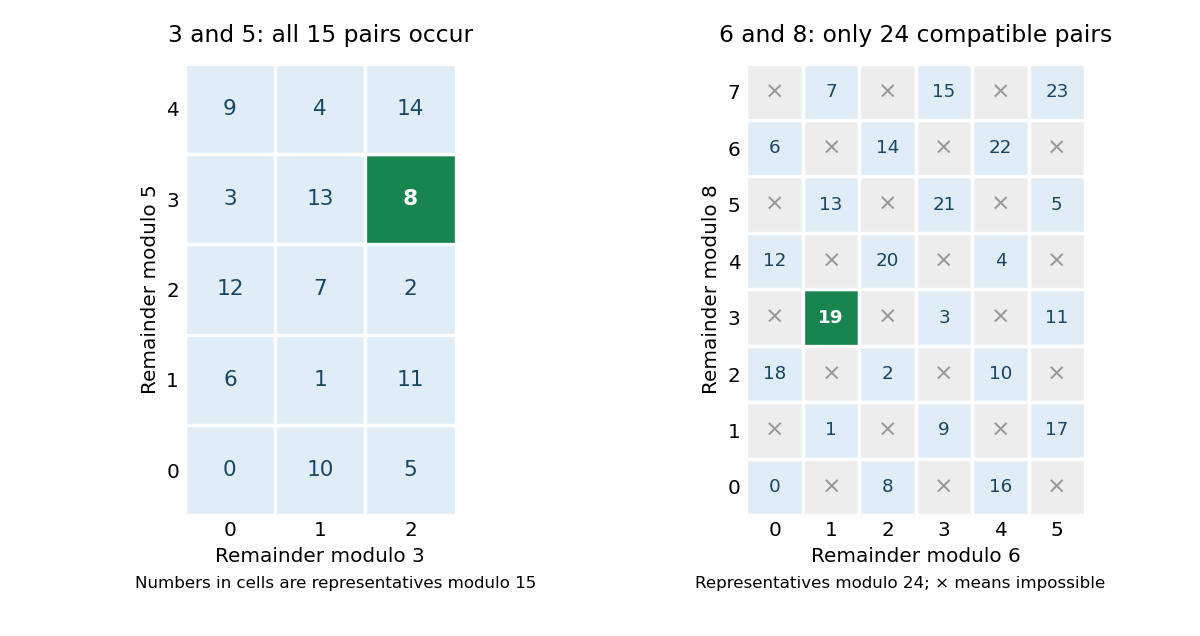
For example, combine and . Write from the first condition. The second becomes . Since three has modular inverse two modulo five, , giving . The integers , and all work. The fifteen possibilities modulo fifteen correspond to the fifteen pairs in a three-by-five grid.

The theorem also preserves arithmetic: reducing an addition or a multiplication modulo each gives the same tuple as performing that operation on the corresponding congruence classes. In the language of quotient rings, reduction is a ring isomorphismOne large residue is thus an exact encoding of several smaller residues. This is useful for splitting arithmetic into smaller calculations and then reconstructing the result; MIT's modular arithmetic notes develop both the reconstruction and the product representation. [ref]
https://ocw.mit.edu/courses/18-200-principles-of-discrete-applied-mathematics-spring-2024/mit18_200_s24_lec15.pdf. Moitra, MIT 18.200, Lecture 15, section 4, Chinese remainder theorem
For a concrete multiplication, corresponds to and to modulo . Their componentwise product is , which reconstructs to , agreeing with .A constructive formula explains the independence. For , put and choose with , using a modular multiplicative inverse. Then is one modulo and zero modulo every other . Thereforehas the desired remainders. A modulus equal to one imposes no restriction and can be omitted. Uniqueness follows because a difference divisible by every is divisible by their product when they are pairwise coprime. This short construction gives a reusable algorithm as well as an existence statement.
The coprime hypothesis explains why every cell in the left grid is attainable. With integer moduli six and eight, a pair must agree modulo their greatest common divisor, two. There are twenty-four compatible pairs, rather than forty-eight arbitrary pairs; each corresponds to a class modulo the least common multiple, twenty-four. The Chinese remainder theorem for noncoprime moduli states the resulting compatibility rule.
There are unlisted articles, also show them or only show them.