The Basel problem asks for the exact sum of the reciprocal squares of the positive integers. The answer isThe integral test proves that the series converges, but does not identify this exact value. The Euler evaluation of even zeta values does: the equally spaced poles of cotangent connect reciprocal integer powers to Bernoulli numbers and . This separates three different questions: whether a sum exists, how well a partial sum approximates it, and what its exact value is.
For example, the ten-term partial sum is about , while the exact value is about . The zeta series truncation error bounds the missing amount between and ; it is much larger than the first omitted term . More terms improve the approximation, but a numerical coincidence with would not prove the identity.
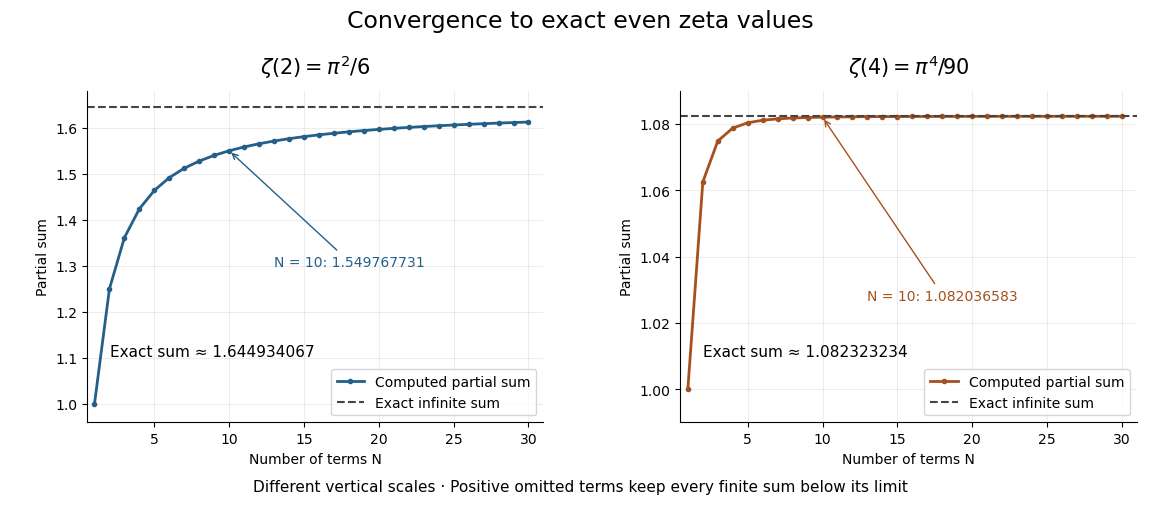
In On the sums of series of reciprocals by Leonhard Euler, §2 identifies the reciprocal-square sum with one-sixth of the squared circumference of a unit-diameter circle. The translation's publication note dates the presentation to 5 December 1735 and publication to 1740.[ref]
On the sums of series of reciprocals by Leonhard Euler. English translation, p. 1, §2 and publication note
The cotangent coefficient proof of the even zeta values gives a short modern outline, while zeta series truncation error addresses the distinct approximation question.Infinity denotes unbounded growth or an ideal quantity larger than every finite value; it is not a real number.
Physics investigates matter, motion, and interactions by building mathematical models and testing their consequences against observations. A physical law supplies a relation; a model specifies the objects, conditions, and approximations used to apply it. Classical mechanics, electromagnetism, thermodynamics, and quantum mechanics organize different aspects of these investigations. Their usefulness comes from turning measurements into predictions that can be checked and refined.
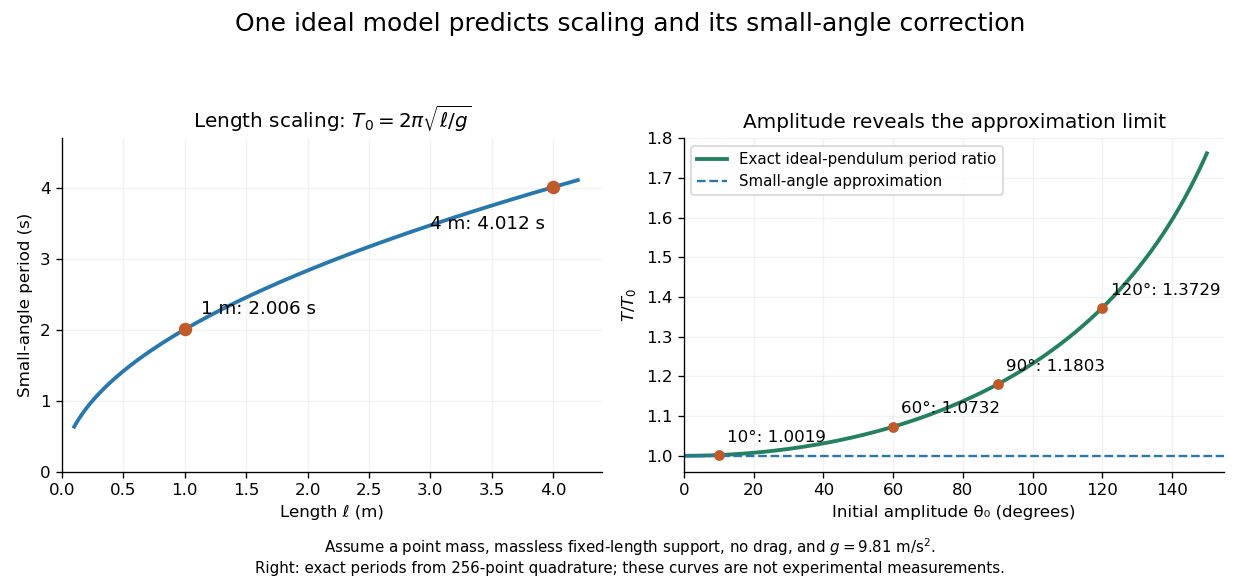
Consider a simple pendulum: how does its oscillation period change when its length changes? For small amplitude, the ideal model gives , where is gravitational acceleration. Taking as the model parameter, a one-metre pendulum has predicted period . Increasing its length to four metres gives : quadrupling the length doubles the period. The point mass cancels from the equation, so changing it alone does not change this model's answer.
The prediction identifies a mechanism and a way to challenge it. The small-angle approximation replaces by ; the full ideal equation predicts a longer period at large amplitude. At , its period is about , already a change. Measurements at such amplitudes can reveal the limit of the approximation, while appreciable drag requires a damped pendulum. These distinctions are developed in simple pendulum and dimensional analysis. The small-amplitude model is also derived in Ling, Sanny and Moebs, University Physics, pendulums.
Several different experiments can become one calculation. Nondimensionalization rewrites the pendulum equation using , leaving . All lengths share that dimensionless equation; the amplitude remains a parameter. Similarly, conservation laws and symmetry reveal features that many models share. This is one source of the subject's beauty: a compact relation can organize a large range of phenomena.
The connection to evidence remains essential when a model is elegant. In his introductory lectures, Richard Feynman emphasizes testing proposed relations by experiment and using idealizations whose accuracy depends on the conditions. [ref]
https://www.feynmanlectures.caltech.edu/I_01.html. Feynman, Leighton and Sands, Atoms in motion, section 1–1
A discrepancy can motivate a better measurement, a better approximation, or a different physical model; the mathematical calculation and the empirical assessment are both part of the explanation.Mathematics studies patterns in quantity, structure, space, and change by giving objects precise mathematical definitions and examining what follows from them. Arithmetic starts with operations on numbers; algebra organizes relations and transformations; geometry and topology studies shapes and the structures preserved by maps; analysis studies limits and continuous change. These fields connect because the same structure can appear in different forms.
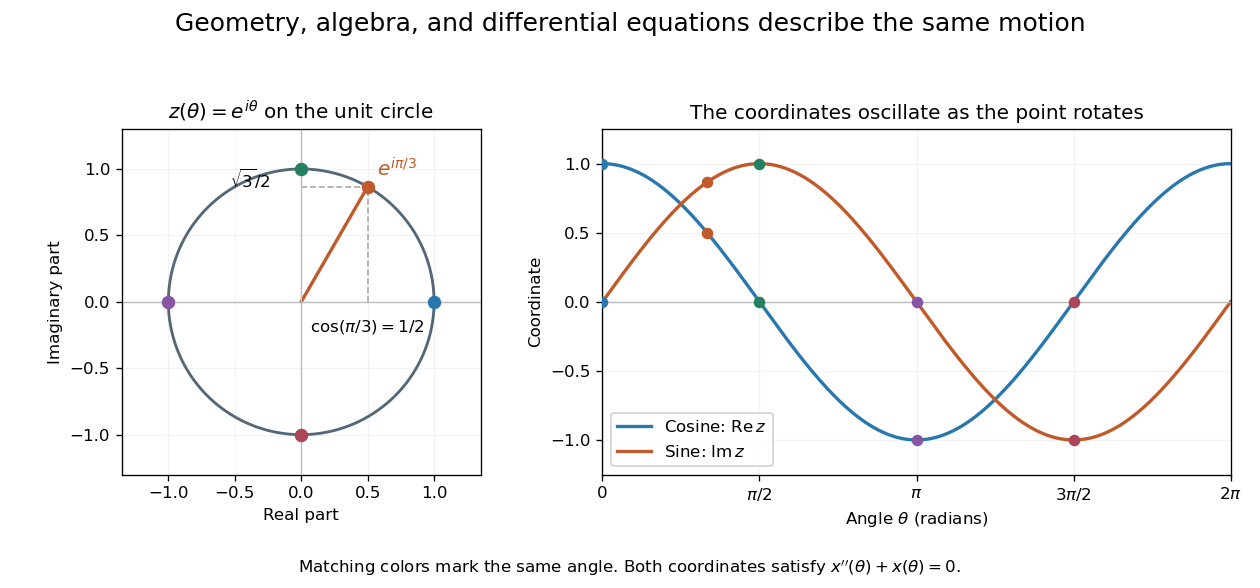
A small example shows the value of changing viewpoint. A point moving around the unit circle has coordinates , . Regard the plane as complex numbers and the same point is , by Euler's formula. Adding two angles now corresponds to multiplying their complex exponentials: . A geometric rotation has become an algebraic operation.
The connection reaches calculus too. Differentiating twice gives and , so the two coordinates solve the harmonic oscillator equation. At angle , ; one point supplies an exact cosine, an exact sine, and the state of an oscillation. The Pythagorean trigonometric identity records that the modulus stays one. Seeing these as descriptions of one object makes each formula easier to remember and reuse.


This is why a useful mathematical explanation provides both a reliable mathematical proof and a way to see what the result is doing. In his 1994 essay, William Thurston discusses mathematical progress in terms of advancing understanding, and uses the many interpretations of a derivative to illustrate this aim. [ref] A diagram, a computed example, and a concise argument can make different parts of the same idea accessible.
Applications ask us to select a mathematical model of a physical or other system. Its assumptions determine which conclusions transfer to that system. Within mathematics, the same practice of making assumptions explicit lets a result about groups, vector spaces, or probability distributions apply to many concrete examples. The beauty is the combination of precision and reuse: an argument can reveal more than the particular case that first suggested it.
Past exam of the mathematics course of the University of Cambridge 2025 iii Paper 115 4 b by  Codex 0 Created 2026-09-23 Updated 2026-09-24
Codex 0 Created 2026-09-23 Updated 2026-09-24 Past exam of the mathematics course of the University of Cambridge 2025 iii Paper 115 4 a by Codex 0 Created 2026-09-23 Updated 2026-09-24
Codex 0 Created 2026-09-23 Updated 2026-09-24 Past exam of the mathematics course of the University of Cambridge 2025 iii Paper 115 3 b by Codex 0 Created 2026-09-23 Updated 2026-09-24
Codex 0 Created 2026-09-23 Updated 2026-09-24 Past exam of the mathematics course of the University of Cambridge 2025 iii Paper 115 3 a by Codex 0 Created 2026-09-23 Updated 2026-09-24
Codex 0 Created 2026-09-23 Updated 2026-09-24 Past exam of the mathematics course of the University of Cambridge 2025 iii Paper 115 2 b by Codex 0 Created 2026-09-23 Updated 2026-09-24
Codex 0 Created 2026-09-23 Updated 2026-09-24 Past exam of the mathematics course of the University of Cambridge 2025 iii Paper 115 2 a by Codex 0 Created 2026-09-23 Updated 2026-09-24
Codex 0 Created 2026-09-23 Updated 2026-09-24 Past exam of the mathematics course of the University of Cambridge 2025 iii Paper 115 1 b by Codex 0 Created 2026-09-23 Updated 2026-09-24
Codex 0 Created 2026-09-23 Updated 2026-09-24 Past exam of the mathematics course of the University of Cambridge 2025 iii Paper 115 1 a by Codex 0 Created 2026-09-23 Updated 2026-09-24
Codex 0 Created 2026-09-23 Updated 2026-09-24 Past exam of the mathematics course of the University of Cambridge 2025 iii Paper 114 4 c by Codex 0 Created 2026-09-23 Updated 2026-09-24
Codex 0 Created 2026-09-23 Updated 2026-09-24 Past exam of the mathematics course of the University of Cambridge 2025 iii Paper 114 4 b by Codex 0 Created 2026-09-23 Updated 2026-09-24
Codex 0 Created 2026-09-23 Updated 2026-09-24 Past exam of the mathematics course of the University of Cambridge 2025 iii Paper 114 4 a by Codex 0 Created 2026-09-23 Updated 2026-09-24
Codex 0 Created 2026-09-23 Updated 2026-09-24 Past exam of the mathematics course of the University of Cambridge 2025 iii Paper 114 3 d by Codex 0 Created 2026-09-23 Updated 2026-09-24
Codex 0 Created 2026-09-23 Updated 2026-09-24 There are unlisted articles, also show them or only show them.