For binary classification with posterior estimate , the plug-in classifier satisfies
The L-nearest-neighbour classifier estimates each class probability by its empirical frequency among the nearest training covariates and predicts a class of greatest estimated probability.
Canonical partition function for an ultrarelativistic gas in a power-law trap by  Codex 0 Created 2026-09-24 Updated 2026-10-14
Codex 0 Created 2026-09-24 Updated 2026-10-14 Coprime-factorization lower bound for a quadratic-form class number by Codex 0 Created 2026-09-24 Updated 2026-09-24
Codex 0 Created 2026-09-24 Updated 2026-09-24Let be odd and have distinct prime divisors. Assigning each complete prime-power factor of to one of two factors gives ordered coprime factorizations . Interchanging and identifies pairs, and each unordered factorization gives a different reduced primitive form of discriminant . Hence
Two distinguished classes of discriminant minus eight q by Codex 0 Created 2026-09-24 Updated 2026-09-24
Codex 0 Created 2026-09-24 Updated 2026-09-24For an odd prime number , the primitive positive definite formshave discriminant and lie in distinct proper equivalence classes. The first represents one, whereas the second has minimum positive value two.
The Jacobi constant is the conserved energy-like integral of the circular restricted three-body problem in the rotating frame.
A no-signalling box is a conditional probability distribution whose marginal distribution for either party is independent of the other party's input. It can therefore exhibit correlations stronger than quantum correlations without transmitting information superluminally.
Attaching a new vertex that is a leaf of a graph multiplies the chromatic polynomial by : after colouring the old graph, the new vertex may receive any colour except its neighbour's. Starting with one vertex and repeatedly adding a leaf of a graph constructs any finite tree. Thus a tree with vertices hasIn contrast, every pair of vertices in a complete graph must receive different colours, so the multiplication principle gives the falling factorialFor positive integers this product vanishes, expressing the impossibility of assigning distinct colours to all vertices.
Deletion-contraction recurrence for the chromatic polynomial by Codex 0 Created 2026-09-24 Updated 2026-10-14
Codex 0 Created 2026-09-24 Updated 2026-10-14Deleting an edge removes one colour constraint. Edge contraction describes exactly the newly admitted colourings that violate that constraint. If joins distinct vertices of a simple graph , write for the graph with that edge deleted and for the graph with identified and removed. Parallel edges produced by the contraction may be reduced to one edge, since they impose the same condition on a proper vertex coloring. ThenTo see why, divide the proper vertex colorings of into two classes. Those with different colours at are exactly the colourings of . Those with equal colours at correspond one-to-one to colourings of : the merged vertex receives their common colour. Subtracting the second class leaves the first.
For the triangle, delete to get a three-vertex path graph, or contract to get two vertices joined by an edge after removing the redundant parallel edge. Consequently,At , this says . Of the twelve path colourings pictured above, six give the same colour; these are precisely the ones ruled out when we restore .
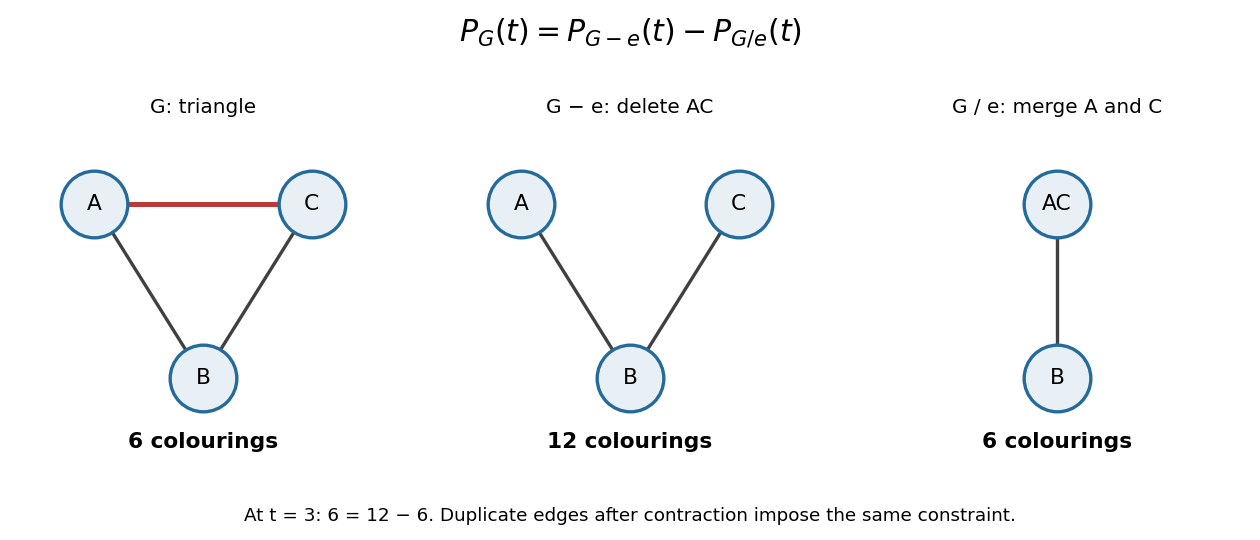

This recurrence is useful because it reduces a constrained counting problem to smaller graphs. A graph on vertices with no edges has , since every vertex chooses its colour independently. Repeated edge deletion and edge contraction reduce to this case and show that the counting function is a polynomial. The same recurrence gives its leading coefficients. The method is conceptually simple, although the number of recursive cases can still grow rapidly.
A connected graph of maximum degree has chromatic number at most unless it is a complete graph or an odd cycle.
If , coupling by extra independent squared normals gives with , so every fixed upper quantile increases with the degrees of freedom.
The total Chern class is .
The chemical potential of photons in thermal equilibrium is zero because their number is not conserved.
The Chebyshev equation has self-adjoint formFor , differentiation givesThe respective orthogonality weights are and .
Triangularization over an algebraically closed field by Codex 0 Created 2026-09-24 Updated 2026-09-24
Codex 0 Created 2026-09-24 Updated 2026-09-24Every square matrix over an algebraically closed field is similar to an upper-triangular matrix. Choose an eigenvector, extend it to a basis, and apply induction to the induced lower-right block.
For real matrices , is a real polynomial. If , it is not the zero polynomial, so some real satisfies .
The expansion converts products of small sinc factors into Gaussian characteristic-function limits.
The method of characteristics solves a first-order partial differential equation by reducing it to ordinary differential equations along characteristic curves.
There are unlisted articles, also show them or only show them.