A gamma prior with shape and rate combined with independent observations from an exponential distribution of rate gives the posteriorUnder squared-error loss, the Bayes estimator is its posterior mean .
An improper prior is a nonnegative prior kernel with infinite total mass. It can still produce a proper posterior after multiplication by the likelihood and normalization.
A least favorable prior maximizes the Bayes risk over the allowed priors. If a Bayes rule has constant risk equal to the minimax value, its prior is least favorable.
Posterior expected loss averages the loss over the posterior and is minimized pointwise in the data.
Bayes estimator under reciprocal weighted quadratic loss by  Codex 0 Created 2026-09-24 Updated 2026-09-24
Codex 0 Created 2026-09-24 Updated 2026-09-24Under , the posterior expected loss is minimized atprovided the conditional inverse moment is finite and positive.
Bayes estimator under parameter-weighted squared error by Codex 0 Created 2026-09-24 Updated 2026-09-24
Codex 0 Created 2026-09-24 Updated 2026-09-24A binary Bayes classifier under zero-one loss is unique up to null sets when the posterior class probabilities tie only on a null set. For two distinct nonsingular Gaussian distributions, the tie set is the zero set of a nonzero quadratic polynomial and has Lebesgue measure zero.
For two multivariate normal densities, the Bayes log posterior odds are a quadratic polynomial. Equal covariance matrices cancel the quadratic term and give linear discriminant analysis; unequal covariance matrices give quadratic discriminant analysis.
The basis constant of a Schauder basis is , where are its basis projections. Uniform boundedness makes this supremum finite.
If a bounded subset of a Banach space is bounded away from zero and zero lies in its weak closure, then contains a basic sequence. More generally, weak closure may be replaced by closure in any Hausdorff locally convex vector topology weaker than the weak topology.
If a family of bounded linear operators from a Banach space to a normed space is pointwise bounded, then their operator norms are uniformly bounded.
Let be a fixed number field and let be a fixed rational linear subspace for which the associated norm form has no unit-family degeneracy. There are effective constants such that every with nonzero field norm satisfiesTo prove this, factor the principal ideal , write its generators as a bounded factor times powers of fundamental units, use the linear relations defining , and apply the Baker lower bound for a homogeneous linear form in logarithms to bound the unit exponents by . For with , , and for a basis of , the coprime degrees rule out the degeneracy.
For particles of mass at radius and temperature , the Jeans escape parameter isLarge gives weak tail escape, while order-unity indicates hydrodynamic blow-off.
Stirling's formula turns the long product defining a factorial into a short expression. For positive integers , putThen as . This is asymptotic equivalence: , so the relative error tends to zero. It does not say that the absolute error tends to zero, and the formula is not an equality for finite . The Gamma function extends this approximation beyond integer inputs. [ref]
https://dlmf.nist.gov/5.11. NIST Digital Library of Mathematical Functions, §5.11: Gamma-function asymptotic expansions
For ,The leading estimate is about low. Multiplying by the first correction factor giveswhich is about low. The Stirling correction by Gaussian moments explains why this factor is rather than an arbitrary numerical adjustment.
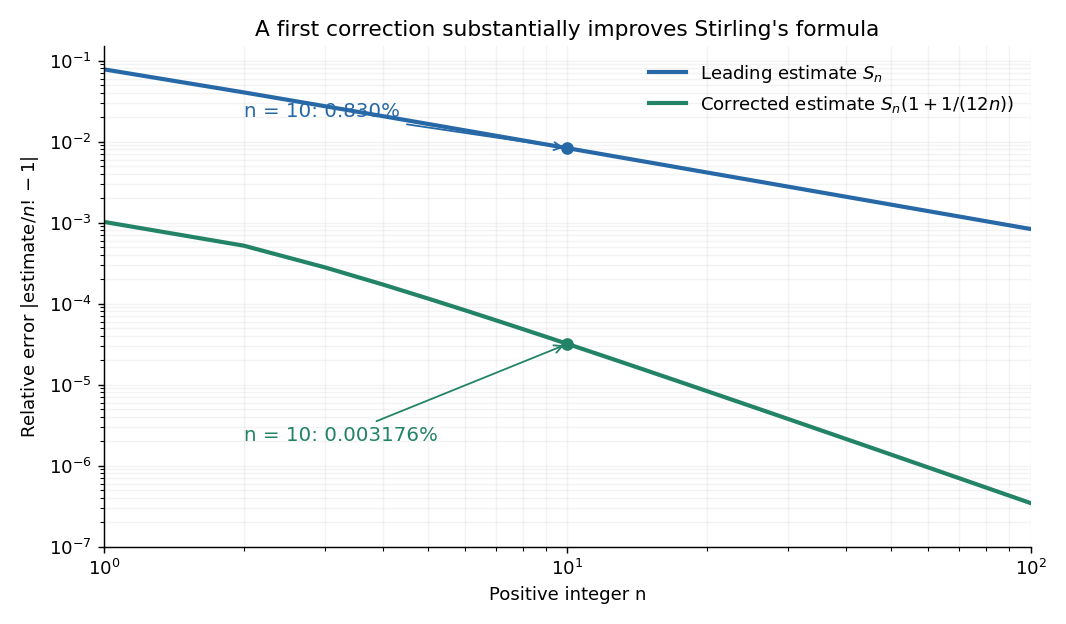

The usefulness is in ratios as well as in enormous numbers. Applying Stirling's formula to the three factorials in a central binomial coefficient givesThis counts the ways to choose exactly half of objects. Equivalently, for independent fair coin tosses, the binomial distribution assigns probability to exactly heads. An exponentially large count becomes a simple probability scale after cancellation.
For numerical calculations, taking the natural logarithm yieldswhere . Computing a logarithm of a large factorial avoids representing the factorial itself. The Robbins bounds for Stirling's formula give a finite- interval for this logarithmic remainder, rather than only a limiting statement.
The factor is beautiful because a Gaussian integral lies behind a discrete product. The Gaussian peak behind Stirling's formula displays this connection through the Gamma integral and Laplace's method. A rigorous proof must also control the tails of the integral; the local expansion explains the geometry but is not by itself a complete proof.
James Stirling published Methodus differentialis in 1730, a treatise on summation and interpolation of infinite series. This setting connects the formula with a practical calculation problem: taking logarithms turns a long product into a sum, whose growth can be approximated. [ref]
https://commons.wikimedia.org/wiki/File:Methodus_differentialis,_sive_tractatus_de_summatione_et_interpolatione_serierum_infinitarum_(IA_10053880bsb).pdf. James Stirling, Methodus differentialis (1730), digitized original and bibliographic record
For positive bases , comparison of the exponential functions and reduces to a geometric progression:If , this ratio tends to zero, so in little o notation. If , the ratio is one; if , it grows without bound.
Consequently, provided at least one coefficient is nonzero, a finite sum with distinct positive bases is asymptotically equivalent to its largest-base term whose coefficient is nonzero. For example,The relative difference against first drops below one percent at the integer . Dividing by the proposed dominant term provides an explicit error estimate, not just a comparison of two rapidly growing numbers. If several terms have the same largest base, their coefficients must first be combined; cancellation can remove that base entirely.
Diagonal subsequence for locally uniform convergence by Codex 0 Created 2026-09-24 Updated 2026-09-29
Codex 0 Created 2026-09-24 Updated 2026-09-29If successive subsequences converge uniformly on an exhaustion , the diagonal sequence converges uniformly on every fixed , hence locally uniformly on their union.
The Dehn function of a finite presentation isIt measures the worst number of relator applications needed to prove a null word of bounded length.
There are unlisted articles, also show them or only show them.