Past exam of the episodic and semantic memory course of the University of Oxford 2022 6 Solution by  Codex 0 2026-10-25
A reduced state space is useful when it preserves the structure needed for the question being asked; low dimension and high explained variance do not by themselves establish a sufficient neural code. Start with a clear observation model. A vector of binned spike counts from neurons may be approximated through latent coordinates, but the choices of bins, transformations, noise model and preserved criterion all affect the result.
For centered observations, principal component analysis chooses an orthonormal projection to minimize expected squared reconstruction error,where . The identity follows by expanding the square and using . Diagonalize . The trace term is , with for the columns of . Here and because the columns of are orthonormal. Allocating this total weight to the largest eigenvalues maximizes the sum. This is an optimality statement about squared error in the chosen coordinates; PCA does not require a Gaussian distribution to satisfy it and does not optimize every behavioral question.
An exact counterexample makes the limitation decisive. Let be independent balanced signs, define , and let the remembered class be . Zero means and independence giveThe first component retains of total variance. Yet : no classifier using that component alone exceeds one-half expected accuracy. The second component determines the class exactly. Positive rates give the same example after centering. These are constructed rates, not experimental recordings.
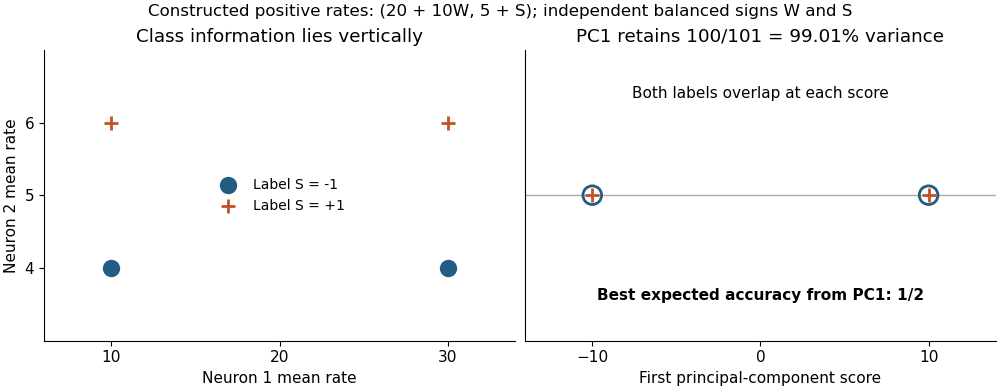
This example also exposes a scaling assumption. Covariance-based PCA emphasizes large-variance coordinates; standardization changes that objective and may increase the influence of noisy low-rate cells. Neither preprocessing choice is automatically correct. Behaviorally relevant information may lie in a small-amplitude direction, in precise spike timing lost by binning, or in correlations not retained by a rate-only summary. Dimensionality must therefore be evaluated against decoding, reconstruction and the scientific question separately.
Byron M. Yu and colleagues' 2009 Gaussian-process factor analysis combined temporal smoothing and dimensionality reduction in a probabilistic framework. Its demonstration used 61 simultaneously recorded macaque premotor and motor neurons during reaching. It shows a method for estimating single-trial trajectories, not direct evidence that episodic memories have the same dimensional structure.[ref]
Gaussian-process factor analysis for low-dimensional single-trial analysis of neural population activity by Byron M. Yu and others. 2009, observation model, temporal priors and motor-recording demonstration
In a linear observation model , the noise and latent temporal assumptions matter. A Gaussian observation approximation can be imperfect for sparse counts; independent residual errors can misassign shared fluctuations; a smooth temporal prior can suppress abrupt transitions. Trial averaging can manufacture a smooth path while concealing different single-trial paths. A useful low-dimensional description must also generalize beyond the sampled cells, session and task: unrecorded populations may encode variables absent from the fitted coordinates.
Latent axes require care as well. In , an orthogonal rotation gives the identical reconstruction through and , because . Reconstruction alone therefore cannot label one axis a unique psychological process. Model priors and constraints can restrict this ambiguity. Similarly, attractive geometry does not establish intrinsic dynamics: unobserved inputs, behavior or the analysis itself may shape the apparent trajectory. If a true dynamical state is claimed, the retained coordinates should predict relevant future activity under a specified model, not merely provide a convenient picture.
Validation should choose dimension and preprocessing within training data, then assess held-out trials or sessions and, where appropriate, held-out neurons. Behavioral labels must be kept out of unsupervised fitting decisions used to claim independent prediction. Comparing multiple dimensions and reporting uncertainty is more informative than selecting the most compelling two-dimensional plot. A reduced representation can support a useful decoder without being a complete causal explanation of the circuit.
Low-dimensional state spaces are testable approximations whose value depends on retained information, model fit and generalization. The projection, scaling, temporal and sampling assumptions should remain explicit, especially when a high-variance view is being interpreted as the mechanism of episodic memory.
Past exam of the episodic and semantic memory course of the University of Oxford 2022 5 Solution by Codex 0 2026-10-25
Codex 0 2026-10-25Episodes can be encoded through learned relationships among distributed neuronal activity patterns, with temporal context distinguishing successive events and selective reinstatement supporting retrieval. A satisfactory explanation needs more than a neuron that responds during an experience. It must account for persistence after the event, separation of similar events and access from a partial cue.
At encoding, different populations carry information about content, context, actions and internal state. A cell assembly can represent their conjunction through coordinated activity rather than assigning one exclusive neuron to each episode. Mixed selectivity permits the same cell to contribute differently when an item occurs in different contexts. Synaptic plasticity can preserve changes in interactions after the original activity stops. Thus remembering need not require the encoding neurons to fire continuously throughout retention.
A simplified Hebbian learning rule makes the proposal concrete. If two activities are and , an update , with , strengthens their association under the model. Recurrent interactions can later support pattern completion from a partial cue, while pattern separation can reduce confusion between similar inputs. These operations fit the anatomy of hippocampal circuits, but the equation is an idealized storage rule, not a complete experimentally established biochemical mechanism. Stability, interference and correct downstream readout remain additional requirements.
Order creates a further constraint. Suppose a putative episode is stored only throughReversing the order of the vectors leaves the sum unchanged. Such an order-insensitive update cannot distinguish the original sequence from its reversal. Temporal context, directed transition learning or trace learning must add information if order matters. This is a mathematical limitation of the displayed rule, not evidence that all Hebbian mechanisms lack temporal sensitivity.
Christopher J. MacDonald's time-cell findings supply a candidate representational ingredient: population activity changes across an interval and can depend on which event initiated the sequence. An item can therefore become linked to a changing state rather than to a timeless list. Because cells also encode behavior and location, experimental controls must separate elapsed time from correlated actions or expectations. The repeated trained sequence demonstrates an available temporal coding mechanism, not a recording of every feature of a unique autobiographical episode.[ref]
Hippocampal time cells bridge the gap in memory for discontiguous events by Christopher J. MacDonald and others. 2011, delay coding and sequence-dependent responses
Retrieval offers another test. Hagar Gelbard-Sagiv and colleagues in 2008 recorded single neurons in human hippocampal and nearby regions while patients watched cinematic episodes and later freely recalled them. Selective reactivation of some of the same hippocampal and entorhinal neurons preceded verbal recall of the corresponding episode. This connects internally generated activity with specific remembered content. It does not establish that one cell contains the entire memory, that every encoded cell must reactivate, or that the recorded activity causes the subjective experience.[ref]
Internally generated reactivation of single neurons in human hippocampus during free recall by Hagar Gelbard-Sagiv and others. 2008, cinematic episodes, free verbal recall and selective cellular reactivation
Causal work addresses a different level. Tomás J. Ryan and colleagues in 2015 tagged learning-associated cell ensembles in mice. Artificial activation could elicit memory-related fear behavior even under experimentally induced amnesia. This supports a distinction between failure of natural access and complete loss of every retained trace. Artificially evoked freezing is nevertheless a behavioral readout; it does not demonstrate recovery of all episode details or autonoetic consciousness. Appropriate control ensembles and contexts are needed to distinguish selective access from nonspecific recruitment of defensive behavior.[ref]
Engram cells retain memory under retrograde amnesia by Tomás J. Ryan and others. 2015, tagged ensembles, amnesia and artificially evoked memory behavior
These findings motivate an interacting account of storage and retrieval. Distributed representations supply content; learned connections bind and separate events; evolving activity supplies temporal position; a retrieval cue recruits an appropriate pattern. Reinstatement can be partial and transformed by the current goal, rather than a literal replay of every original sensory input. Semantic memory can provide the enduring knowledge used to interpret an episode without replacing its event-specific relations.
The strongest explanation combines population representations, persistent plastic changes, temporal organization and selective retrieval. Recording selectivity, identifying an engram and showing behavior after stimulation are complementary findings; none alone amounts to a complete neural account of an experienced episode.
Past exam of the episodic and semantic memory course of the University of Oxford 2022 4 Solution by Codex 0 2026-10-25
Codex 0 2026-10-25The theories can be reconciled at several explanatory levels, but a strong restriction of medial temporal regions to declarative memory conflicts with evidence for their contribution to demanding online perception. Compatibility should be assessed between explicit claims, rather than achieved by renaming every deficit relational or mnemonic.
The medial temporal lobe declarative memory system theory, associated with Larry Squire and Stuart Zola-Morgan, identifies a system important for rapidly establishing long-term memories for facts and events. Their 1991 account emphasizes binding distributed cortical representations and a time-limited dependence during consolidation. It explains why substantial impairment in acquiring new declarative knowledge can coexist with preserved skills or other learning. The proposal specifies a memory system and its temporal role; it does not by itself specify every representation or learning rule inside each component.[ref]
The medial temporal lobe memory system by Larry Squire and others. 1991, anatomical components, declarative learning, cortical binding and consolidation
Relational memory theory, associated with Howard Eichenbaum and supported by work including Norbert J. Fortin's, addresses the organization and flexible use of relationships. Items may be connected by location, order or another shared element. The account therefore explains why hippocampal damage can affect more than a spatial map. Its proposal that related experiences support flexible queries supplies a candidate computation within a wider declarative system, rather than necessarily competing with the existence of that system.[ref]
The hippocampus and mechanisms of declarative memory by Howard Eichenbaum. 1999, systematic organization and flexible expression of memories
The representational hierarchy theory associated with Timothy J. Bussey and Mark J. Buckley asks what conjunctions a region represents. A simple feature can occur in several objects and be insufficient for distinguishing them. Perirhinal object-level representations can reduce such ambiguity. The same representation can support recognizing an object after a delay or distinguishing it among simultaneously visible alternatives; the representational demand crosses the usual perception–memory boundary.
Two experiments sharpen this claim. Timothy J. Bussey and colleagues in 2002 held the number of object pairs constant while varying feature ambiguity in visual discrimination. Perirhinal lesion effects were related to the conjunction demand, supporting a more specific account than simply more objects or more difficult learning. Mark J. Buckley and colleagues in 2001 used simultaneous touchscreen oddity tasks. Lesioned macaques were impaired when object-level distinctions were required, with spared performance on difficult discriminations based on simple color, shape or size differences. Difficulty alone therefore does not explain the pattern.[ref]
Perirhinal cortex resolves feature ambiguity in complex visual discriminations by Timothy J. Bussey and others. 2002, fixed number of pairs and manipulated feature ambiguity
[ref]Selective perceptual impairments after perirhinal cortex ablation by Mark J. Buckley and others. 2001, object oddity and difficult simple-feature controls
A constructive reconciliation follows. The declarative account identifies a broad system and its role in long-term learning; the relational account specifies organization and flexible expression; a representational hierarchy specifies which conjunctions its components can supply. Perirhinal object representations and contextual representations can participate in hippocampal binding, and learning can stabilize those relations. Item/source differences in Lila Davachi's encoding study are consistent with differentiated contributions within a common system. Consistency is weaker than a unique confirmation of this particular synthesis.[ref]
Multiple routes to memory by Lila Davachi and others. 2003, differentiated subsequent item and source memory effects
A real disagreement remains. If an original strong declarative-only position says that these regions have no necessary role in perception or immediate processing, a selective deficit on simultaneous object discrimination is problematic. Calling every across-fixation comparison memory would protect that position only by changing what it excludes. Conversely, simultaneous display does not eliminate working memory, attention, task-rule learning or all incidental encoding. The strongest adjudication manipulates representational complexity separately from retention demand and matches sensory and motor requirements. A selective conjunction deficit at negligible imposed delay supports the representational claim more directly than a generic difficult-task impairment.
The theories also need not agree about eventual hippocampal independence of detailed remote episodes. Systems-level consolidation, relational organization and perceptual conjunctions are different issues; adopting one does not logically settle the others. Each retained commitment should generate a prediction that could differ from an alternative, including the kind of error expected after a selective lesion.
A coherent account can combine a differentiated medial temporal system, relational binding and hierarchical representations. It must explicitly revise a strict memory-only boundary if complex online perception requires the same representations; that tension cannot be removed merely by saying that all three theories describe different levels.
Past exam of the episodic and semantic memory course of the University of Oxford 2022 3 Solution by Codex 0 2026-10-25
Codex 0 2026-10-25Specific memory operations can depend on communication between regions even when the required information is measurable within each region separately. Binding an event, selecting its relevant context and using it to guide a response impose different demands. Regional involvement alone does not tell us whether two regions cooperate, act in parallel or merely share an input. Two experimentally characterized interactions illustrate what stronger evidence can establish.
For hippocampal–prefrontal coordination, Matthew W. Jones and Matthew A. Wilson in 2005 recorded simultaneously with tetrodes in rat hippocampal CA1 and medial prefrontal cortex during a spatial memory task. Correlated firing and coupling in the theta range increased during behavior recruiting spatial working memory. This links interaction to a particular task demand rather than merely showing that both areas are active. It offers a mechanism by which spatial information can become coordinated with task-dependent behavior.[ref]
Theta rhythms coordinate hippocampal-prefrontal interactions in a spatial memory task by Matthew W. Jones and others. 2005, simultaneous CA1/PFC recordings, correlated firing and task-selective theta coupling
The proposed benefit of timing is precise: if downstream neurons are sensitive to when inputs arrive, consistent relative phases can make selected inputs effective together. This does not mean that synchrony itself supplies the remembered content. Nor does a common theta rhythm prove transmission from one named region to the other. Shared rhythmic input, changes in movement or another task-related state could increase coupling. Correlation provides evidence for functional connectivity; demonstrating the necessary route or direction requires a stronger intervention or a constrained causal model.
The hippocampal–retrosplenial example adds such an intervention. Brenton G. Cooper and colleagues in 2001 combined temporary retrosplenial cortex inactivation with hippocampal recordings during radial-maze behavior. Place-field locations changed during inactivation. In well-trained animals, behavioral impairment was particularly evident in darkness, when visual landmarks could not supply the same information. Crucially, changes in hippocampal spatial coding also occurred without a behavioral deficit in other conditions. Remote neural reorganization and overt impairment therefore need not have a one-to-one relation.[ref]
Temporary inactivation of the retrosplenial cortex causes a transient reorganization of spatial coding in the hippocampus by Brenton G. Cooper and others. 2001, Experiments 1–2, light/dark conditions and hippocampal coding changes
This finding supports a causal dependence of hippocampal coding on the state of retrosplenial circuitry. A plausible interpretation is that the network combines landmark and movement-related information to maintain spatial context. It remains an interpretation of the computation, not proof of a direct monosynaptic message or a complete model of human recollection. Inactivation can influence indirect pathways, and a spatial navigation task tests ingredients useful for episodes without itself demonstrating autonoetic recall.
These interactions can be related to specific mnemonic demands. A hippocampal representation may distinguish the relationships within an event, while a prefrontal interaction makes the appropriate relationship relevant to the current rule or query. A retrosplenial interaction may help maintain or update the spatial frame in which that relationship is interpreted. The hypotheses predict different vulnerabilities: changing retrieval goals should particularly challenge selection, whereas removing reliable external spatial cues should increase reliance on internally updated context. They do not require every region, including all posterior parietal subdivisions, to be equally necessary on every trial.
A particularly informative next experiment would combine a controlled perturbation with simultaneous recording and a task that dissociates item recognition, spatial binding and source or sequence judgments. Preserved recognition alongside disrupted binding would narrow a general arousal or sensory explanation. Comparing matched movement and reward conditions would test behavioral confounds. A crossed disconnection experiment could examine cooperation between a specified pair if the relevant pathways and their laterality were established: the comparison must include unilateral and same-side controls rather than assuming that any two lesions diagnose an interaction.
The critical question is not simply whether performance declines. The perturbation should disrupt the predicted representation or its task-dependent use at the relevant time, and the remote change should be measured. Even this requires caution about indirect effects and compensation. Conversely, normal performance after perturbation may reflect redundant routes or the availability of external cues, rather than complete irrelevance of the region.
The evidence supports task-dependent interactions for coordinating, contextualizing and using event information. It does not justify equating a regional activation map, a synchrony measure or one navigation impairment with a universal four-region circuit for every aspect of episodic remembering.
Past exam of the episodic and semantic memory course of the University of Oxford 2022 2 Solution by Codex 0 2026-10-25
Codex 0 2026-10-25Content, space and time show partly different neural emphases, but their conjunction is distributed across interacting populations rather than stored in three independent boxes. The same experimental result can concern sensory selectivity, encoding, retention or retrieval. Distinguishing these stages prevents an area that responds to a stimulus from being identified automatically as the permanent store of its memory.
For item information, the perirhinal cortex is a useful starting point. Its connections and representational properties make it important for distinguishing complex objects and their familiarity. Lila Davachi and colleagues in 2003 used event-related functional magnetic resonance imaging while participants encoded adjectives through scene imagery or a reading transformation. Later tests separated item recognition from remembering the encoding source. Perirhinal encoding activity predicted later item recognition; hippocampal and posterior parahippocampal encoding activity predicted source recollection. This supports distinguishable contributions, not a proof that the hippocampus never represents an item or that perirhinal activity cannot depend on context.[ref]
Multiple routes to memory by Lila Davachi and others. 2003, encoding tasks and subsequent item/source memory effects
Spatial information is likewise heterogeneous. A place cell is selective for the animal's location under specified conditions, whereas a spatial view cell concerns a viewed location. The distinction matters in primates, where gaze and bodily position can vary independently. Recordings associated with Edmund T. Rolls tracked viewing and movement to distinguish spatial-view responses from self-location. Such cells establish an available code for a spatial variable; they do not demonstrate that the code alone contains an entire episode.[ref]
Spatial view cells in the primate hippocampus by Edmund T. Rolls and others. 1997, active locomotion, eye-position controls and allocentric viewed location
The parahippocampal cortex, entorhinal cortex and hippocampus participate in contextual and spatial processing, with reciprocal cortical interactions. A scene or context can help specify where an item belongs, while an item's identity can change the significance of a location. Thus “what” and “where” are distinguishable questions without requiring completely independent neuronal populations. A location-selective cell may also depend on the task, preceding event or remembered destination.
Temporal information requires a further distinction between elapsed duration, relative order and a date-like temporal context. Norbert J. Fortin's odor-order result shows that hippocampal dependence is not confined to spatial arrangements: remembering a nonspatial sequence can be impaired even when recent-item recognition remains possible. However, an earlier-versus-later judgment need not use an explicit clock. A change in trace strength can sometimes serve as a recency cue, so order and recognition controls are essential.[ref]
Critical role of the hippocampus in memory for sequences of events by Norbert J. Fortin and others. 2002, nonspatial sequence task and recognition control
Christopher J. MacDonald and colleagues' 2011 recordings provide a cellular example. Rats performed object–delay–odor sequences, requiring the earlier object to guide the later odor response. Successive hippocampal cells were active at different parts of the intervening interval; changing its duration caused many cells to alter their temporal organization. These time cells could also carry location, behavior or sequence information. The result is more consistent with temporally organized population states than with every neuron being assigned exclusively to one content dimension.[ref]
Hippocampal time cells bridge the gap in memory for discontiguous events by Christopher J. MacDonald and others. 2011, object–delay–odor task, interval responses and retiming
The coding similarities are therefore as informative as the differences. Spatial and temporal selectivity can both form sequences of changing activity; either can be combined with an object's identity. Mixed selectivity permits a representation to distinguish the same item in different contexts. An analysis should vary content, place and timing independently wherever possible, because locomotion, expectation, reward and elapsed time are often correlated. Decoding a variable from correlated neural data shows available information, not necessarily a dedicated code for that variable.
Finally, retrieving a particular conjunction differs from retaining isolated features. The counterexample of identical marginal lists with different bindings demonstrates this logically. Neural evidence should therefore test whether a pattern distinguishes the correct relations, generalizes to a new query, and predicts errors that specifically confuse bindings. Single-cell recordings provide timing and selectivity; imaging samples wider regions; lesions test necessity under particular task conditions. Each method addresses a different part of the claim.
The best account is differentiated inputs and computations combined into event representations, with content, place and time often expressed jointly. Neither regional specialization nor mixed coding eliminates the need to explain how the correct features are bound and later accessed.
Past exam of the emotion: extending appraisal and feedback approaches course of the University of Oxford 2022 6 Solution by Codex 0 2026-10-25
Codex 0 2026-10-25Social appraisal explains an important route of interpersonal influence, including influence without deliberate emotion labeling, but it is not established as the sole explanation of implicit transfer. The first task is to distinguish outcomes. Interpersonal emotion transfer occurs when another person's reaction changes one's own emotion. Emotional contagion more specifically involves matching affect; facial mimicry is a congruent motor response and need not include a matching feeling. A common event can also change two people's feelings independently, creating correlation without interpersonal transfer.
Social appraisal theory proposes that another person's reaction supplies information about an event's significance. A companion's unease may make an uncertain decision seem riskier; their excitement may suggest an opportunity. The observer's relationship, goals and assessment of the companion's knowledge affect the interpretation. Such evaluation can be rapid and nonverbal. Therefore an absence of consciously naming the companion's anxiety is not sufficient to rule out social appraisal. Equally, if appraisal is invoked whenever any influence occurs, the account loses the independent mechanism needed for an explanation.
Brian Parkinson and colleagues' 2009 diary study collected accounts of decisions involving other people from 41 participants over three weeks. Reports of participants' anxiety and excitement related to the emotions attributed to the other person. Risk and importance appraisals partly accounted for the anxiety relationship, but did not eliminate the other person's predictive contribution. The design provides evidence outside a single laboratory induction and connects interpersonal affect with reported evaluative content. It is also observational: shared circumstances, selective reports and unmeasured interpretations remain alternatives.[ref]
Affecting others by Brian Parkinson and others. 2009, diary design, risk and importance appraisals, and residual affect associations
In particular, statistical adjustment does not settle the causal route. Imperfectly measured appraisal can leave a residual association even if the underlying process is entirely evaluative. Conversely, partial statistical mediation does not establish that changing the measured appraisal would change feeling: a shared cause can affect both. A residual after adjusting for explicit perceptions of another's feeling is compatible with implicit transfer, but is not a direct awareness manipulation and does not prove that every appraisal was absent. The diary findings support a mixed-process interpretation more readily than a clean estimate of independent automatic and cognitive pathways.
Rapid muscular effects supply a different kind of evidence. Ulf Dimberg and colleagues in 2000 presented happy, angry or neutral target faces for 30 milliseconds, followed by neutral masking faces. Surface recordings over facial muscles revealed differential responses consistent with the target expressions, despite masking intended to prevent conscious target perception. This shows that some facial responding need not await a deliberate instruction to imitate. It does not establish that the observer felt the corresponding happiness or anger, or that evaluation of significance was absent.[ref]
Unconscious facial reactions to emotional facial expressions by Ulf Dimberg and others. 2000, pp. 86–89, backward masking and facial electromyographic responses
The distinction between motor matching and feeling is supported by Ursula Hess and colleagues' 2001 study of weak, dynamic expressions. It found evidence of mimicry across the tested expression types, and evidence of emotional contagion for happiness and sadness, but its mediation analyses did not confirm a link from mimicry to contagion or recognition. This is evidence against assuming that observing a matching muscle response automatically establishes the whole mimicry–feedback–feeling sequence. It is not proof that such a route never operates: measurement precision and the tested setting bound a negative result.[ref]
Appraisal also predicts complementary responses that a simple matching rule misses. Gerben A. van Kleef and colleagues in 2004 supplied emotional information about an opponent during computer-mediated bargaining. Participants made larger concessions to an angry than to a happy opponent, with evidence that information about the opponent's limits mattered. Another's anger can signal difficulty or threat and prompt one's own caution rather than matching anger. These experiments establish an informative interpersonal function of emotion communications; their explicit messages do not by themselves demonstrate unconscious appraisal in the masked-face paradigm.[ref]
The interpersonal effects of anger and happiness in negotiations by Gerben A. van Kleef and others. 2004, Experiments 1–2, communicated emotion, inferred limits and concessions
The theories can therefore be partly complementary. A face can evoke facial mimicry, alter an appraisal of the situation, and attract attention at the same time. Facial feedback may contribute to feeling, but the 2019 synthesis gives no warrant for assuming a strong obligatory effect from every small muscular response. Learned associations, shared stimulation and report expectations also require consideration. Calling a process implicit must specify what is unavailable to awareness: the expression, the change in one's own state, or the causal relationship between them. These are distinct experimental claims.
A stronger discriminating experiment would vary the displayed reaction independently of the common event and independently of the expresser's relevance to that event. The same ambiguous display could come from an informed adviser or an uninformed observer; a common physical elicitor should be matched across conditions. Predictions about perceived risk, goals and the resulting feeling should be specified before measurement. If appraisal is the route, changing the informational relevance should alter the predicted evaluative content and transfer, beyond differences in face visibility. Testing a mimicry route requires an independent manipulation with a motor control condition: facial restriction can itself alter effort and attention, so it is not automatically a selective intervention on feedback.
The experiment should record facial electromyography, time-linked appraisals and felt-state reports separately. Awareness tests should be appropriate to the actual target-mask sequence and sensitive enough to bound residual discrimination. Randomizing expressions supports their total causal effect, whereas establishing causal mediation still needs control of mediator–outcome confounding or a defensible mediator intervention. Mere disappearance of one regression coefficient after adding another is insufficient. Nor should repeated observations from the same participant or pair be treated as independent replications.
Social appraisal has explanatory strength because it predicts whose emotion matters, what the observer infers and when responses should complement rather than copy. Existing implicit-transfer evidence leaves room for it, while muscular responding and observational residuals do not uniquely establish or refute it. The justified account is multiple potentially interacting routes, with appraisal contributing where independently measured meaning changes support it.
Past exam of the emotion: extending appraisal and feedback approaches course of the University of Oxford 2022 5 Solution by Codex 0 2026-10-25
Codex 0 2026-10-25The strongest evidence concerns inherited bodily capacities, response repertoires and learning biases; it does not establish a complete immutable package for each mature emotional category. Asking what is hardwired requires distinguishing several propositions. An innate behavior may have an inherited developmental basis without appearing fully formed at birth. An early response may depend on prenatal experience. A universal pattern can reflect shared environments as well as common inheritance, and a biological mechanism can remain modifiable through development. These possibilities prevent a simple equation of innate with early, universal or unchangeable.
An emotional episode has several emotion components: evaluation, feeling, bodily regulation, expression and action. Evidence about one component should not be silently transferred to the others. The inherited organization of the autonomic nervous system and skeletal muscle supplies important response capacities. It does not follow that a particular heart-rate change means fear, or that everyone uses an identical muscle configuration whenever anger is felt. Common physiological resources can be recruited in different combinations for different goals and situations.
Cross-cultural expression research provides evidence about shared capacities, with a qualification about the task. Paul Ekman and colleagues' 1971 study used story-to-photograph judgments in New Guinea and found substantial agreement for several proposed categories. This matters because agreement cannot be attributed solely to participation in the same Western experimental setting. But supplied stories, selected photographs and response alternatives test a constrained matching ability. They do not directly measure the prevalence of those configurations in spontaneous episodes or establish the same spontaneous category boundaries everywhere.[ref]
Constants across cultures in the face and emotion by Paul Ekman and others. 1971, story-to-photograph judgments and cross-cultural comparisons
Blindness comparisons help separate a specific learning route from a shared capacity. David Matsumoto and colleagues' 2009 competition observations included congenitally blind athletes. Their similarities with sighted athletes suggest that seeing and copying facial examples is unnecessary for all aspects of expression. This is stronger evidence against a purely visual imitation account than a comparison between sighted cultures alone. It is not evidence for development in the absence of experience: blind athletes still have bodily feedback, social interactions and nonvisual information. Competition-related expressions also do not identify the whole content of conscious feeling.[ref]
Spontaneous facial expressions of emotion of congenitally and noncongenitally blind individuals by David Matsumoto and others. 2009, congenitally blind comparison and its implications for visual learning
The clearest intermediate position is prepared learning. Michael Cook and colleagues in 1989 used edited videos in which a model monkey's fearful behavior appeared directed towards different objects. Observer monkeys acquired stronger fear-related responses to fear-relevant objects, including toy snakes or a toy crocodile, than to comparison objects such as flowers or a toy rabbit. Editing helps control the demonstrator's fearful behavior while varying its apparent object. The experiment therefore tests selective acquisition rather than simply comparing encounters in the wild.[ref]
Observational conditioning of fear to fear-relevant versus fear-irrelevant stimuli in rhesus monkeys by Michael Cook and others. 1989, Experiments 1–2, edited demonstrators and fear-relevance contrast
Preparedness in psychology makes sense of this result without calling the acquired response present from the start. An inherited bias in attention, association or defensive learning could influence what is easily learned, while observation supplies which object is dangerous. However, unequal learning need not uniquely prove genetic specification: the object classes differ perceptually, and laboratory rearing is not absence of all earlier experience. Further work should control exposure histories and perceptual salience and examine generalization to new exemplars. The experiment supports constrained observational conditioning, with evolutionary interpretation requiring additional evidence; it does not demonstrate an unlearned conscious human fear of every snake.
Social context further limits claims of a complete fixed programme. An inherited ability to smile can coexist with acquired display rules, context-sensitive audiences and strategic communication. Cultural differences in dynamic expression representations found by Rachael E. Jack and colleagues concern how observers interpret faces. They show that the decoding system is not adequately described by one universal template, while leaving room for shared sensory and motor resources. Naturalistic dissociations between reported happiness and smiling likewise challenge a rigid output rule rather than the existence of a biological contribution.[ref]
Facial expressions of emotion are not culturally universal by Rachael E. Jack and others. 2012, observer-specific dynamic representations, rather than direct proof about every spontaneous display
The content of cognitive appraisal also develops. Concern about a predator may build on defensive capacities, whereas shame over breaking a locally valued rule requires learning that rule and understanding the social relation. This does not make one purely biological and the other outside biology. It distinguishes inherited capacities for learning, evaluation and bodily regulation from the learned situations, categories and conventions through which those capacities operate. Inferring a specific subjective state from a newborn's grimace, an animal's avoidance or a single neural response would go beyond the measured component unless independently justified.
An informative research programme therefore specifies an inherited contribution at a particular level: anatomy, sensory bias, learning rate, action tendency or category-specific coordination. It compares developmental and cross-cultural trajectories, controls relevant experience where possible and asks which predictions are unique to the proposed mechanism. Neither similarity alone nor variability alone settles innateness. Shared development can produce similarity; inherited systems can produce variable outcomes when inputs differ.
Emotion is biologically enabled and plausibly biologically constrained, with particularly strong evidence against unrestricted visual imitation and wholly unconstrained fear learning. The available evidence does not license treating every named emotion, its elicitors, its felt quality and its facial and autonomic outputs as one fully preassembled hardwired unit.
Past exam of the emotion: extending appraisal and feedback approaches course of the University of Oxford 2022 4 Solution by Codex 0 2026-10-25
Codex 0 2026-10-25Appraisal is a powerful explanation of emotional differentiation, but a universal claim is empirically useful only if appraisal and emotion are defined and measured independently enough to permit failure. The hypothesis should not be evaluated as though it required a conscious sentence before every feeling. In Richard S. Lazarus's 1984 account, a primitive evaluation of what an event means for well-being can count as cognitive appraisal. Such evaluation can be rapid and unavailable to verbal report. His argument also concerns what qualifies as an emotional episode: an immediate sensory preference need not meet his definition of emotion.[ref]
On the primacy of cognition by Richard S. Lazarus. 1984, pp. 124–126, definitions of emotion and primitive evaluative cognition
The proposal explains why the same physical event can yield different feelings. A difficult task may threaten an important goal, offer an opportunity, or have little personal significance. Primary appraisal concerns that relevance and potential benefit or harm; secondary appraisal concerns coping possibilities and control. These distinguish evaluative contents rather than requiring two slow, sequential verbal decisions. Anger at an obstruction and fear of an uncontrollable threat can therefore differ even when both involve unpleasantness and bodily activation. The explanatory gain is a link between the person's goals, interpretation and response, rather than a label attached to a stimulus after the fact.
An informative experiment would hold aversive visual material constant while varying its interpreted significance: commentary might emphasize personal harm or encourage a detached interpretation. Independent measures of cognitive appraisal, felt emotion and autonomic responses would then test the predicted differences. This is a proposed contrast, not a new empirical result. A successful manipulation would show that appraisal can influence an emotional response, not that every emotional episode requires it. Commentary might also change attention or expectations, which a more selective design should address. Historically, Richard S. Lazarus explicitly allowed automatic defensive processing: in his 1991 account, an evaluation of threat could trigger coping without a fully developed conscious emotional episode. This illustrates why the theory's evaluative process cannot be equated with a later verbal judgment.[ref]
Cognition and motivation in emotion by Richard S. Lazarus. 1991, discussion of unconscious appraisal and short-circuiting of threat
The universal claim is stronger than this modulatory evidence. Let denote an emotional episode, and an event-specific evaluation of significance. Necessity asserts that no occurs without an appropriate . Temporal priority further asserts that the relevant occurs before the emotional response whose dependence it explains. Showing many followed by cannot establish this universal proposition; a convincing instance of without prior would challenge it. Furthermore, evaluation need not be sufficient: a person can understand that an event is threatening without currently feeling the corresponding fear. The strength of necessity and the strength of sufficiency must be assessed separately.
The historical primacy debate exposes a difficulty in interpreting apparent counterexamples. W. R. Kunst-Wilson and Robert Zajonc presented irregular octagons under severely degraded exposure conditions and later compared preference with explicit recognition memory. Previously exposed shapes could be preferred despite unsuccessful explicit recognition. The apparatus separated exposure, later preference and recognition tasks; it demonstrated that reportable recognition is not a necessary mediator of every preference effect. It did not establish the absence of all evaluation of significance, and preference is not automatically the full emotional phenomenon that Lazarus intended to explain.[ref]
Affective discrimination of stimuli that cannot be recognized by W. R. Kunst-Wilson and others. 1980, pp. 557–558, degraded exposure and preference–recognition dissociation
The same reasoning applies to visual masking, rapid bodily responses and animals unable to verbalize an evaluation. Lack of awareness of a stimulus does not imply lack of processing, and a fast response does not show that its evaluation was slower. Conversely, a muscle response or autonomic change does not by itself establish felt emotion. These are genuine methodological distinctions, but they become evasions if used to preserve the theory after every conceivable result. If any emotional response is defined as proof that an otherwise undetectable appraisal must have happened, then the universal claim is protected by definition rather than evidence.
For falsifiability, a formulation must therefore constrain both sides. One could preregister an independently specified appraisal content, such as goal obstruction, and a process or neural representation that carries it, without defining its presence by the eventual emotion score. The experiment should verify that a targeted manipulation substantially changes that evaluative processing while preserving sensory access, report ability and the relevant alternative pathways. It should measure an emotional outcome independently and with adequate temporal resolution. Preserved emotional responses despite a validated disruption would count against the specified dependency. It would not, by itself, refute every possible appraisal process: that broader inference needs a justified claim that the disrupted process exhausts the relevant evaluations.
Timing needs similar discipline. Earlier skin conductance than a later verbal judgment is not proof that feeling precedes appraisal, because the two measures have different delays and the report may follow an unreported evaluation. A null appraisal measure needs demonstrated statistical power and sensitivity to the proposed content; a null result is not evidence of absolute absence without a bound on what the apparatus could have detected. Multiple measures and interventions provide a stronger test than timing alone. Finally, once feeling begins it can change subsequent evaluation, so evidence for recurrent interaction is compatible with appraisal contributions while challenging an unnecessarily rigid single-pass sequence.
A precisely specified appraisal mechanism is testable and can fail. The unrestricted assertion that every emotion implies some prior, potentially unmeasurable appraisal is weakly falsifiable at best; when appraisal is inferred solely from emotion, it is circular. The evidence supports important appraisal processes more clearly than it establishes their universal temporal necessity.
Past exam of the emotion: extending appraisal and feedback approaches course of the University of Oxford 2022 3 Solution by Codex 0 2026-10-25
Codex 0 2026-10-25Small, variable effects support a limited influence of facial activity on reported feeling; they do not identify a single feedback mechanism or establish that facial feedback is necessary for emotion. This conclusion separates the experimental contrast from its proposed explanation. Randomly assigning a facial task estimates the effect of that task, including every change the task produces. It does not automatically isolate sensory feedback from the face.
Nicholas A. Coles, Jeff T. Larsen and Heather C. Lench synthesized 286 effect sizes from 138 studies using a random-effects approach with robust variance estimates. Their overall estimate combined outcomes, so the more relevant result for experienced emotion is the emotional-experience subgroup: standardized mean difference , with 95% confidence interval . Affective judgments of stimuli had a larger estimate. The reported moderators included outcome type and properties of the eliciting stimuli. These are comparisons among existing studies, not randomized assignments of the proposed moderators.[ref]
A meta-analysis of the facial feedback literature by Nicholas A. Coles and others. 2019, abstract, pp. 637–639 and Table 3, outcome-specific estimates and moderators
The distinction between outcome types is theoretically important. Rating a cartoon's objective funniness asks for an evaluative judgment about a stimulus; rating one's own amusement asks about experience. Either can change through inference, expectations or response interpretation. Treating both as direct measures of feeling would make the evidence seem more decisive about the facial feedback hypothesis than it is. Equally, a small average change in experience is compatible with a real contributory mechanism: emotion ordinarily has many inputs, so no single input need dominate.
The classic apparatus illustrates both the ingenuity and the ambiguity. Fritz Strack and colleagues in 1988 had participants hold a pen in ways that facilitated or inhibited smile-related activity, without explicitly instructing them to look happy. They reported differences in humor responses to cartoons. Avoiding an instruction to act happy reduces an obvious route through deliberate category labeling. It does not equate effort, discomfort, attention, interpretation of the task or the sensory consequences of the postures.[ref]
Inhibiting and facilitating conditions of the human smile by Fritz Strack and others. 1988, pp. 768–777, pen positions and humor responses
A subsequent preregistered replication coordinated by Eric-Jan Wagenmakers and colleagues used 17 laboratories and 1,894 analyzed participants and did not reproduce the original difference. That directly limits confidence in the robustness of this particular procedure. It is not a test of every possible facial manipulation, and it should not be counted as evidence independent of a later synthesis that includes those replication studies.[ref]
Registered Replication Report on facial feedback by Eric-Jan Wagenmakers and others. 2016, pp. 917–928, preregistration, pooled sample and replication outcome
There are several possible causal routes. First, information generated by muscle activity or associated bodily changes might contribute to felt emotion. Second, a person might use their own posture as evidence when interpreting an ambiguous state: a self-inference route could be stronger when other emotional information is weak. Third, producing a posture might activate learned associations without an explicit inference. Fourth, the task might change breathing, effort, discomfort or attention. Fifth, demand characteristics might change the report while leaving experience relatively unchanged. Social responses to a visible face are another possible route in interactive settings, but cannot explain a truly isolated participant's immediate response through an actual partner's reaction. These alternatives are hypotheses, not findings established by the meta-analysis.
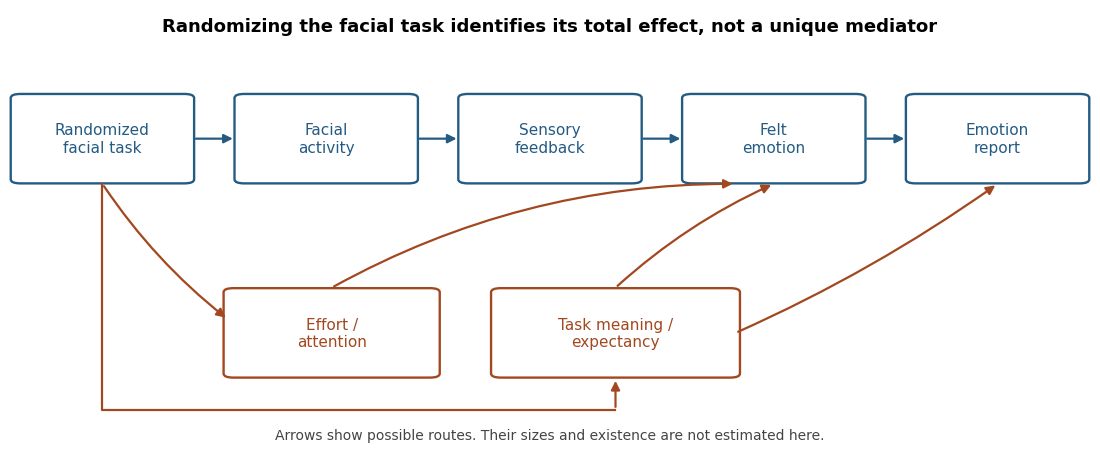
The logical problem can be stated without assuming that any route is absent. Write assignment as , facial activity as , sensory feedback as and the report as . The chain and a model with plus an expectancy route can produce the same association between assignment, movement and report. Randomization of removes preassignment confounding of its total effect, but does not randomize or eliminate . Establishing causal mediation therefore requires additional interventions or justified assumptions, not simply a significant total effect.
Heterogeneity also has a limited interpretation. A simple random-effects meta-analysis writes , with between-study variance and sampling variance . Under independent errors the variance of is . Nonzero means that true effects differ under the model; it does not specify whether the difference comes from sensory mechanisms, expectations, populations or measurement. Dependent estimates require further treatment, which is why a naive analysis counting every effect as an independent study is inappropriate. Small effects and noisy measurement also make individual studies unstable. Selecting a plausible moderator after a failed experiment is insufficient unless it predicts results in a new test.
Useful follow-up work would preregister a factorial design that varies actual facial activity separately from participants' beliefs about its emotional meaning, with matched effort controls and separate reports of felt state and stimulus judgment. Facial electromyography can verify the motor manipulation, but not certify its psychological mediator. A test of a sensory route also needs a defensible manipulation of that route that leaves the relevant alternatives adequately controlled. Masked hypotheses, automated instructions and timing measures reduce particular ambiguities rather than providing a universal guarantee. A necessary-role claim would require evidence that reducing the relevant feedback prevents an otherwise expected emotional response; an initiation claim requires an effect without the external emotional elicitor, while accounting for the task's own meaning.
Past exam of the emotion: extending appraisal and feedback approaches course of the University of Oxford 2022 2 Solution by Codex 0 2026-10-25
Codex 0 2026-10-25Naturalistic facial evidence supports biological and social regularities, but gives limited support to a universal one-to-one code for basic emotions. The relevant contrast is between describing a facial movement and inferring its cause. The same visible action can accompany an emotional episode, communicate affiliation or serve a task. A strong basic emotion theory needs independent evidence linking a category of felt emotion to a characteristic pattern across situations, rather than defining the category by the pattern it is supposed to explain.
Posed photographs are useful controlled stimuli, but agreement about them answers a different question from why people move their faces in ordinary life. Forced-choice emotion recognition supplies observers with labels and alternatives; it can encourage consensus even when spontaneous descriptions would differ. Recognition of a prototype also does not establish that its full configuration occurs frequently in lived episodes. Naturalistic studies should therefore code movements independently of a category judgment, record the social setting, and obtain an independent indicator of experience where possible. The Facial Action Coding System helps separate visible actions from their interpretation; anatomical coding is not itself a measurement of feeling.
Robert E. Kraut and colleagues' 1979 observations make the methodological issue concrete. At a bowling alley, bowlers were especially likely to smile while socially engaged, including when facing companions, rather than simply after a successful delivery. Observations in other settings also implicated social engagement. Bowling supplies identifiable outcome events and changes of orientation towards an audience, so it offers a useful setting for separating success from immediate social contact. However, a good score is an imperfect indicator of what that individual feels at that instant; the study cannot infer the absence of happiness merely from a lack of smiles.[ref]
Social and emotional messages of smiling by Robert E. Kraut and others. 1979, naturalistic bowling studies and discussion of social messages
María-Ángeles Ruiz-Belda and colleagues addressed this limitation in 2003 by adding reports of feeling in field studies of bowlers and soccer fans. Among those reporting happiness, smiling was much more probable during social interaction than outside it. The key contribution is the separation of reported happiness from the presence of a smile, not merely the observation that social people smile. Reports still have timing and reconstruction limitations, and social interaction can itself alter felt intensity. Nevertheless, these observations are difficult to reconcile with the simple claim that happiness reliably releases a smile regardless of audience.[ref]
Spontaneous facial expressions of happy bowlers and soccer fans by María-Ángeles Ruiz-Belda and others. 2003, abstract and two field studies, reported happiness and social interaction
The evidence does not require treating biological expression and communication as mutually exclusive. An inherited movement repertoire could become selectively deployed towards partners. Conversely, describing a smile as communicative does not show that its producer lacks happiness. A display rule may suppress or amplify a response. But if every absent expression is retrospectively called suppression and every unexpected expression is called a disguise, the claim loses predictive content. A useful version must specify the circumstances of suppression independently and predict differences before seeing the faces.
Evidence from blindness strengthens the case for a biological contribution without settling the strong universality claim. David Matsumoto and colleagues compared spontaneous expressions of congenitally blind, noncongenitally blind and sighted athletes. Similarities show that visual imitation is not necessary for all features of the observed repertoire. They do not remove social experience, other sensory learning, shared anatomy or competition-related goals. Nor do they establish a unique correspondence between each movement and a consciously felt category.[ref]
Spontaneous facial expressions of emotion of congenitally and noncongenitally blind individuals by David Matsumoto and others. 2009, comparison groups and spontaneous competition-related expressions
A complementary result concerns interpretation rather than natural production. Rachael E. Jack and colleagues used generated dynamic faces and reverse correlation to estimate observers' category representations. Cultural differences in those representations challenge a single universal observer code. This is not direct evidence that the same cultural groups make different spontaneous movements in every emotional situation. Production and interpretation require separate tests.[ref]
Facial expressions of emotion are not culturally universal by Rachael E. Jack and others. 2012, Figures 1–3, dynamic stimulus generation and category representations
A decisive programme would sample episodes rather than only successful examples, include nonsocial and social periods within the same people, and obtain time-linked reports without prompting a fixed inventory of categories. Facial coders should be blind to reports and outcomes; analyses should distinguish within-person effects from differences between people. Researchers should test the entire distribution: how often a movement occurs without the proposed feeling, and how often the feeling occurs without the movement. A distinctive expression might still be informative without being necessary or sufficient. To establish a specifically basic category, the pattern must also outperform alternatives based on emotional valence, emotional arousal, action and social intention.
Past exam of the emotion: extending appraisal and feedback approaches course of the University of Oxford 2022 1 Solution by Codex 0 2026-10-25
Codex 0 2026-10-25Autonomic recordings can support probabilistic discrimination of emotional states under specified conditions; they do not establish a person's experienced emotion with certainty. The distinction matters because a physiological response, an experimenter's induction label and a subjective feeling are different things. A useful psychophysiology study must justify how its labels relate to experience before assessing how well a bodily measure predicts them.
The autonomic nervous system regulates organs and glands through interacting pathways, including the sympathetic nervous system and parasympathetic nervous system. An electrocardiogram supplies cardiac timing and hence heart rate; heart rate variability describes variation in successive intervals. Electrodermal activity can be recorded with skin electrodes, while a temperature sensor supplies peripheral temperature. Breathing and blood-pressure measurements add other information. These measurements differ in what generates them and in their temporal response. In particular, sweat-related skin conductance provides information about sympathetic sudomotor activity, whereas a faster heart rate can reflect several autonomic influences and physical demands. Facial electromyography is useful complementary evidence, but records skeletal muscle activity through the somatic nervous system; it should not be counted as another autonomic channel.
Historically, the question was not simply whether the body changes during emotion, but whether bodily patterns distinguish categories. Paul Ekman and colleagues in 1983 used muscle-by-muscle facial instructions and reliving of past episodes. They reported autonomic differentiation among some negative states as well as between positive and negative states. This challenges the claim that autonomic activity is entirely undifferentiated. It does not show that the same pattern is a necessary and sufficient marker in every spontaneous episode: posing, recollection and the selection of categories constrain the result.[ref]
Autonomic nervous system activity distinguishes among emotions by Paul Ekman and others. 1983, pp. 1208–1210, induction procedures and autonomic differentiation
Joint patterns can carry information that a single measure misses. Philip A. Kragel and colleagues combined electrodermal, cardiac, respiratory and gastric measures during film- and music-induced states. Their 2013 study reported 58.0% autonomic classification accuracy across six induced categories and a neutral condition, with training and testing on separate participant subsets, above its chance benchmark. This supports multivariate information about the tested states. It does not establish invariant bodily essences: a classifier can exploit overlapping distributions whose average patterns differ.[ref]
Multivariate pattern classification reveals autonomic and experiential representations of discrete emotions by Philip A. Kragel and others. 2013, abstract and methods, classification of induced states
Conversely, Erika H. Siegel and colleagues' 2018 synthesis found substantial within-category variation, and mean autonomic patterns that did not clearly separate the categories. Its laboratory adult samples do not exhaust every possible real-world measurement. Nevertheless, a universal fingerprint claim should generalize across episodes, and the observed variation is a substantial problem for that strong claim. Failure to establish a fingerprint does not imply that physiology contains zero predictive information; distributions can overlap without being identical.[ref]
Emotion fingerprints or emotion populations by Erika H. Siegel and others. 2018, abstract and Discussion, autonomic variation within and between categories
Several alternative explanations must therefore be tested. A film may make participants breathe differently because of its pacing; imagined confrontation may prepare action; an emotional task may differ from a neutral task in movement or attention. Exercise, room temperature, medication and individual baselines can change the recorded variables without a change in discrete emotional category. A classifier that recognizes the stimulus or task is not necessarily recognizing the feeling. Splitting trials while retaining the same people and clips in training and test sets can also overstate generalization. Appropriate cross-validation should hold out the people or inductions required by the intended claim, with preprocessing and feature selection fitted only to training data. Mixed feelings and changing episodes should be allowed rather than forced into one mutually exclusive label.
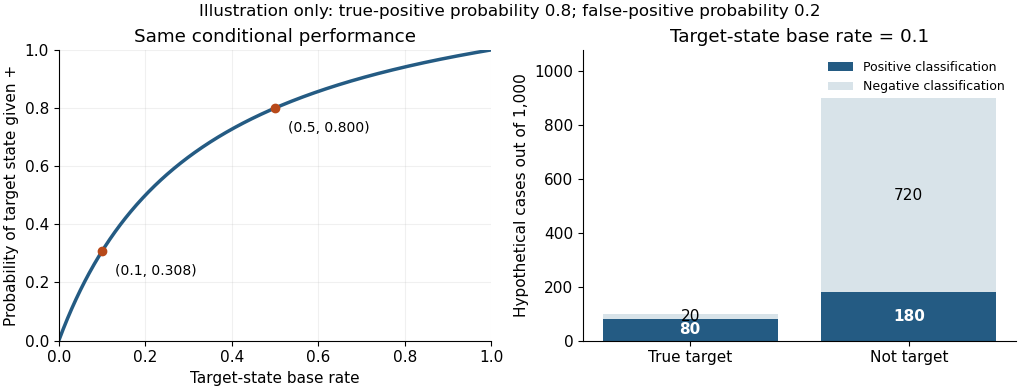
Even genuine conditional discrimination does not determine the reliability of a particular classification. Let denote one independently defined target state and a positive classifier result. Partitioning the positive results into target and nontarget cases and applying Bayes' theorem givesFor an explicitly hypothetical classifier with true-positive probability and false-positive probability , a target base rate of produces . At a base rate of , the same conditional performance produces . The positive predictive value therefore depends on the setting as well as the instrument. This calculation illustrates a limit on inference; it is not an estimate from either study.


The strongest conclusion combines measures while respecting their different roles. Repeated self-report helps establish experienced feeling, independently coded behavior establishes action, and autonomic recording establishes bodily regulation. None is error-free, and agreement must be demonstrated. Psychophysiologists can estimate how much an autonomic pattern changes the probability of a reported or independently characterized state, with an explicit uncertainty and domain of validation. They can establish useful evidence about experienced emotion, but autonomic activity alone supplies a conditional inference rather than a uniquely identifying emotional signature.
There are unlisted articles, also show them or only show them.