
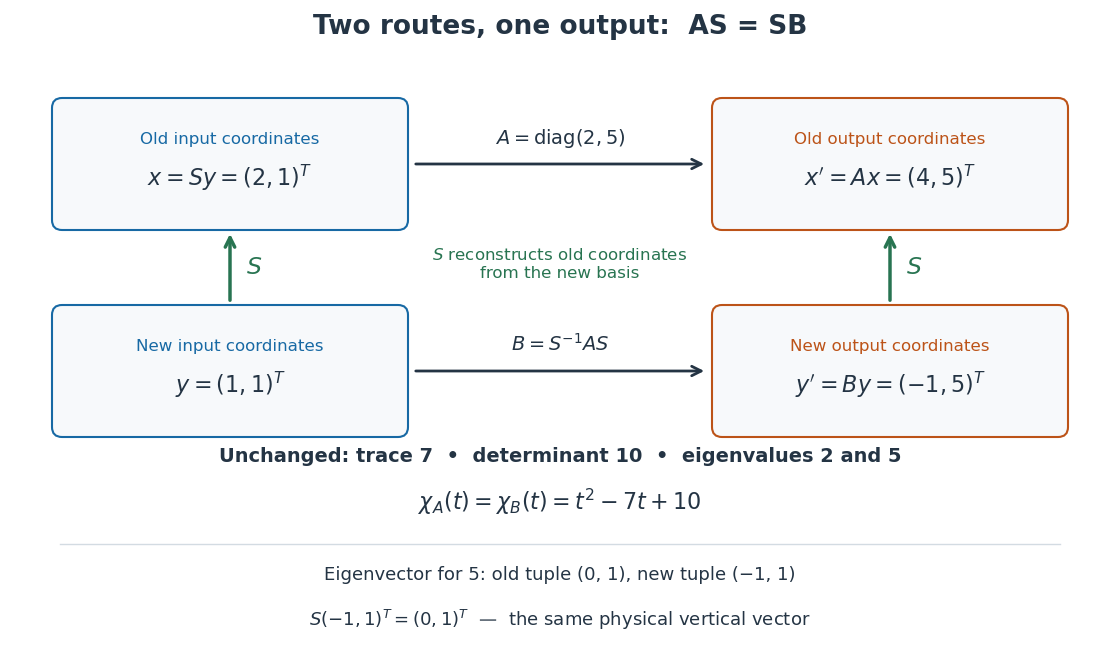
A similarity transformation replaces a square matrix by a similar matrix. With the change-of-basis matrix convention , it sends to : reconstruct the input in old coordinates, apply , then extract the output's new coordinates. These three operations explain the order of the factors.
The equivalent formula uses as the conversion from old to new coordinates, reversing the role assigned to above. For the opening example's numerical , this opposite conversion gives . If the old basis is , the new basis vectors in that convention are the columns of , namely and . Both formulas are similarity transformations; the direction of the coordinate conversion decides which one describes a specified basis.
An especially useful form is the intertwining operator equationIt says that applying before reconstruction by gives the same physical output as reconstructing first and applying . Given an invertible matrix , multiplying this equation by proves matrix similarity. Without invertibility, the equation alone does not prove matrix similarity.
For an algebraic number of degree and a small , Siegel lemma constructs integer polynomials of degree at most and exponentially bounded coefficients for which has a zero at of order close to . A Wronskian then prevents every specialization from having a high-order zero at a rational point. This is the auxiliary-polynomial mechanism in the Thue-Siegel method.
The th normalized derivative isIf has integer coefficients, then also has integer coefficients. For , its naive polynomial height is at most .
The VC dimension is the largest number of points on which a binary hypothesis class realizes every possible labeling.
For binary hypothesis classes,because the label vectors realized by the union form the union of the two sets of realized label vectors.
A period-three orbit forces an interval-covering graph with adjacency matrixIts number of closed pointed length- itineraries is . Möbius removal of lower periods and division by give four primitive cyclic classes at and five at .
The upper shadow of isAmong families of fixed size, an initial lexicographic segment minimizes its upper shadow.
A family of sets is intersecting when every two of its members have nonempty intersection.
Let be random subsets of a common ground set. If every pairwise union takes values in a fixed family of sets of cardinality at most , then Shearer's inequality and the fact that a pair of bits with prescribed OR has at most three possibilities give
A total order is a reflexive, antisymmetric, transitive relation in which every two elements are comparable.
A partially ordered set, or poset, is a set equipped with a reflexive, antisymmetric and transitive binary relation.
A pair is a collection of two objects. An ordered pair records which object is first, whereas an unordered pair does not.
An ordered pair is a pair with distinguished first and second positions; an unordered pair does not record those positions.
The intersection keeps exactly the set elements common to both sets:Membership in an intersection therefore uses logical conjunction (AND). For and , the only shared member is , so . The Venn diagram in set union shades only the overlap for this operation.
An intersection is useful when every requirement must hold. If and are the sets of database records passing two separate conditions, their intersection gives the records passing both. Similarly, satisfying two equations requires belonging to the intersection of their solution sets. The same membership rule applies even when the objects have entirely different meanings.
For a family of sets, the intersection contains exactly the set elements belonging to every set :Here universal quantification expresses “every”. If all the sets lie within a fixed universal set , the intersection over no indexing members is defined to be : there are no requirements to fail. This convention depends on specifying . By contrast, intersecting with the empty set always gives .
The union collects the set elements belonging to either set, including those belonging to both:Thus membership in a union uses logical disjunction (OR). For and , the union is : the shared member occurs only once, because a set records membership without repeated entries.
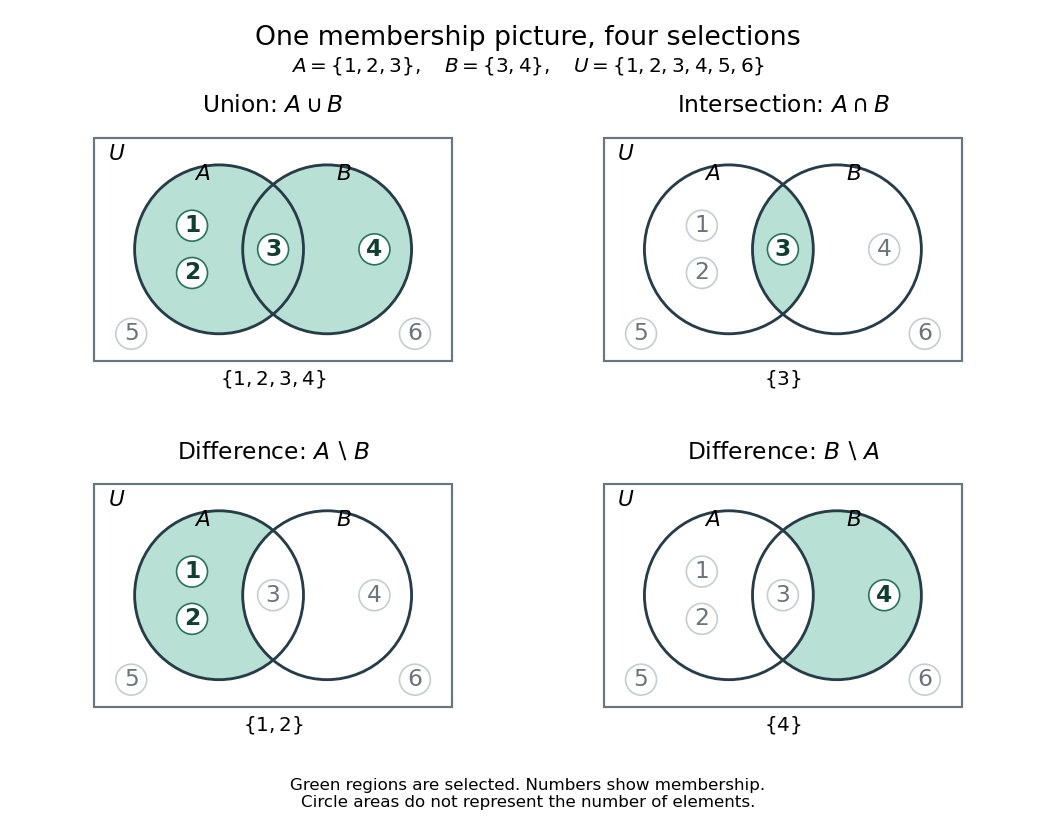


In this Venn diagram, belong only to , belongs to both sets, belongs only to , and belong to neither. The surrounding universal set is . Numbers are placed by membership; circle areas do not represent cardinalities. Each panel shades the region selected by its operation.
For a database illustration, let collect records matching one condition and collect records matching another. Their union selects records matching at least one condition, with a record satisfying both still appearing once. This interpretation turns an abstract operation into a reusable rule for combining selections. For an authored treatment of union, intersection, set difference, and complement, see Lehman, Leighton and Meyer, Mathematics for Computer Science (2015), Definition 4.1.1, pp. 82–83.
More generally, the union contains exactly the set elements belonging to at least one set :The existential quantification expresses “at least one”. With no indexing members, the union is the empty set. Combining a set with the empty set leaves it unchanged: .
There are unlisted articles, also show them or only show them.