
Caregivers may facilitate access and practice, receive information, change accommodation, or receive treatment for their own difficulties. These roles imply different mechanisms and should be compared against the same adequate child treatment when testing augmentation. Parent-only treatment and adding parent sessions to child treatment answer different questions.[ref]
A randomized controlled trial of internet-delivered cognitive behaviour therapy for adolescent anxiety disorders in a routine clinical care setting with and without parent sessions by Polly Waite and others. Child and Adolescent Mental Health 24, 242–250; randomised parent-session allocation, primary remission and follow-up
Parents should have a negotiated, formulation-led role that helps an adolescent undertake effective treatment while supporting increasing autonomy. Three roles must be distinguished: facilitating access and practice, changing parental responses that maintain avoidance, and receiving treatment for the parent's own difficulties. A parent being present in more sessions is not a mechanism in itself. The relevant question is which parental action changes which maintaining process, for which adolescent, beyond the effects of adolescent treatment alone.
Initial assessment should obtain both the young person's and caregiver's perspectives on feared situations, avoidance, impairment and family responses. Separate discussion with the adolescent can reveal difficulties they would not disclose in a joint meeting. A shared formulation can then identify whether parents provide repeated reassurance, take over social interactions or organise routines around avoidance. Accommodation can bring immediate relief while reducing opportunities for the adolescent to learn that uncertainty and distress are manageable. Support can instead combine recognition of distress with confidence in the young person's capacity to approach an agreed activity. These descriptions concern potentially modifiable interactions, rather than assigning parental blame for the disorder's origin.
The role should fit developmental circumstances. A thirteen-year-old dependent on a caregiver for transport may need different practical support from a seventeen-year-old arranging appointments. Parents can help implement between-session practice, notice approach rather than merely the disappearance of distress, and support school coordination. The adolescent should help decide what information is shared and which sessions are joint, within clearly explained confidentiality and safeguarding arrangements. Parent involvement can undermine treatment if it becomes surveillance, coercion or another route for excessive reassurance. Fathers, other caregivers and relevant family relationships should be considered rather than assuming that the mother is always the appropriate participant.
Adolescent-specific evidence does not support mandatory additional parent sessions for everyone. Polly Waite and colleagues randomised sixty thirteen- to eighteen-year-olds in routine services to immediate or delayed Internet CBT, with an additional random allocation of parent sessions. The parent addition did not significantly improve remission, either immediately or at follow-up, and the online programme itself did not clearly outperform waiting list on the primary remission endpoint. Confidence intervals were wide. This is evidence against assuming a reliable benefit from that particular addition, rather than proof that parental involvement is useless or that a modest targeted effect is impossible.[ref]
A randomized controlled trial of internet-delivered cognitive behaviour therapy for adolescent anxiety disorders in a routine clinical care setting with and without parent sessions by Polly Waite and others. Child and Adolescent Mental Health 24, 242–250; randomised parent-session allocation, primary remission and follow-up
Evidence from younger samples suggests hypotheses about selection. Vanessa E. Cobham and colleagues stratified families by parental anxiety before randomising sixty-seven seven- to fourteen-year-olds to child CBT with or without parental anxiety management. Their findings suggested greater benefit of the addition when a parent was anxious, but results varied across measures. The study motivates a moderator hypothesis; its small subgroups and younger participants limit a general rule for adolescent treatment.[ref]
The role of parental anxiety in the treatment of childhood anxiety by Vanessa E. Cobham and others. Journal of Consulting and Clinical Psychology 66, 893–905; parental-anxiety strata and parent anxiety-management addition
A larger test cautions against treating a plausible family risk factor as an established augmentation target. Cathy Creswell and colleagues studied 211 children whose mothers also had anxiety disorders. All received child CBT; additions targeted either maternal anxiety or mother–child interaction, with nonspecific contact balanced. The additions changed some maternal outcomes but did not clearly improve the primary child diagnostic outcome. Treating a parent's anxiety may be worthwhile for that parent without necessarily producing an incremental child-treatment effect. Family-risk association, target engagement and improvement in the child's disorder are separate evidential steps.[ref]
Treatment of childhood anxiety disorder in the context of maternal anxiety disorder: a randomised controlled trial and economic analysis by Cathy Creswell and others. Health Technology Assessment 19(38); 211-family trial, maternal CBT and mother–child interaction arms
An alternative is parent-based treatment rather than parental augmentation of child therapy. Eli R. Lebowitz and colleagues randomised 124 seven- to fourteen-year-olds to child CBT or SPACE treatment, a parent intervention reducing accommodation without direct child–therapist sessions. SPACE treatment met prespecified noninferiority criteria for anxiety outcomes and reduced accommodation. This supports the possibility that changing caregiver responses can be an effective delivery route. It does not establish that replacing adolescent-focused therapy with parent work is appropriate across the older teenage years, or that the same approach is preferred by every young person.[ref]
Parent-Based Treatment as Efficacious as Cognitive-Behavioral Therapy for Childhood Anxiety: A Randomized Noninferiority Study of Supportive Parenting for Anxious Childhood Emotions by Eli R. Lebowitz and others. Journal of the American Academy of Child and Adolescent Psychiatry 59, 362–372; SPACE treatment noninferiority trial, ages 7–14 and accommodation outcomes
Together, these studies favour flexible involvement. A useful clinical formulation can identify practical support needs, accommodation that interferes with learning, and parental anxiety requiring its own assessment. However, personalised selection rules remain hypotheses unless prospectively tested. Neither a null augmentation trial nor a successful parent-only trial settles the optimal dose of parent contact alongside a given adolescent therapy. Treatment fidelity also matters: a nominally parent-inclusive programme may differ greatly in whether it rehearses supportive responses, changes accommodation or merely provides information.
A future study should therefore recruit adolescents with diagnosed anxiety across routine services and deliver the same adequate adolescent CBT in every arm. Randomise caregivers to a brief accommodation-focused module or a credible contact-matched education condition; an additional prespecified stratum could examine parents with their own anxiety disorder. Measure accommodation and parental anxiety before allocation, and power the study for the specific treatment-by-baseline-characteristic interactions rather than searching retrospectively for successful subgroups. Include age, caregiver availability and adolescent preference in recruitment and reporting without treating chronological age as a complete measure of autonomy.
Masked diagnostic interviews, young-person-rated impairment and school or social functioning should be assessed after treatment and at six and twelve months. Parent reports should be retained as a separate perspective, not substituted for adolescent outcomes. Record what parents actually do through agreed observations or structured practice tasks, alongside session attendance and treatment fidelity. Measure changes in accommodation repeatedly before the proposed downstream improvement. Temporal mediation would constrain a mechanism, although additional mediator–outcome assumptions would still be needed for a causal mediation claim.
The trial should also measure family burden, acceptability and any deterioration in relationships, and examine families unable to attend conventional sessions. An approach that improves completer outcomes while excluding caregivers with work or language barriers may reduce practical access. Qualitative interviews can explain why a module helps or fails, while the randomised contrast estimates its incremental effect. The 2022 evidence supports parents as potential partners, change agents and recipients of care, but supports a collaboratively chosen and testable role more strongly than indiscriminate intensification of parental attendance.
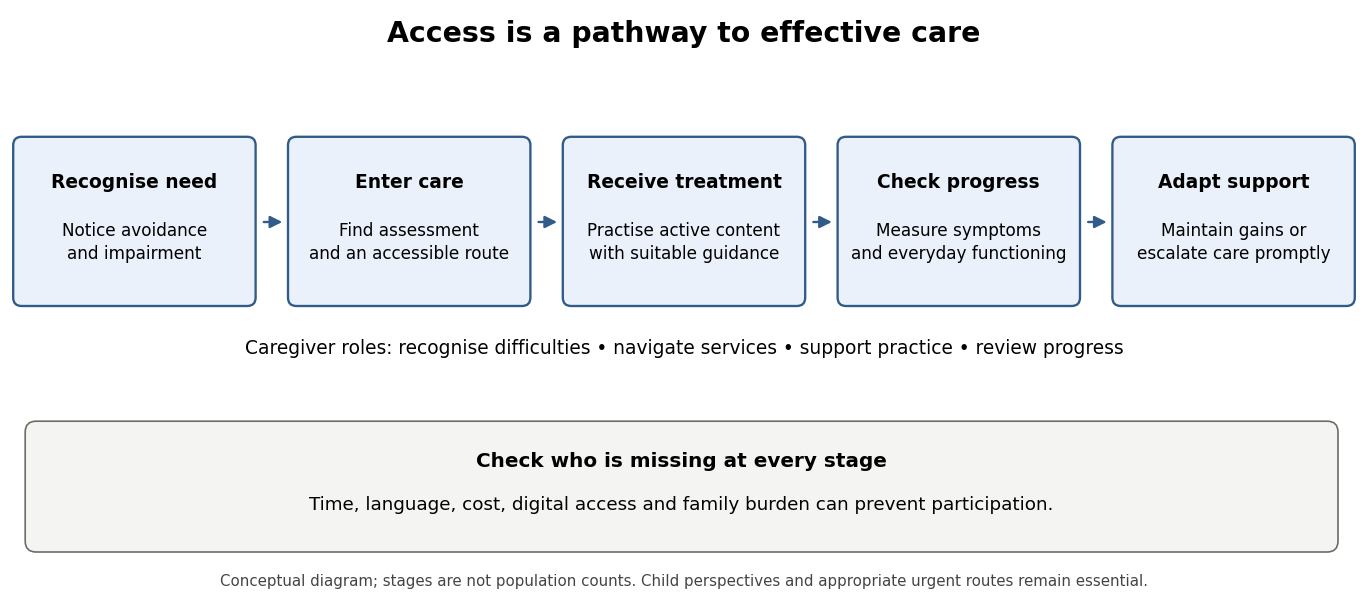
Improving access means increasing the proportion of children who receive an effective, acceptable intervention in time, not simply increasing referrals or distributing an app. The pathway includes recognition, deciding that help is needed, finding a service, starting treatment, receiving its active content and obtaining further care when it is insufficient. Parents can influence every stage, while schools and services determine whether practical barriers make that influence effective. Access and clinical benefit should therefore be evaluated together.
Tessa Reardon and colleagues interviewed parents of sixteen seven- to eleven-year-olds identified through schools as having anxiety disorders. The qualitative accounts distinguished recognising a problem, recognising the need for help, contacting professionals and receiving support. This is useful evidence about the pathway and barriers experienced by families. It is not a population estimate of how often each barrier occurs, nor a trial showing that a particular information campaign increases recovery.[ref]
Barriers and facilitators to parents seeking and accessing professional support for anxiety disorders in children: qualitative interview study by Tessa Reardon and others. European Child and Adolescent Psychiatry 27, 1023–1031; interviews with parents of sixteen school-identified children aged 7–11
Recognition can be supported by concrete descriptions of avoidance and impairment rather than assuming caregivers know diagnostic terminology. School and primary-care routes can offer an initial assessment and an explanation of available options. Information alone, however, cannot remove an inaccessible appointment time, transport cost or long waiting list. Services should provide clear referral instructions, choices of contact mode and a way to ask questions without requiring a caregiver to become an expert navigator. Children whose parents cannot participate still need a route to care.
Guided parent-delivered CBT is one approach to increasing treatment capacity. Kerstin Thirlwall and colleagues randomised 194 children to fuller parent guidance, briefer guidance or waiting list. The fuller programme involved four face-to-face and four telephone contacts; the brief version used two of each. Reported recovery from the principal diagnosis was 50%, 39% and 25%, respectively, with clear evidence for the fuller version against waiting list but greater uncertainty for the brief version. Eligibility excluded a current anxiety disorder in the primary caregiver, limiting direct extrapolation to families who may themselves need support.[ref]
Treatment of child anxiety disorders via guided parent-delivered cognitive-behavioural therapy by Kerstin Thirlwall and others. British Journal of Psychiatry 203, 436–444; 194 children, full/brief parent guidance and waiting list; primary-carer eligibility
The mechanism is not simply giving parents a manual. Guidance can help caregivers identify avoidance, plan manageable approach practice and alter accommodation while receiving feedback from a therapist. This can reduce specialist time spent directly with each child, but shifts some work onto families. Literacy, language, working hours, confidence and the caregiver's own mental health may affect participation. Flexible guidance and practical assistance should be built into delivery rather than interpreting failure to complete as parental unwillingness.
Routine-service evidence is important because research-clinic efficacy does not settle implementation. Cathy Creswell and colleagues randomised 136 five- to twelve-year-olds in four NHS services to brief Guided parent-delivered CBT or solution-focused brief therapy. The trial did not establish a clear difference on global clinical improvement, and the economic analysis suggested a possible efficiency advantage with uncertainty. The improvement endpoint should not be relabelled diagnostic remission; nor does a nonsignificant superiority result prove equivalence. The study nevertheless directly addresses a real service choice between active interventions.[ref]
Clinical outcomes and cost-effectiveness of brief guided parent-delivered cognitive behavioural therapy and solution-focused brief therapy for treatment of childhood anxiety disorders: a randomised controlled trial by Cathy Creswell and others. Lancet Psychiatry 4, 529–539; 136 routine-service participants aged 5–12, CGI-I endpoint and economic uncertainty
Digital delivery offers another route, with limits. Maral Jolstedt and colleagues compared therapist-guided Internet CBT with online child-directed play in 131 eight- to twelve-year-olds. Both conditions involved twelve modules and therapist contact. CBT improved the principal anxiety diagnosis more often, with 48% versus 15% no longer meeting that diagnosis at the assessed endpoint. This supports a guided programme with active clinical content and a credible comparator, not the effectiveness of every freely available anxiety app or the elimination of therapist input.[ref]
Efficacy and cost-effectiveness of therapist-guided internet cognitive behavioural therapy for paediatric anxiety disorders: a single-centre, single-blind, randomised controlled trial by Maral Jolstedt and others. Lancet Child and Adolescent Health 2, 792–801; 131 children aged 8–12, internet CBT versus child-directed play
Results should not be assumed to generalise across ages and programmes. Waite and colleagues did not establish clear remission benefits for their routine-service adolescent online programme or its extra parent sessions. Nordh and colleagues found benefits for a different, disorder-specific internet programme for youth social anxiety against active support. These findings favour evaluating a specified treatment and delivery system, rather than treating the internet itself as the active ingredient.[ref]
A randomized controlled trial of internet-delivered cognitive behaviour therapy for adolescent anxiety disorders in a routine clinical care setting with and without parent sessions by Polly Waite and others. Child and Adolescent Mental Health 24, 242–250; randomised parent-session allocation, primary remission and follow-up
[ref]Therapist-Guided Internet-Delivered Cognitive Behavioral Therapy vs Internet-Delivered Supportive Therapy for Children and Adolescents With Social Anxiety Disorder: A Randomized Clinical Trial by Martina Nordh and others. JAMA Psychiatry 78, 705–713; 103 participants aged 10–17, active comparator and masked severity ratings
Parent-only treatment is also distinct from parent-guided child treatment. Lebowitz and colleagues' SPACE treatment trial showed that changing parental accommodation could provide an effective route in a seven- to fourteen-year-old sample without direct child–therapist treatment sessions. It expands the range of possible offers, but does not justify making parental participation the sole gateway for every older adolescent or assuming the same evidence covers all family circumstances.[ref]
Parent-Based Treatment as Efficacious as Cognitive-Behavioral Therapy for Childhood Anxiety: A Randomized Noninferiority Study of Supportive Parenting for Anxious Childhood Emotions by Eli R. Lebowitz and others. Journal of the American Academy of Child and Adolescent Psychiatry 59, 362–372; SPACE treatment noninferiority trial, ages 7–14 and accommodation outcomes
A sensible service model would offer supported, lower-intensity care where appropriate, measure progress and provide timely escalation when improvement is inadequate. Assessment should identify complexity or urgent need that requires a different pathway immediately. Follow-up should include families who discontinue, because apparently good outcomes among completers can conceal exclusion. Remote and in-person options, interpreters, accessible materials and attention to digital privacy can widen participation; access should also be checked among families without reliable devices or private space.
Parents can support referral, appointments and between-session practice, but the child's perspective remains essential. Parent and child reports may differ, particularly for internal fears. For adolescents, involve caregivers in a negotiated way that respects autonomy and explains confidentiality. Supportive accommodation reduction should not remove disability-related adjustments or expose the child to genuine danger. An access intervention that increases coercion or burden may look efficient while reducing acceptability and sustained engagement.
A future implementation trial could randomise schools or primary-care networks to an accessible parent-guided pathway with direct supported referral, versus the existing referral pathway. Cluster allocation can reduce contamination when staff change their practices across a whole site. Both pathways should provide appropriate assessment and escalation. Prespecify the eligible population, measure how many are offered help, start, receive the intended content and improve, and analyse outcomes using the cluster structure rather than treating every child as independently allocated.
The main service endpoint should combine reach with clinically meaningful outcome, accompanied by masked diagnostic follow-up and everyday functioning. Report waiting time, therapist resource use, family time, dropout and six- or twelve-month outcomes. Examine inequalities by deprivation, language, caregiver anxiety and digital access using prespecified comparisons. A programme that reduces therapist hours but transfers an unmanageable burden to parents has not necessarily improved access. The 2022 evidence supports guided parental involvement and selected digital treatments as useful routes, embedded within assessment, support and escalation rather than offered as universal substitutes for care.

Polly Waite 2026-10-25
A researcher whose work concerns child and adolescent anxiety or relevant cognitive mechanisms.[ref]
A randomized controlled trial of internet-delivered cognitive behaviour therapy for adolescent anxiety disorders in a routine clinical care setting with and without parent sessions by Polly Waite and others. Child and Adolescent Mental Health 24, 242–250; randomised parent-session allocation, primary remission and follow-up

Portrait of Polly Waite
. Professional-association workshop portrait. Source.