Let be the initial monetary balance in the bank account, negative for borrowing. Matching successor financial payoffs gives the linear systemSubtracting determines the stock holding in the header; substitution determines . The initial cost is . For the European call option with , , strike price 100 and payoffs 20 and zero,The debt becomes 40 at maturity: half a share minus 40 yields in the up state and in the down state. Holding these positions until maturity is self-financing. Repeating this two-equation construction at earlier nodes gives backward option pricing and the unique price in the complete market.
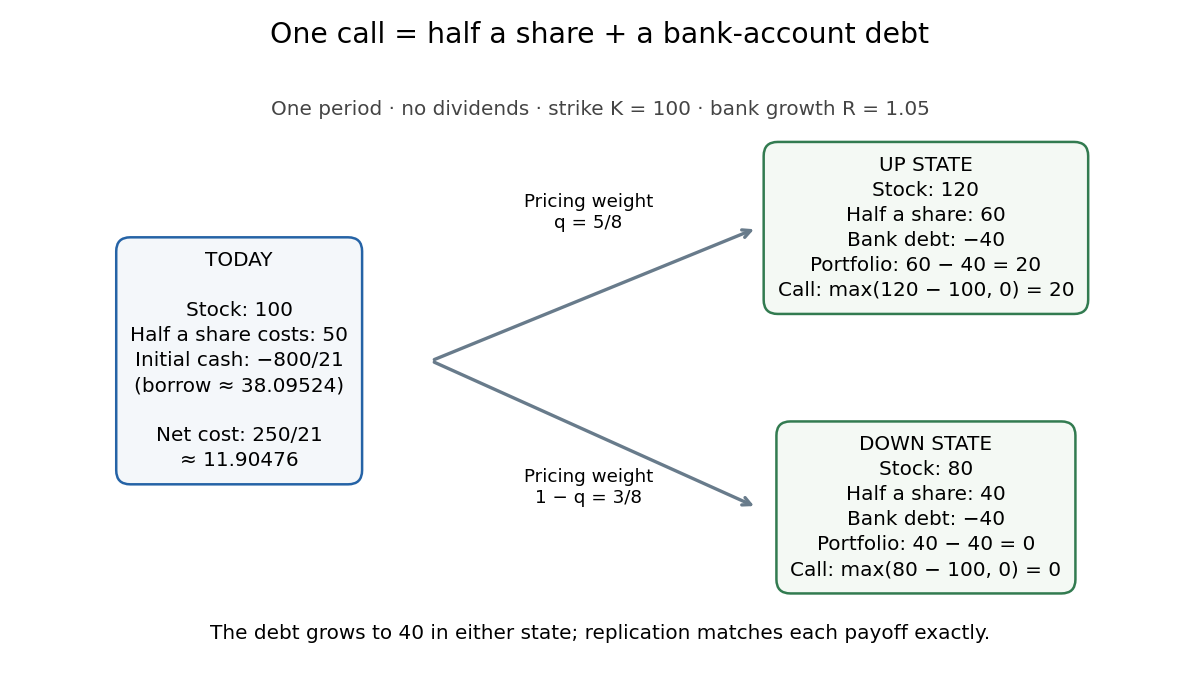

The discrete replication method was developed in Cox, Ross and Rubinstein's 1979 paper, whose Sections 2–3 explain borrowing, statewise matching and why physical probability drops out of relative option valuation. Their symbols for physical and pricing probabilities differ from the convention here. [ref]
https://bpb-us-w2.wpmucdn.com/u.osu.edu/dist/7/36891/files/2017/07/CRR79-1yy8av8.pdf. Cox, Ross and Rubinstein, Option Pricing: A Simplified Approach (1979), Sections 2–3
A convex terminal payoff has a convex pricing extension in the binomial market, because risk-neutral pricing is a positive weighted sum of rescaled copies of the payoff. Let the stock factors be , the riskless gross factor be , and . The replicating portfolio in a binomial market satisfiesThe weights sum to one. Convexity orders the secant slopes on the adjacent intervals and , proving the displayed inequalities. The inequalities need not be strict: an affine payoff has constant stock holding.
At each node of a binomial tree, a claim with next-period values has valuewhere is the local risk-neutral probability in a binomial market. For an American claim, replace this continuation value by the maximum of continuation and immediate exercise value.
Articles by others on the same topic
There are currently no matching articles.