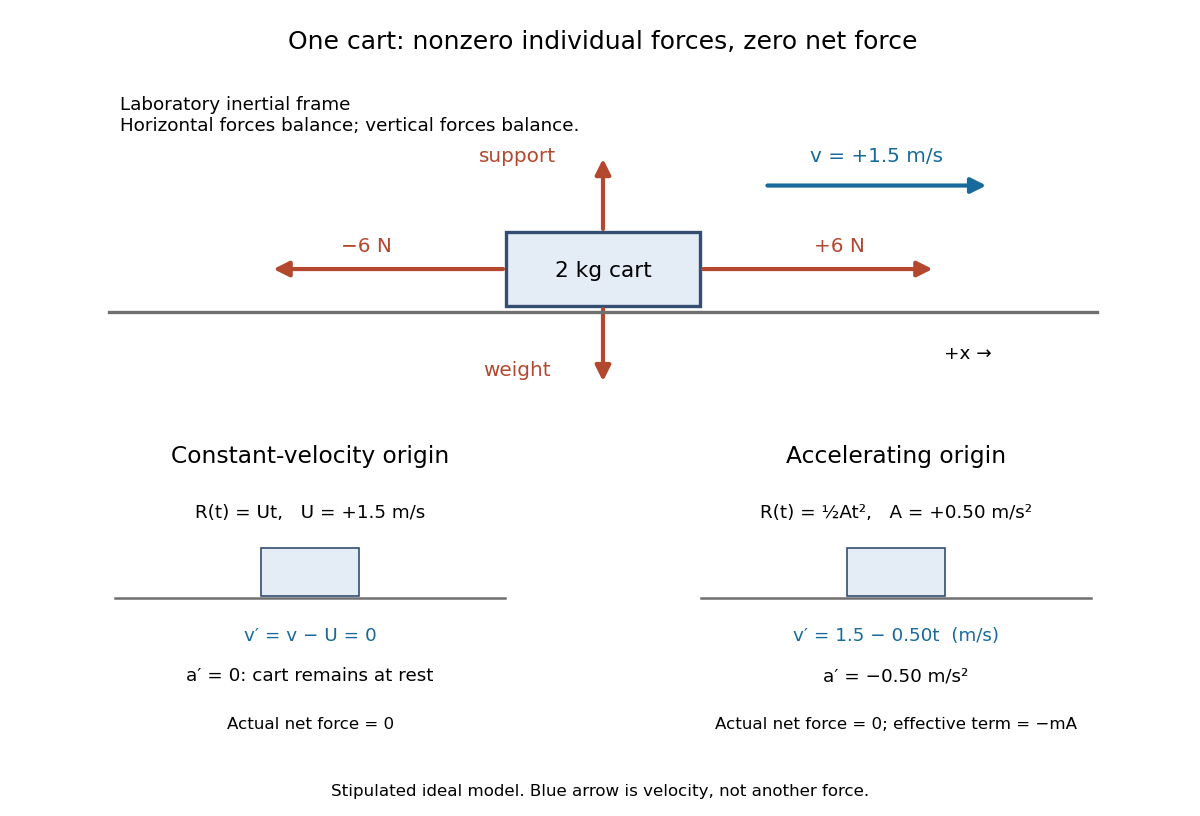
Consider a stipulated ideal cart modeled as a point mass of mass on a horizontal track in a laboratory inertial frame. Its initial position is and its initial velocity is to the right. Independent devices exert horizontal forces and on this same cart. Its upward support force balances its downward gravitational weight; no other forces contribute. Rotation and deformation are excluded from this model.After , the cart is at , still moving right at . Starting the same model at rest instead would leave it at rest. Force balance determines the zero acceleration, while the initial velocity determines whether the cart moves.

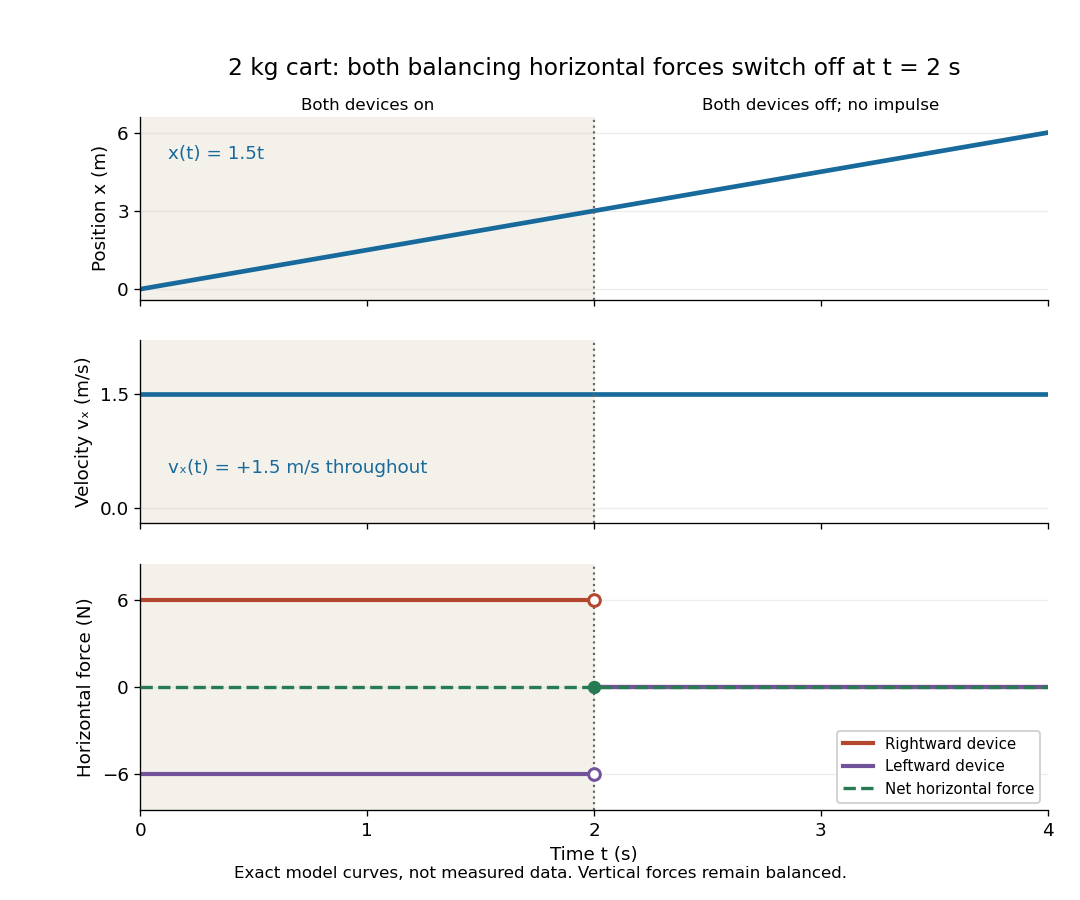
For the plotted model, both horizontal devices are switched off simultaneously at , with no impulse. The support and gravitational weight remain balanced. The individual horizontal forces change, but their sum stays zero on both sides of the switch, so the velocity stays continuous and unchanged. Switching off just one device would be a different model with a nonzero net external force.

Articles by others on the same topic
There are currently no matching articles.