Let be fixed and known, and let be independent and identically distributed Bernoulli random variables with common success probability . Their joint probability mass function, on the binary sample space , isThere are arrangements with successes, so has the binomial distribution. For and , its exact conditional full-data probability mass function isThis conditional distribution is uniform over arrangements, with no dependence on : the sum is a sufficient statistic. [ref]
Sufficiency (Stat 210a, Fall 2025) by Will Fithian. Sufficiency, Will Fithian, “Independent Bernoulli sequence”: conditional pmf
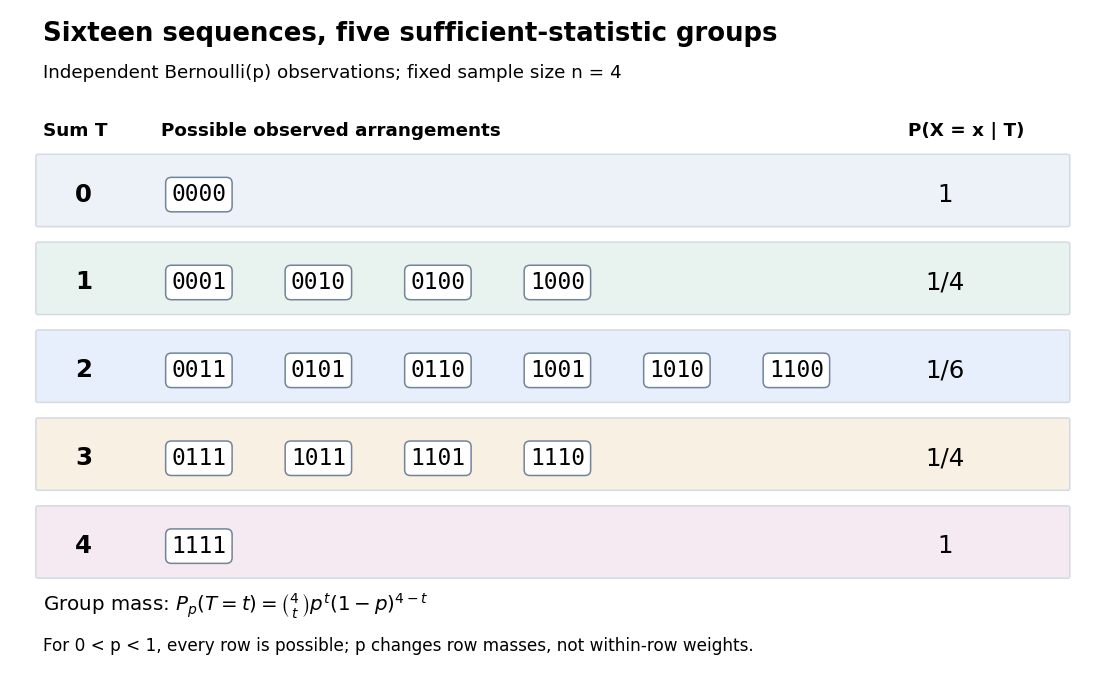
Four Bernoulli observations grouped by their sufficient sum
. All sixteen binary sequences are grouped by . Within each group the conditional distribution is uniform; changing changes the group's total probability, not the conditional weights within it. Details.
For , the group sizes are and the within-group conditional probabilities are respectively . For example, leaves exactly , each with conditional probability . At , each such sequence has unconditional probability and the group has probability . At , these values are and ; at they return to and . The conditional weights stay in all three cases.
At the boundary , only has positive probability; at , only does. Dividing by on the other groups would divide by zero. Nevertheless, the same uniform-on-arrangements Markov kernel is a valid common version for the entire family : it gives the correct point mass on the one observed group at each boundary and assigns permissible versions on its unobserved groups. Define the joint probability mass function there by the original product of the one-trial Bernoulli probability mass functions, or use the limiting convention in the compact formula.
The sample mean is an unbiased estimator of and retains the sufficient statistic because is known. By contrast, is also an unbiased estimator of but, for , is not sufficient: the conditional success probability of the independent given is still . Thus unbiasedness does not imply sufficiency.
Sufficiency also does not imply completeness of a statistic. For , the full-data sufficient statistic admits the nonzero function with expectation zero for every . Nor does minimality imply completeness of a statistic: for and the restricted statistical model , is a minimal sufficient statistic since the likelihood ratio distinguishes its three values. Yet has expectation at both parameter values and is never zero. Changing the parameter family can change completeness of a statistic even while preserving sufficiency.
Articles by others on the same topic
There are currently no matching articles.