The -qubit bit-flip repetition code stores one logical qubit in and . Its stabilizer generators are for , and its logical operators are and . Interchanging the Pauli X gate and Pauli Z gate gives the phase-flip repetition code. For odd , majority-vote decoding of a repetition code corrects up to physical Pauli X gate errors, assuming ideal operations and a noise family containing only these bit flips.
For , prepare two quantum ancillas in and apply controlled-NOT gates from the input qubit to each of them. By linearity, encoding sendsThis does not produce , which would contain cross terms. For example, encoding produces , whereas three independent copies would have eight equal computational basis amplitudes. The encoding creates quantum entanglement when both coefficients are nonzero and respects the no-cloning theorem.
The three-qubit bit-flip syndrome table corrects the family and its entire linear span, as specified by the Knill--Laflamme condition. It cannot correct arbitrary errors on one physical qubit: the phase flipcommutes with both checks and acts as logical . In particular, it takes the encoded to the orthogonal encoded with error syndrome . Thus its full quantum code distance is one, despite correcting one error of the restricted Pauli X gate type. The Shor code, Steane code and five-qubit error correcting code provide protection against arbitrary one-qubit errors.
Measure the commuting stabilizer generators and in that order. Use error syndrome bit for eigenvalue and bit for eigenvalue . For the Pauli X gate on physical qubit , every row holds for arbitrary normalized . This ordered parity-check convention follows [ref]
https://www.preskill.caltech.edu/ph229/notes/chap7.pdf. Preskill, §7.1
:| Error | State before recovery | eigenvalues | Error syndrome | Recovery |
|---|---|---|---|---|
Each pair of computational basis words within a row has the same two parities. Consequently the projective measurement reveals the row without distinguishing its two amplitudes. For example, becomes under . Both checks give with probability one, and applying restores both coefficients exactly, including the relative phase .
One implementation uses two quantum ancillas initialized to . Two controlled-NOT gates from data qubits 1 and 2 to the first quantum ancilla write their parity; two more from data qubits 2 and 3 to the second quantum ancilla write the other parity. Measuring only the quantum ancillas in the computational basis gives . Measuring the individual data qubits instead would reveal the encoded computational basis value and destroy the unknown quantum superposition. The existing coherent syndrome extraction for the three-qubit repetition code uses the alternative ordered checks , so its bit labels differ from this table.
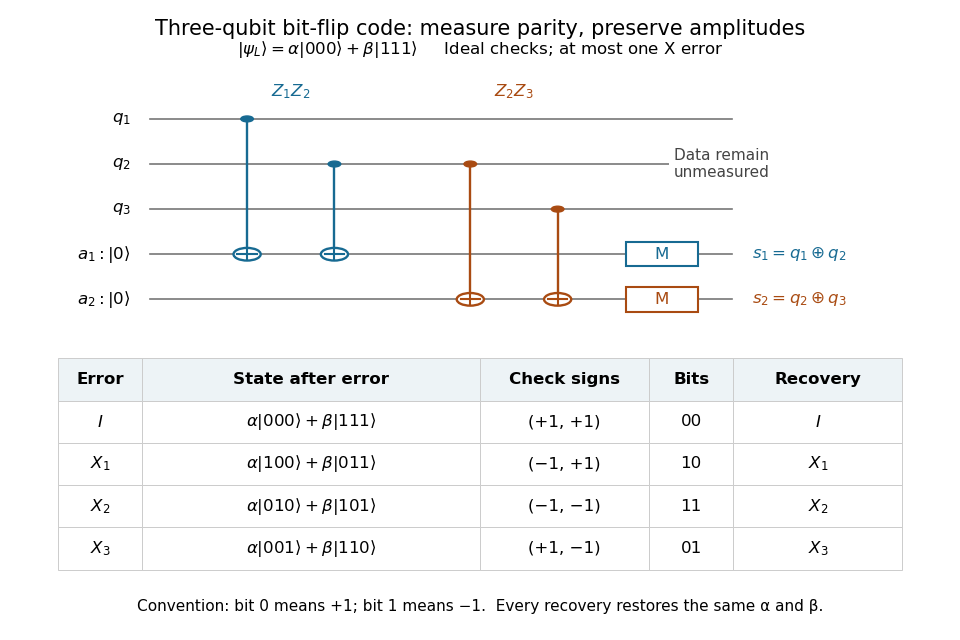
The recovery also handles coherent errors. Put . Their images of the code are mutually orthogonal, giving , the Knill--Laflamme condition for this family. For any linear combination , its component in sector is . Measuring that error syndrome has probability on the normalized erroneous state, and recovery returns . More generally one recovery quantum channel corrects every noise quantum channel whose Kraus operators belong to this span. The assumption concerns the whole jointly correctable family; it does not extend to the span of arbitrary single-site Pauli errors. [ref]
https://www.preskill.caltech.edu/ph229/notes/chap7.pdf. Preskill, §7.2: correction of an error span
.A fully computed coherent example is the unitary operator . At it givesThe error syndromes and occur with probabilities and , independently of . Doing nothing for and applying for restores the same logical qubit in both branches; the scalar in the second branch is an irrelevant global phase. This is an example of linearity of coherent quantum error correction, rather than an assumption that the original error was a classical random bit flip.
Assume that each physical qubit undergoes an independent quantum bit-flip channel with probability during one storage interval, and that encoding, error syndrome extraction, recovery and decoding are all ideal. Use the three-qubit bit-flip syndrome table to apply the indicated minimum-weight recovery. Zero or one bit flips are corrected. Two bit flips have the same error syndrome as the complementary one-site error: for example, gives , so recovery leaves . Three bit flips give and also leave . This exchanges and , and therefore acts as a logical Pauli X gate after decoding.
The number of physical bit flips has a binomial distribution with three trials, hence the logical-error probability isFor a logical density operator , the decoded quantum channel is exactly . Here logical failure means a nontrivial logical Pauli X gate error; a particular input such as can be invariant under that error. At , exactly two flips have probability and three flips have probability , giving . The block succeeds with probability compared with for an unencoded qubit. At , , illustrating the quadratic suppression of rare independent bit flips.
Factoring the improvement givesThus one level reduces logical-error probability for , is equal at , and makes it worse for under this same decoder. The suppression arises because a logical error requires at least two physical bit flips. With independent disjoint inner blocks, the same noise model and ideal correction at every level, a concatenated quantum error-correcting code has , with . At , two levels use nine data qubits and give .
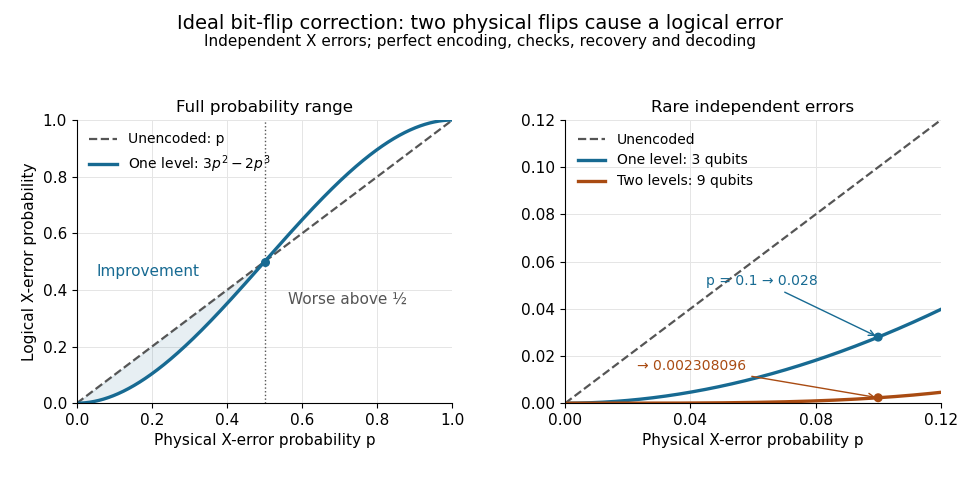


This calculation describes ideal correction of stored information with the specified quantum bit-flip channel. Repeated correction in time additionally requires a fresh specified noise model for each interval; imperfect quantum gates, faulty measurements and correlated errors change the calculation. The timed bit flip during repetition-code syndrome extraction and exact encoded-state failure with a faulty parity check show concretely why this storage calculation alone is not a fault-tolerance result.
Encode as . Four controlled-NOT gates copy the displayed two data parities into initially zero quantum ancillas. No logical amplitude is measured. The error syndromes correspond respectively to no bit flip and bit flips on data qubits . Conditional Toffoli gates, with temporary Pauli X gates implementing zero-valued controls, undo the indicated error. Inverse encoding yields the original logical state and a separate syndrome state. A phase flip has zero bit-flip syndrome and remains as a logical phase error; this three-qubit code is not a general single-qubit-error code.
Suppose the first ancilla records parity , then a fault of value flips , and the second ancilla records parity . For incoming bit-error pattern , the observed error syndrome is the displayed pair, while the final data error before recovery is . When , the observed syndrome differs from the actual data syndrome by . Applying the usual minimum-weight recovery leaves a nonzero syndrome, so the state is outside the code space even when the channel itself made no error. This is a timing-dependent failure of this simple extraction circuit, not a general obstruction to fault-tolerant quantum error correction.
For independent channel bit flips of probability and the specified extraction fault of probability , require recovery of an arbitrary input in the original encoded subspace. Every extraction-fault event leaves nonzero error syndrome; without that fault, channel errors are corrected exactly at weight zero or one. Thus success probability is . Compared with a single unencoded bit-flip channel, strict improvement for requires . A different decoder or an added later ideal recovery changes the performance criterion and must be specified separately.
Articles by others on the same topic
There are currently no matching articles.