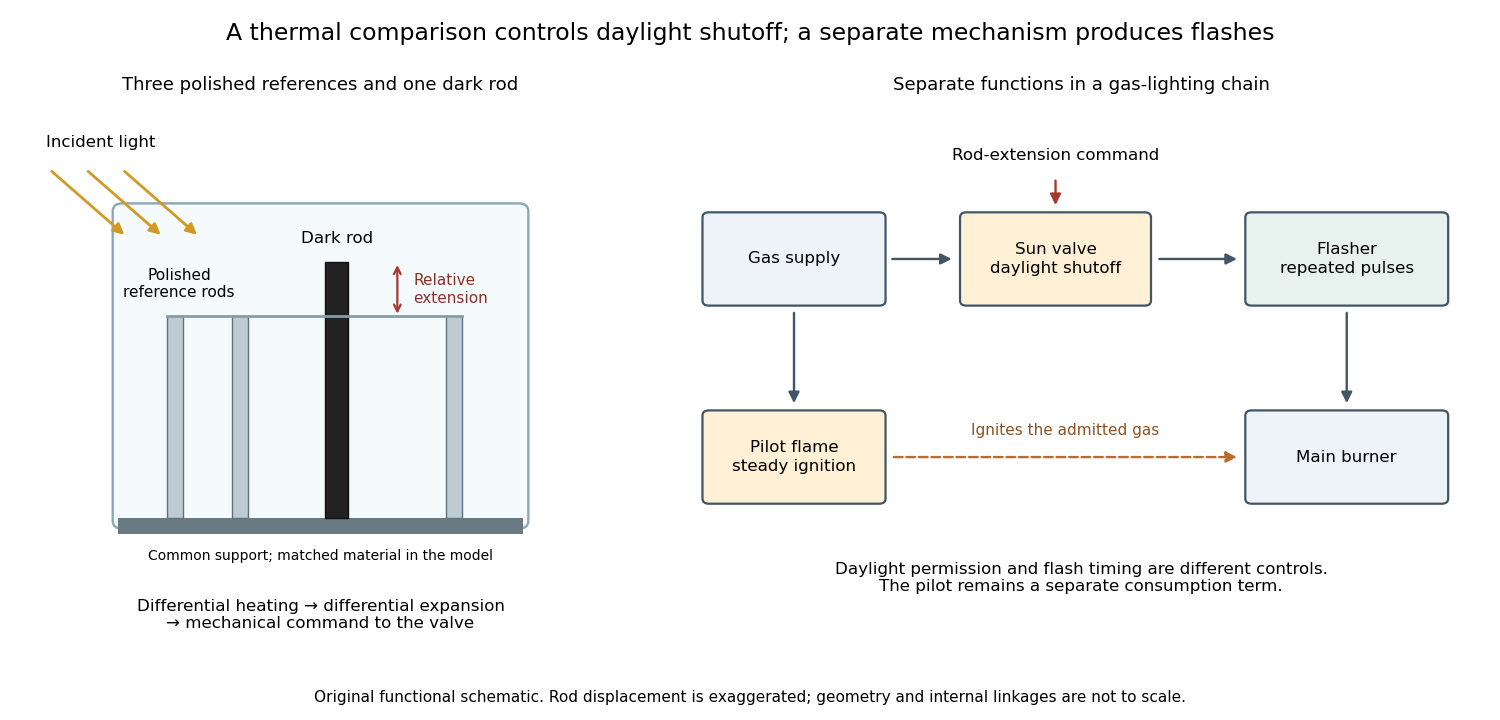
A sun valve automatically restricts a gas light's supply in daylight and allows it again as illumination falls. In Gustaf Dalén's design, a blackened rod and three polished rods respond differently to sunlight. Their relative thermal expansion operates the gas valve through a membrane; a pilot flame permits relighting. The museum dates this design to 1907.[ref]
Gustaf Dalén – Beacon Lighting by Tekniska museet. Sun valve: date, black rod, three polished rods, membrane and daylight/night operation
The useful comparison is between two thermal responses. Both kinds of rod expand when warmed; a dark surface can absorb more incident radiant power, so its temperature rises more. Comparing their extensions can reject a common ambient-temperature change while responding to illumination. The mechanism converts light into heat, heat into a difference of length, and that difference into a change of gas flow. Differential thermal model of a sun valve makes those assumptions quantitative.
Take a stipulated pair of effective rods with common length , linear thermal expansion coefficient , heat capacity , projected illuminated area , and thermal conductance to an environment at constant temperature . One reference represents the symmetric polished-rod assembly. Write and . Let their effective radiometric absorptances be for a fixed incident optical spectrum, and let be the common irradiance. A spatially uniform, linear heat-balance model givesHere includes a linear approximation to the relevant losses; changing the surface treatment can also change those losses in a real device. We stipulate equal and to isolate the response to absorbed illumination, with thermal coupling from the burner neglected. Small, mechanically unconstrained extensions then give a differential displacementThe time constant describes thermal memory. A common imposed temperature shift cancels from the extension difference under the matched-coefficient assumptions; mismatched materials, geometry or thermal coupling can spoil that cancellation.
For a step from darkness to constant irradiance , with initially equal rod temperatures, the first-order linear differential equation givesChoose , , , , , , and . The calculated difference of absorbed powers is , givingFor an illustrative ideal valve that closes at , the closing time isThis threshold is crossed only when . These are chosen model parameters, not a fit to a historical valve.
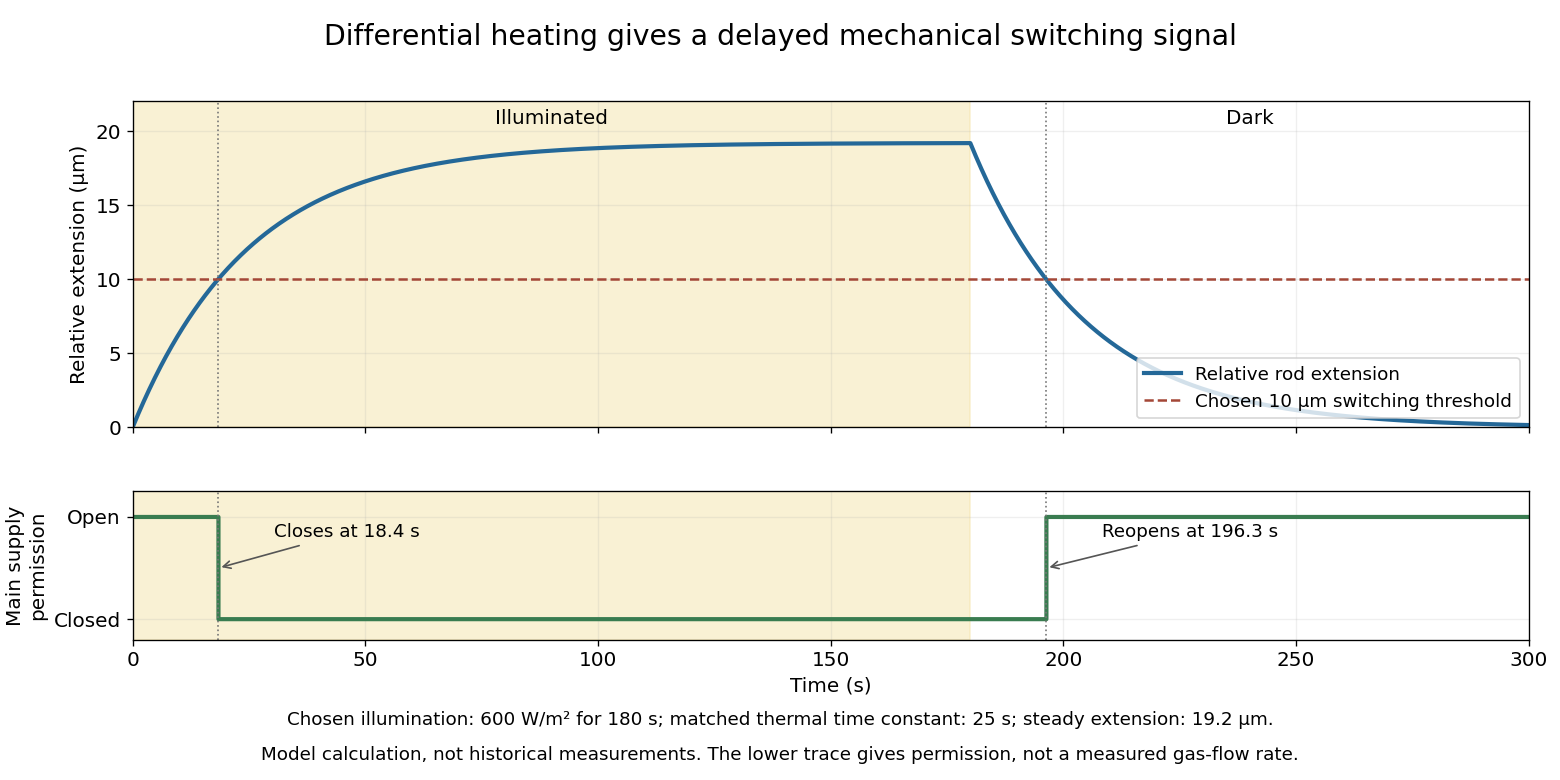
After illumination stops at , the displacement decays as . With , the model reopens about later. Thus a sun valve responds to the thermal history of illumination; it does not read a clock or directly measure the beacon's brightness.
A proposed bench test can isolate the mechanism without a gas burner. Illuminate a blackened and a polished sample of matched material and geometry, record both temperatures and their relative displacement, then block the beam. Measure incident irradiance separately. Swap the surface treatments, hold the ambient temperature fixed for the illumination test, and change it with the beam blocked for a common-heating control. This is a model-based experiment proposal, not a report of measurements.
A larger response of the dark sample would support a difference in absorbed power; the displacement and cooling curves test the assumed linear thermal expansion coefficient and time constant. A stable illumination step that never reaches the switching gap challenges the chosen parameter model rather than the existence of thermal expansion. Nonuniform sample temperature, unequal losses and mechanical friction can separate the physical device from the ideal equations.
Articles by others on the same topic



Valve Corporation is a video game development and digital distribution company founded in 1996 by Gabe Newell and Mike Harrington. It is known for creating some of the most popular and influential video games in the industry, including the "Half-Life" series, "Portal," "Team Fortress," and "Dota 2." Valve also developed the Source game engine, which powered many of its titles.