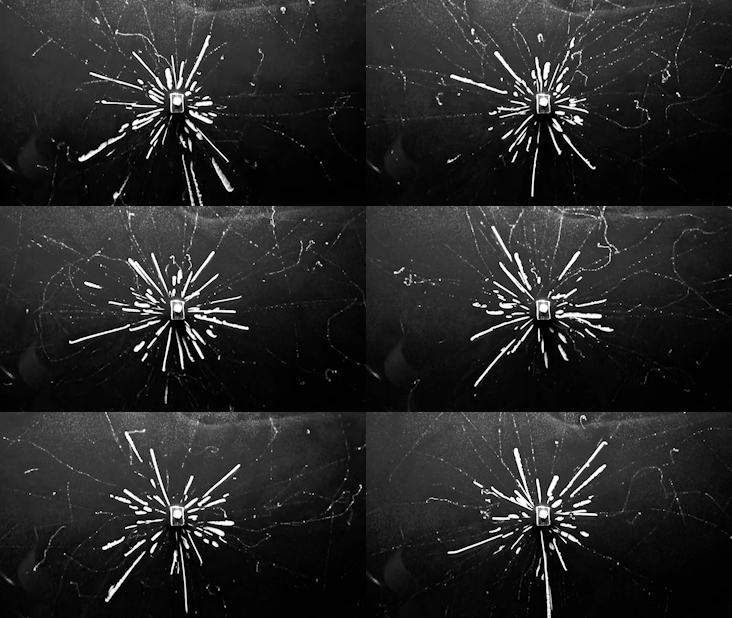
A cloud chamber contains supersaturated vapor. Ionization along a charged particle's path supplies sites for nucleation; the resulting liquid drops scatter light and reveal the trail. The observed objects are drops, not magnified particles. Its beauty is that a spatially distributed microscopic interaction becomes a visible geometrical record.
Two ways of making supersaturated vapor must be distinguished. An expansion cloud chamber rapidly increases the volume of moist gas, producing a temporary sensitive interval through cooling by adiabatic expansion. A diffusion cloud chamber maintains a cold base and a warmer vapor supply, producing a continuously replenished sensitive layer through diffusion and a temperature gradient.
Articles by others on the same topic

A cloud chamber is a particle detector that allows scientists to visualize the paths of charged particles, such as electrons or alpha particles, as they traverse a supersaturated vapor of a suitable working fluid (often alcohol or water vapor). Here's how it works: 1. **Supersaturation**: The chamber is filled with vapor and cooled to create a state where the vapor is supersaturated.