Keep the gap fixed and vary positive temperature. With , the Boltzmann factor is . In the four-microstate example, as , : the unique ground state has probability tending to one, and the other microstates have probabilities tending to zero. If several microstates instead shared the lowest energy, their state degeneracy would split that limiting population equally.
As in this fixed finite model, all four individual Boltzmann factors tend to one, so all four individual microstates have probability tending to . The three aggregate probabilities instead approachThe equal-population limit applies to this finite set of microstates. An infinite collection of microstates cannot all have the same positive normalized probability, so the statement cannot be extended to an unbounded energy spectrum. Real systems may also acquire additional accessible microstates as temperature rises.
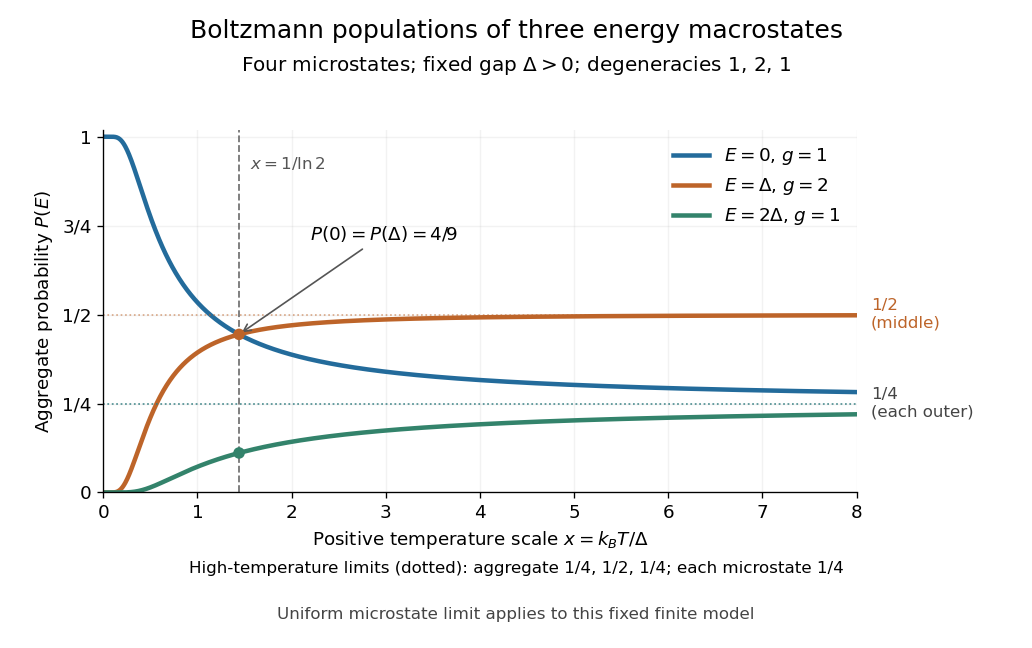
Aggregate Boltzmann distribution populations versus positive temperature for state degeneracies 1, 2, 1
. Details. 
The plotted crossing occurs at , where . For larger positive temperatures, the middle macrostate is more probable than the lowest-energy macrostate, although the lowest-energy individual microstate remains more probable than either individual middle microstate. The expected value of energy rises from zero toward in this finite model.
Articles by others on the same topic
There are currently no matching articles.