C. Kumar N. Patel developed the carbon dioxide laser at Bell Laboratories. His National Inventors Hall of Fame record identifies the contribution and records his birth in 1938, education in India and at Stanford, and induction in 2012.[ref] UCLA's faculty record uses the Kumar form and lists a Stanford doctorate in 1961; its publication list preserves the C.K.N. Patel byline.[ref]
C. Kumar Patel faculty profile at UCLA. Educational Background and Selected Publications
His 1964 experiment showed continuous laser action on rotational transitions within molecular vibrational bands of carbon dioxide, rather than only on atomic transitions. The strongest reported line was in vacuum, with about continuous output.[ref]
Continuous-Wave Laser Action on Vibrational-Rotational Transitions of CO2 by C. K. N. Patel. Abstract and Table I
Molecular vibration and molecular rotation therefore provide the energy-level structure behind the observed infrared lines.The apparatus made those invisible lines measurable. The paper describes a five-metre quartz tube with an electrical discharge, a nearly confocal optical cavity formed by silicon mirrors with aluminium coatings, and output coupled through an uncoated central mirror aperture. A copper-doped germanium photoconductor cooled to detected the radiation; a thermopile checked power, and a scanning grating spectrometer measured wavelengths.[ref]
Continuous-Wave Laser Action on Vibrational-Rotational Transitions of CO2 by C. K. N. Patel. §II, pp. A1187–A1188, Experimental Technique
Electrical excitation, resonator feedback and infrared detection play separate roles in that observation.An original calculation connects the recorded wavelength to familiar quantum scales. Using the Planck constant and vacuum speed of light,Treating a output as monochromatic at that line gives photons per second. This is a derived scale estimate, not a photon-count measurement from the paper. Photon energy and total radiant flux are different quantities.
The Hall of Fame records the later importance of carbon dioxide lasers for industrial cutting, welding, engraving and drilling.[ref]
C. Kumar N. Patel at the National Inventors Hall of Fame. Industrial applications
That engineering reach explains why a small early molecular-laser demonstration became historically significant.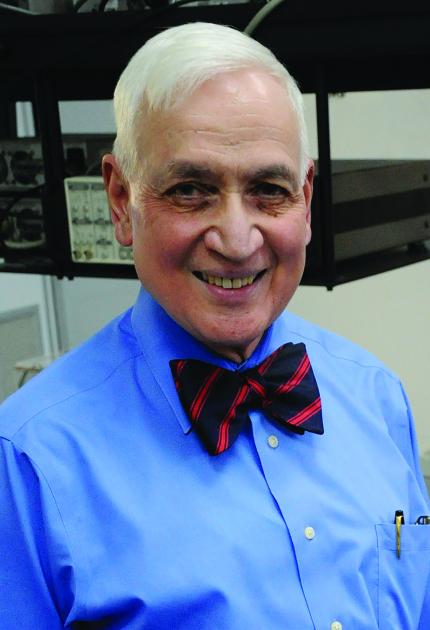
Articles by others on the same topic

C. Kumar N. Patel is an Indian-American physicist and engineer known for his contributions to the fields of laser technology and optics. He is particularly recognized for his pioneering work in developing the carbon dioxide (CO2) laser, which has had significant applications in various fields including industrial manufacturing, medicine, and research. In addition to his work on lasers, Patel has held notable academic and administrative positions, including serving as a professor and dean at the University of California, Los Angeles (UCLA).