A directional Gibbs energy of activation measures the climb from a starting state to a transition state. The net standard reaction change in Gibbs free energy measures the difference between endpoints. Changing the climb can strongly change a rate constant while leaving that endpoint difference intact. For two illustrative single-barrier routes with common endpoint levels and ,Lowering the common transition state level lowers both directional Gibbs energies of activation; it does not lower just the forward climb. The usual statement that a catalyst lowers an activation energy describes a kinetic route, not a change in the net Gibbs free energy. An activation energy inferred from an Arrhenius plot is also distinct from a Gibbs energy of activation at one temperature.
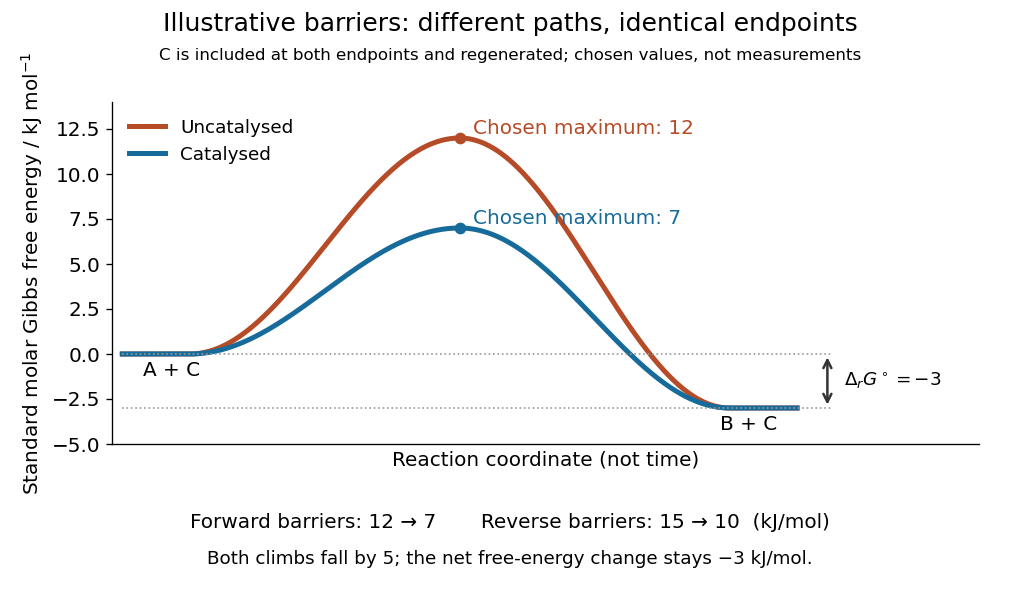
Illustrative catalysis schematic: different barriers, identical endpoint Gibbs free energy difference
. Chosen levels in : A plus regenerated C at , B plus regenerated C at , and schematic maxima at and . Forward barriers are and ; reverse barriers are and . Neither curve is a measured molecular path. The reaction coordinate is not time. These values illustrate the barrier bookkeeping and do not parametrize the separate reversible catalytic relaxation example. Details.
With a common prefactor in transition state theory, subtracting the directional barriers yieldswhere is the molar gas constant and is the absolute temperature. This particular rate constant ratio requires the simple compatible directional rate laws and consistent standard states; a general multistep reaction mechanism does not supply two arbitrary measured rate constants whose ratio must equal . At fixed temperature a catalyst preserves for the same net conversion. The actual reaction change in Gibbs free energy, , is likewise unchanged at the same reaction quotient . Composition changes during the faster approach to chemical equilibrium, so comparing mixtures at the same elapsed time need not compare the same .[ref]
13.3 Shifting Equilibria: Le Châtelier’s Principle. §13.3, Effect of a Catalyst: both directional rates accelerate while equilibrium composition is unchanged
Articles by others on the same topic
There are currently no matching articles.