A catenary is the static shape of an ideal flexible, inextensible chain hanging under its own gravitational weight in a uniform gravitational field, with uniform linear mass density along its arc length. With the lowest point above , one convenient vertical origin givesHere has units of length. The supports and the chain's arc length determine the scale and position; horizontal and vertical shifts give the general catenary. [ref]
https://www.damtp.cam.ac.uk/user/reh10/lectures/nst-mmii-handout3.pdf. Robert Hunt, Cambridge Mathematical Methods II: worked example, The Catenary
For , the three points at have heights , , and . If heights should instead be measured from the lowest point, subtract :The same three heights are then approximately , , and . The shift changes the vertical origin and preserves the catenary shape.
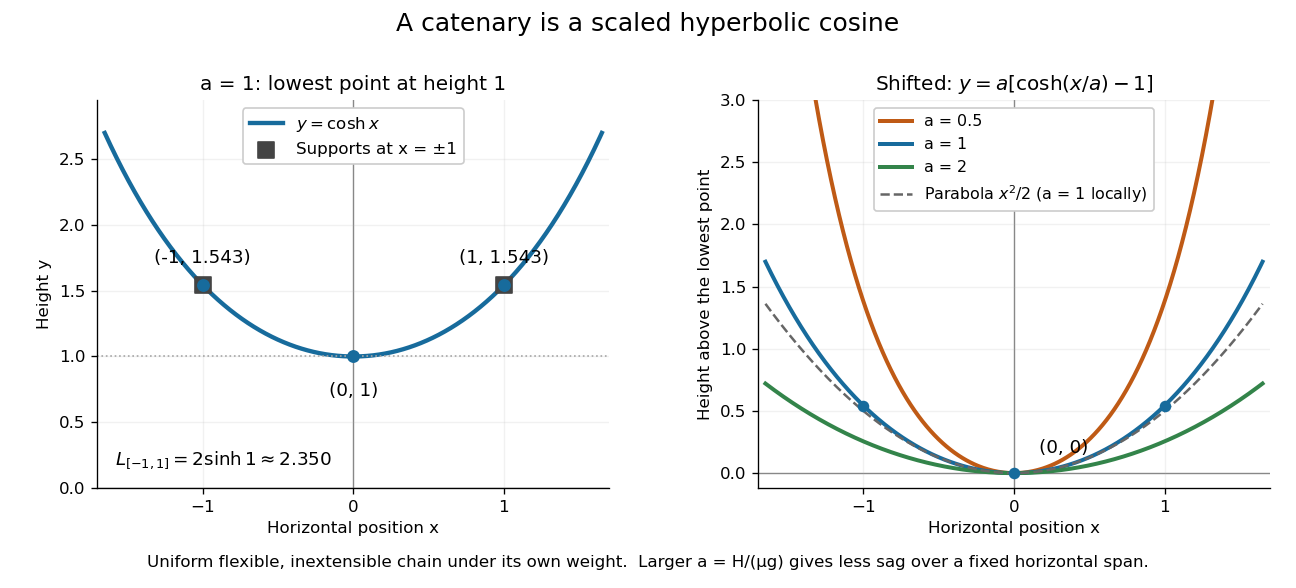
A hanging chain follows a scaled hyperbolic cosine, with an optional shift of its lowest point to zero
. The left panel marks on . The right panel puts the lowest point at zero, compares three positive scales , and shows the local parabola for . Details.
The scale also measures tension: if is its constant horizontal component, is the linear mass density, and is the magnitude of gravitational acceleration, then . A short force balance explains this. For the portion from the lowest point to , with arc length , vertical tension balances its gravitational weight and horizontal tension givesApplying differentiation yields . The proposed hyperbolic cosine solves this differential equation, because and . This is the mechanism behind the shape, under the stated ideal chain assumptions.
The same identity simplifies the arc length between symmetric supports at :For , , exceeding the horizontal span of two. A larger at fixed gives a shallower sag: the Taylor series gives . Thus a parabola is a local approximation, while the exact ideal chain shape is a catenary. The useful connection is that the same hyperbolic Pythagorean identity controls its coordinates, force balance, and arc length.
Articles by others on the same topic
There are currently no matching articles.