A coil-stretch transition is a sharp change from a coiled to a substantially extended polymer conformation under sufficiently strong extensional flow. The driving extensional strain rate must compete with the chain's relaxation rate, and the available residence time matters. A long polymer relaxation time lets a weak but sustained flow produce a large effect. The Hookean dumbbell in planar extension below isolates this competition; its unbounded growth signals a model limitation, rather than a prediction of infinitely long molecules.
Pierre-Gilles de Gennes's 1991 lecture describes Andrew Keller and collaborators using four rollers to deform a dilute polymer solution. A well-chosen exit trajectory kept coils under sustained extension. Above a threshold flow rate the solution became birefringent, revealing a change in chain orientation and conformation. The experiment connected an optical readout to a mechanically driven molecular response.[ref]
Soft Matter by Pierre-Gilles de Gennes. Printed p. 9: four-roller experiment and coil-stretch interpretation; text inspected in the Columbia reproduction
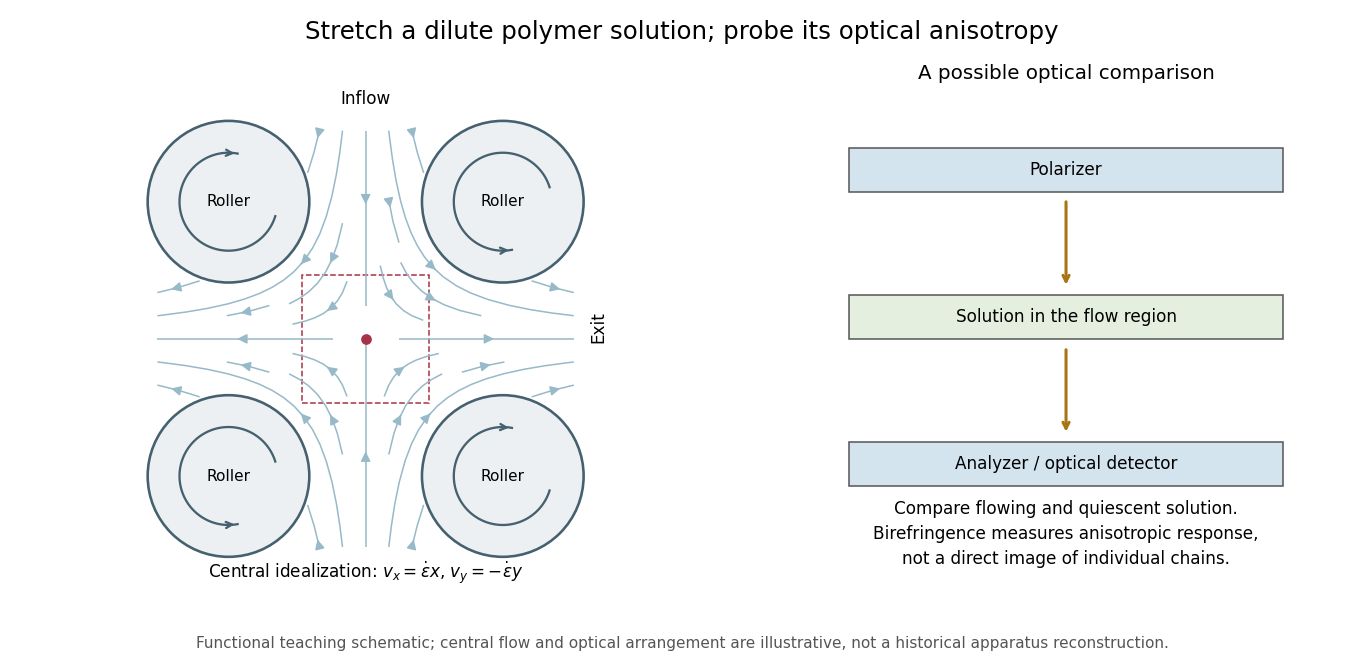
This original functional diagram shows a central flow idealization, rather than historical dimensions or a photograph. A probe of birefringence detects different optical responses along different directions; it does not directly photograph a chain or establish its extension without an optical model. Comparing a flowing solution with its quiescent state and controlling temperature and concentration are useful proposed checks, not an assertion that this is the complete historical protocol.
An original local flow model has velocity for constant extensional strain rate . Its divergence is zero, and its trajectories satisfy the displayed equations. Material approaches along and leaves along . If the idealized observation region ends at , a trajectory starting at has residence timeFor chosen , and , this is . Starting ten times farther from the symmetry line halves this particular residence time. The mathematical trajectory never exits in this model; diffusion, imperfect flow and finite apparatus prevent treating that ideal trajectory as a guaranteed infinite exposure in an experiment.
Represent one polymer by two beads joined by an ideal linear entropic spring, and stipulate a dimensionless conformation tensor with equilibrium value . The displayed model uses velocity gradient and positive polymer relaxation time . It omits finite chain extensibility, interactions with other chains, and feedback from the polymer onto the flow. It is a teaching model, not a fitted description of Keller's apparatus.
Define the Weissenberg number for this model as and dimensionless time . With an initially isotropic , the diagonal entries obeyBelow , both transverse and longitudinal responses approach positive finite steady values:For a chosen , and : the longitudinal mean-square separation is five times its quiescent value, while the transverse separation contracts. A root-mean-square length grows as the square root of a variance, so the longitudinal length factor is , not five. The anisotropy is an orientational indicator; converting it to measured birefringence requires an additional calibrated optical relation.
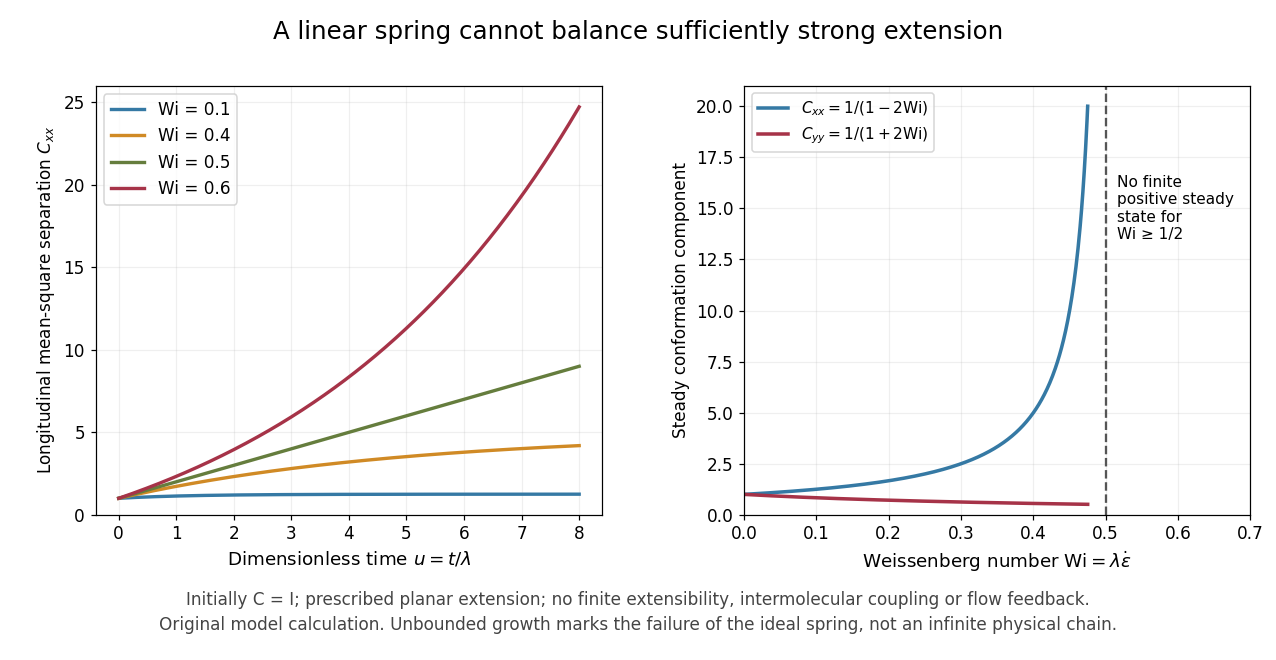


At , . Above that value, the growing homogeneous solution prevents a positive finite steady state. For instance, gives . Real chains have finite contour lengths, so this growth identifies the failure of the linear spring model. It does not establish a universal threshold for arbitrary flow histories, finite chains or other definitions of polymer relaxation time. Combining the growth equation with residence time in planar extension also explains why a large instantaneous Weissenberg number alone does not guarantee a strongly stretched exiting chain.
Articles by others on the same topic
There are currently no matching articles.