Collection geometry in nail-transmission measurements specifies which light emerging from a nail plate reaches the detector. A narrow forward detector and an integrating sphere can report different signals from the same specimen because light scattering redistributes directions. The reported transmittance must identify its collection conditions.
The primary 1983 nail study measured total transmitted radiation at fifteen wavelengths from 300 to 600 nm through thirteen autopsy toenails, using a monochromator, integrating sphere and photodiode.[ref]
The transmission of optical radiation through human nails by S. G. Parker and B. L. Diffey. Abstract, specimen set and apparatus
The angular collection is part of the measurement, alongside the wavelength and the separate correction for fluorescence.An original angular model separates on-axis direct transmission from a diffuse transmitted fraction . Suppose the diffuse component has constant radiance over the outgoing hemisphere. A detector accepting all azimuths up to angle from the surface normal collects the fractionThe cosine accounts for projected emitting area. Assuming the direct beam is entirely collected, . This is a constructed angular distribution, not a measured scattering law for nails.
At stipulated , and degrees, and the detected fraction is 0.06 although total transmission is 0.12. Aperture-dependent diffuse transmission in nail measurements also depends on distance. For a small emitting region facing a circular aperture of radius at distance , in this model. With mm, distances 10 and 20 mm give approximately 0.0560 and 0.0447 for measured transmission, respectively, without a specimen change.
An integrating sphere collects a much broader angular distribution, but its ports, coating and detector coupling still require characterization. A useful comparison holds the specimen, incidence and spectral band fixed while changing collection aperture or recording angular response. Correcting fluorescence does not recover scattered light that was never collected, and a calibration made in one geometry does not automatically apply in another.
Aperture-dependent diffuse transmission in nail measurements is the change in measured transmittance caused by accepting different outgoing directions from a nail plate. The material can remain unchanged while the collected fraction changes. The relevant quantity is the optical acceptance, not aperture area alone.
For an original geometric model, take a small emitting region with constant diffuse radiance, viewed by a coaxial circular opening of radius at distance . Its limiting angle obeys . Projected-area weighting gives the accepted diffuse fractionIf the direct beam is fully collected, a direct fraction and a total diffuse fraction produce . This assumes geometric propagation and negligible finite-source and diffraction effects. In particular, the direct-beam assumption is not valid for an arbitrarily small physical opening.
At stipulated mm, and , openings of radius 5 and 10 mm collect and 0.50. The respective measured fractions are 0.056 and 0.080, although total transmittance is 0.12 in both cases. Doubling the aperture radius quadruples its area but does not quadruple the collected diffuse fraction.
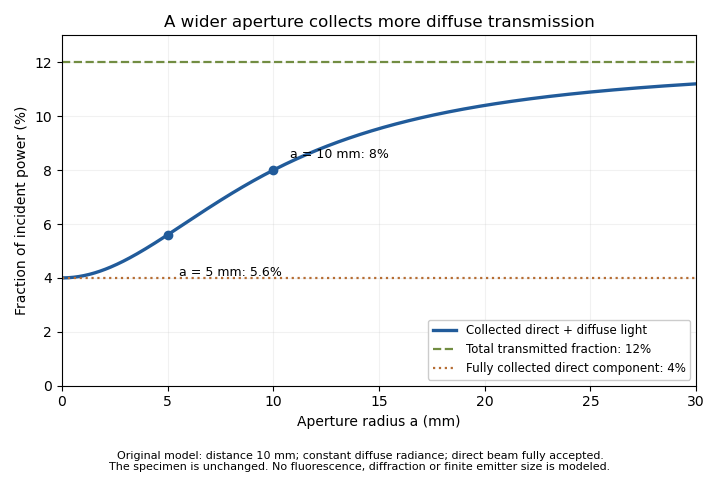
An unchanged hypothetical nail specimen gives different measured transmission as collection radius changes
. Original constant-radiance geometric model at distance 10 mm. The direct fraction is 4 percent and the diffuse fraction is 8 percent. These are stipulated values, not measured human-nail data. Details.
An aperture-scan separation of direct and diffuse nail transmission needs distinct acceptances and a stable angular model. In the ideal two-aperture case,For the stated values, the two measurements recover 0.08 and 0.04. Nearly equal acceptances amplify measurement differences by a large factor. Changing distance or source size during the scan would change the model as well as the acceptance.
The primary nail experiment used an integrating sphere with a monochromator and photodiode to measure transmitted radiation.[ref]
The transmission of optical radiation through human nails by S. G. Parker and B. L. Diffey. Abstract, collection apparatus
The sphere provides a different angular collection arrangement from this opening model; it does not establish the assumed diffuse radiance law. A useful comparison characterizes each detector geometry before interpreting a signal difference as a change in the nail plate.Aperture-scan separation of direct and diffuse nail transmission estimates the directly collected and diffusely transmitted fractions of light by changing detector acceptance while keeping the nail plate and illumination fixed. Separation depends on a stated angular model: a change in aperture is an experimental control, not a direct label attached to every photon.
In the original constant-diffuse-radiance model, let , where is the fully accepted direct fraction, the total diffuse fraction and the known diffuse acceptance. For a coaxial circular opening, the geometric approximation gives . Two distinct acceptances giveThe distinction between these components is identifiable within this model only when the acceptances differ.
Suppose , , and . The fitted fractions are and . If independent signal errors each have standard uncertainty , with acceptance uncertainty temporarily neglected, linear propagation givesandThe resulting uncertainties are about 0.00943 and 0.00359. Their negative covariance matters when adding the components: the total-transmission uncertainty is about 0.00629, rather than the value obtained by incorrectly treating the fitted components as independent.[ref]
Guide to the expression of uncertainty in measurement by JCGM. §5.2.2, equation 13, covariance in propagation
Additional apertures give a straight-line fit of against , with intercept and slope . Weighted least squares can use independently characterized signal uncertainties. Systematic curvature would challenge the assumed angular law or fixed direct-beam acceptance. A plausible line alone does not prove that a finite source, changing geometry or residual fluorescence has been modeled correctly.
The primary nail-transmission study collected transmitted light using an integrating sphere, monochromator and photodiode.[ref]
The transmission of optical radiation through human nails by S. G. Parker and B. L. Diffey. Abstract, collection apparatus
The aperture scan here is an original proposed comparison, not a procedure or angular scattering law reported in that experiment. Articles by others on the same topic
There are currently no matching articles.