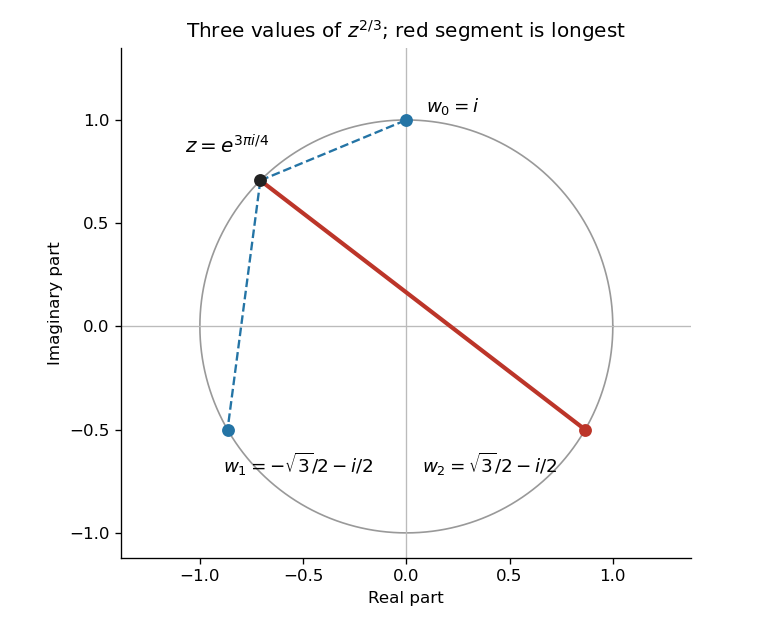
A branch of a multivalued analytic expression is a single-valued holomorphic function on a specified domain that consistently selects one of the expression's possible values. A branch cut is a convenient way to choose such a domain, rather than an intrinsic locus of singularities. On D=C∖(−∞,0], the principal logarithm supplies two square-root branches
For z=i, these give B+(i)=eiπ/4=(1+i)/2 and B−(i)=−(1+i)/2. Their derivatives follow by differentiating B±2=z: B±′=1/(2B±), so B+′(i)=(1−i)/(22). There are exactly two branches on D: for any other holomorphic square rootB, the ratio B/B+ is continuous, takes values in {1,−1}, and hence is constant on the connected domain.
which are different. Thus parentheses in nested complex exponentiation cannot be dropped or moved. There is an additional issue when all complex logarithm branches are allowed: each nested operation must retain its own branch choices. In the first expression, the complete set of values is −ie−2πm, m∈Z; in the second, it is exp[i(π/2+2πm)e−(π/2+2πk)], k,m∈Z. The principal-value comparison already establishes nonassociativity; the multivalued sets make the role of branching explicit.
Here Arg is the chosen complex argument, and ImLogz∈(−π,π). One may conventionally assign aprincipal value on the negative real axis, but that axis is excluded from this holomorphic domain. [ref]
For z=0, every logarithmic value is log∣z∣+i(argz+2πk) with integer k. Multiplying by z and taking the real part proves the displayed formula for the modulus of each value of complex exponentiation. For nonreal z, these values form ageometric progression with nonunit positive ratio e−2πImz. For real nonzero z, changing the logarithm branch changes only the phase and leaves the modulus fixed. A fixed initial argument changes only the indexing of the set of values.
Every value is positive and real. If the power is defined using the principal logarithm, the single value is e−π/2. Keeping the logarithm branch explicit distinguishes this value from the full multivalued set.
One must retain the parentheses: complex exponentiation is not associative. If all complex logarithm branches are allowed, the inner values are e−π/2−2πk. Taking the outer logarithm with an independent integer branch index ℓ yields exp[−iπ/2−2πik−2πℓ]=−ie−2πℓ. Thus the complete multivalued set is {−ie−2πℓ:ℓ∈Z}, and the boxed answer selects its principal evaluation.
The principal complex exponentiation gives zi=e−θeilogr. Equality to one requires its complex modulus to be one, hence θ=0, and then its complex argument requires logr∈2πZ. Thus all solutions are positive real, namely
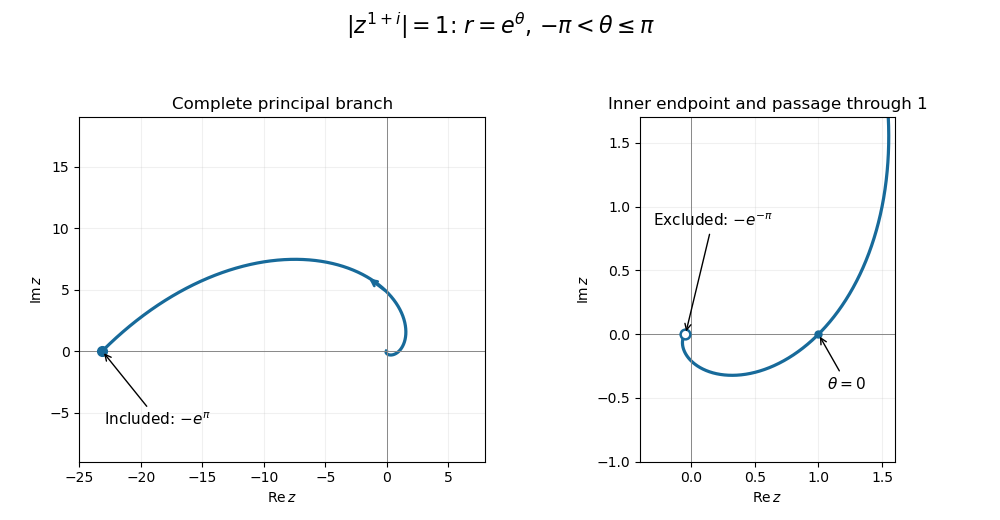
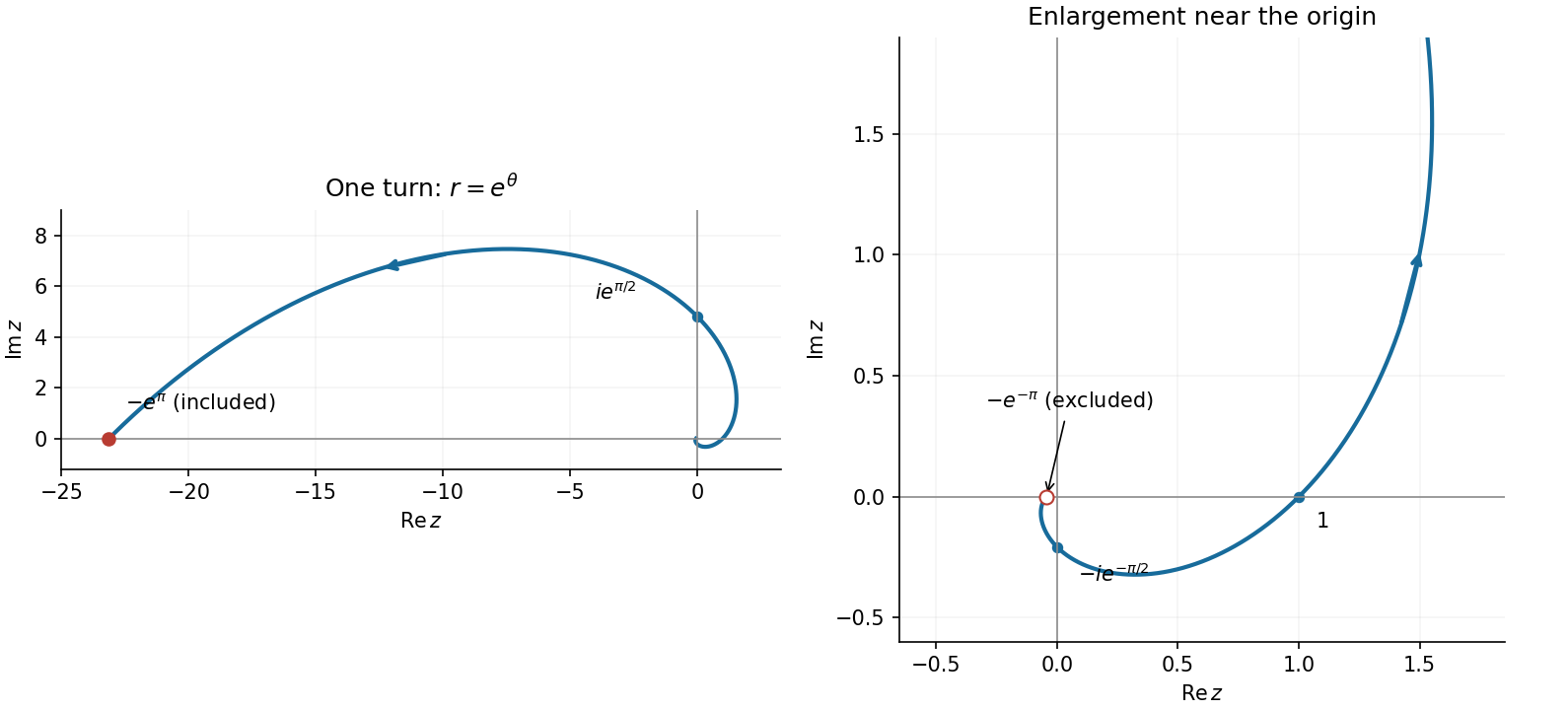
This is one turn of a logarithmic spiral, with increasing radiusas the polar angle increases. It passes through 1 at θ=0, approaches the excluded endpoint −e−π from below the negative real axis, and ends at the included endpoint −eπ from above that axis. The endpoint distinction follows from the chosen principal complex argument.
If all branches are requested, i also has the negative of its principal value, and the complex logarithm of −e is 1+i(π+2πk). Allowing nonprincipal logarithms of the positive base 2 gives e−2πkeiln2. Finally, all values of (ii)i are −ie−2πm, for integers k,mas appropriate. These alternatives do not alter the principal-value table.
As θ increases, it runs from the negative real axis near radius e−π through −ie−π/2, 1 and ieπ/2 to the negative real axis at radius eπ. The angle increases by one complete turn. Using the conventional principal argument−π<θ≤π, the inner negative-axis endpoint is excluded and the outer endpoint is included. The convention −π≤θ<π reverses those endpoint choices. If both limiting arguments are admitted by the paper's wording, both limiting endpoints are drawn; the interior curve is the same. The origin is never included because the complex logarithm is undefined there.
Choosing the principal complex logarithm at both stages gives the particular value −i. The independent logarithmchoices are needed because the question asks for all possible values.
Equivalently these are rReze−Imz(θ+2πk). If z is real and nonzero the modulus is the single value rRez; otherwise the values form ageometric progression with ratio e−2πImz. Changing the initially chosen argument just reindexes the same set. The logarithmic definition excludes z=0. This is the modulus of a complex self-power.
The large arc is O(Rs−1) and the small arc is O(ϵs+1), so both vanish. On the negative real segment, zs=eiπs∣z∣s; accounting for the direction of traversal, the two real segments therefore sum to (1+eiπs)I, where I is the desired positive-axis integral. The residue theorem gives