Composite Simpson's rule applies Simpson's rule to consecutive pairs of equal subintervals. Choose a positive even integer , put , and take quadrature nodes for . There are subintervals, two-subinterval panels, and quadrature nodes. ThenThe second sum is empty when , recovering one panel. The quadrature weights, before multiplication by , are . Every interior even-indexed quadrature node is an endpoint of two panels, so its two endpoint contributions add to two; every odd-indexed quadrature node is a midpoint with weight four. An odd cannot be covered by these pairs. The displayed formula requires equal spacing.[ref]
5.6 Numerical integration. Fundamentals of Numerical Computation by Tobin A. Driscoll and others; §5.6, equations 5.6.20–5.6.21: elementary and composite Simpson formulas
For the exponential function on the interval , the exact integral is . With , the formula gives , an overestimate of about . With , it gives , an overestimate of about . The figure shows the intermediate refinements and compares every computed absolute error with the error bound for composite Simpson's rule.
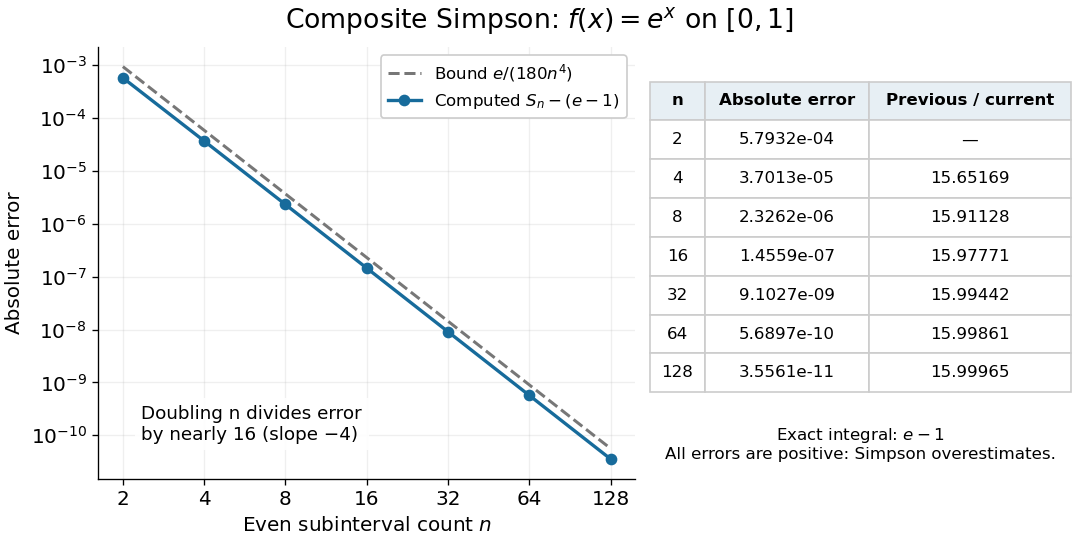
Computed composite Simpson errors for the exponential function on zero to one approach fourth-order convergence; the dashed curve is the rigorous bound e over 180 n to the fourth power
. Details. 
For this exponential function, a geometric series also gives a compact independent formula. With and , summing the panel contributions yieldsA Taylor series at givesThe Big O notation describes the remaining terms as tends to zero. Consequently tends to sixteen: the computed ratios increase from about to . Fourth-order truncation error is also obtained by Richardson extrapolation of the composite trapezoidal rule.[ref]
5.6 Numerical integration. Fundamentals of Numerical Computation by Tobin A. Driscoll and others; §5.6.2, equations 5.6.14–5.6.15: Simpson extrapolation and fourth-order error
Suppose has a fourth derivative that is a continuous function on the interval , and there. With , the signed quadrature error here is . Then, for some point ,In particular, a strictly positive fourth derivative makes : composite Simpson's rule overestimates the integral.[ref]
The bound's scale follows by adding the panel errors. A panel of width has signed quadrature error and absolute error at most . There are panels, so the triangle inequality gives . The intermediate value theorem for the continuous fourth derivative replaces the average of the panel values by a single value , giving the signed formula.
The underlying single-panel calculation can be seen through the Peano kernel theorem. On the interval , define the raw Peano kernel , where is integral minus Simpson's rule and is the positive part. Then for and for . It is strictly negative inside the interval and has integral . ThusThe uniform norm bounds the fourth derivative. The polynomial attains equality. Scaling to endpoint spacing multiplies the coefficient by , giving the sharp single-panel bound . The normalized Peano kernel is , so the external factorial must be omitted when using that normalization.
For the exponential function on , , so and the bound is . Its leading actual absolute error is , smaller than the bound because a uniform upper bound on the fourth derivative does not use its variation across the interval. The theorem bounds truncation error with exact function evaluations; sample errors and roundoff error are additional contributions, as described by noise sensitivity of a quadrature rule.
Articles by others on the same topic
There are currently no matching articles.