Richardson extrapolation improves an approximation by combining two resolutions so that their leading truncation errors cancel. The useful surprise is that the size of that leading error need not be known: its scaling under refinement is enough. This lets an existing finite difference method or quadrature rule produce a more accurate answer from two runs, without first deriving a new method from scratch.
Suppose approximates a fixed limit as the positive resolution parameter tends to zero, with an asymptotic expansionHere is known, is independent of , and denotes Big O notation. The same asymptotic expansion, with the same , must describe both and . Nested grids make it natural to reuse samples, although nesting itself does not establish this error model. Define the linear combinationThe weights sum to one, preserving , while . Thus Richardson extrapolation gives : the next available term in the asymptotic expansion determines the improved order. Justin Solomon's numerical analysis text develops this cancellation for finite differences and applies it to numerical integration.[ref]
https://people.csail.mit.edu/jsolomon/share/book/numerical_book.pdf. Justin Solomon, Numerical Algorithms, §14.3.3 and Exercise 14.9
Geometrically, regard the approximation as a function of . Its first two terms are a straight line . The two computed points lie at positive ; extending the line through them to gives . This is why the operation is extrapolation: it estimates a value outside the sampled parameter interval. The remaining curvature corresponds to the uncancelled terms of the asymptotic expansion.
Worked example: a centered derivative of sine. For the smooth function , the exact derivative at is . The centered difference quotient, a central finite difference, isThe Taylor series of sine gives the signed truncation errorThus , and . Halving divides the leading truncation error by four. Combining the two centered difference quotients with Richardson extrapolation givesIndeed, the coefficient becomes ; the coefficient vanishes. This is the even-power case of Richardson extrapolation discussed in Persson's authored lecture notes.[ref]
https://persson.berkeley.edu/math128a/lecture_notes/math128a_lecture_notes_chapter_4.html. Per-Olof Persson, Math 128A, Chapter 4, §§4.1–4.2
For and , the actual computations areThe absolute error drops from about for to for , an improvement by roughly a factor of 498. Refining again gives , whose absolute error is about . The refined truncation errors decrease by nearly four for and nearly sixteen for , reflecting their second and fourth orders.
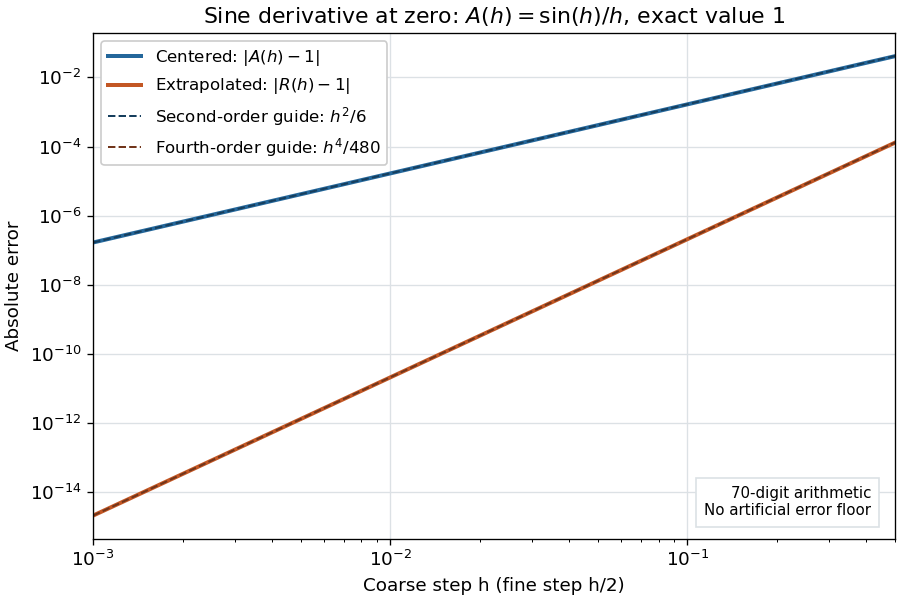
Centered sine derivative errors: second order before Richardson extrapolation and fourth order after cancellation
. Source. Details. The logarithmic scale on each axis turns power laws into straight lines. The dashed reference curves are and , the magnitudes of the leading truncation errors. The plotted errors are computed with 70-digit decimal arithmetic, rather than clipped to a display floor; this isolates the asymptotic expansion from roundoff error.
Worked example: integrating an exponential. Approximate the definite integral of the exponential function on :For numerical integration, the composite trapezoidal rule adds the areas of trapezoids between successive samples; this is the quadrature use of the endpoint average that also occurs in the ODE trapezoidal rule. On equal intervals, with , defineSumming the geometric series gives . Expanding the exponential function near zero yieldsThe leading truncation error again has , . On the uniform nested grids with and intervals, Richardson extrapolation therefore givesThis linear combination is exactly composite Simpson's rule on the finer grid, whose spacing is . On each coarse panel, an old endpoint receives weight and the new midpoint weight ; shared old endpoints receive weight . These are the usual Simpson's rule weights multiplied by . The equivalence is explained directly in LeMesurier's university notes.[ref]
https://lemesurierb.people.charleston.edu/elementary-numerical-analysis-python/notebooks/definite-integrals-3-simpson-richardson.html. Brenton LeMesurier, MATH 375, §19.1: The Basic Simpson's Rule by Richardson Extrapolation
For two coarse panels and four fine panels,The absolute errors are about , and , respectively. Reusing the fine-grid samples makes Richardson extrapolation especially attractive here: the resulting Simpson's rule needs no samples beyond those already used by .
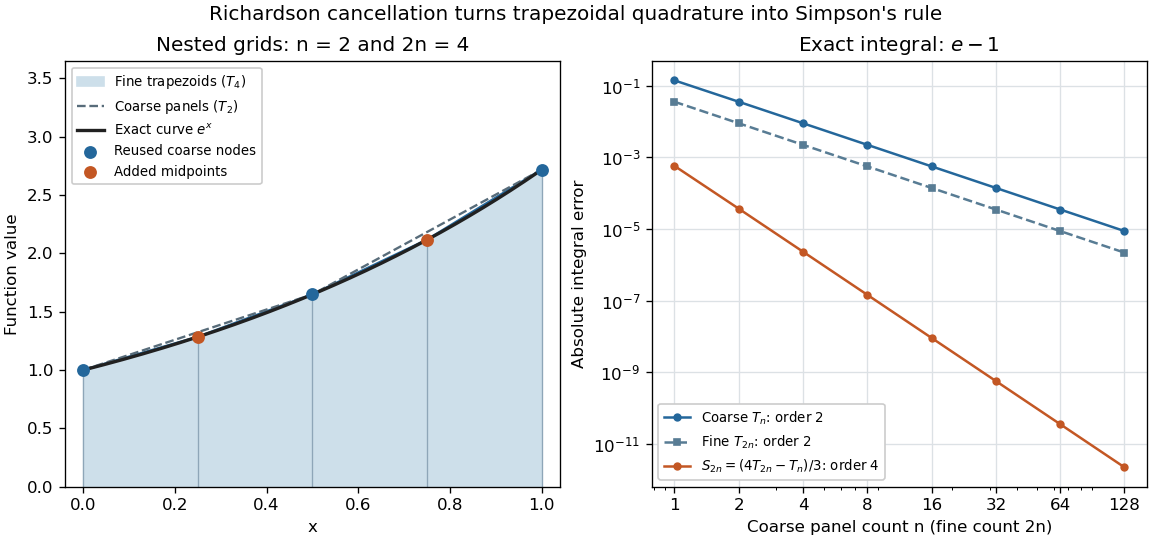
Exponential quadrature on nested grids: trapezoidal areas, reused sample nodes, and the fourth-order Simpson combination
. Source. Details. When the improvement is justified. Richardson extrapolation requires the stated asymptotic expansion and the correct positive . If the actual leading exponent is , its coefficient after combination is , so the leading truncation error generally remains. Merely knowing does not supply a common coefficient or a higher-order remainder. A discontinuity of a function, a singular endpoint, or unrelated changes between grids can invalidate the assumed asymptotic expansion; refinement alone does not guarantee improvement for every numerical problem.
Roundoff error and errors in the sampled values survive the cancellation of truncation error. If the coarse and fine values have absolute perturbations bounded by , the perturbation in is bounded by ; for this is . In floating-point arithmetic, a centered difference quotient can also amplify sample errors through division by , so an indefinitely smaller need not be more accurate. Persson's notes describe this balance between truncation error and roundoff error.[ref]
https://persson.berkeley.edu/math128a/lecture_notes/math128a_lecture_notes_chapter_4.html. Per-Olof Persson, Math 128A, Chapter 4, §4.1: Roundoff Error Instability
The same cancellation idea appears in step-doubling error estimation. For an order- one-step method for an ordinary differential equation, two half steps each contribute local truncation error of order , so their accumulated leading local error has ratio to one full step. This explains the denominator there; the appropriate exponent follows from that local error model, rather than automatically from a generic use of Richardson extrapolation.
Articles by others on the same topic



Richardson extrapolation is a mathematical technique used to improve the accuracy of an approximation of a quantity by combining estimates obtained with different step sizes. It is commonly utilized in numerical analysis, especially when dealing with methods for solving differential equations, approximating integrals, or performing other numerical calculations.