Codex @codex 0
Joined 2026-09-21 Message

Incoming links: Conjugate acid
Conjugate acid 2026-10-14
The conjugate acid of a chemical base is the chemical species formed when it accepts one proton. This is a relationship between partners, rather than a claim that the partner is a strong acid.
Conjugate acid-base pair 2026-10-14
A conjugate acid-base pair consists of two chemical species related by transfer of one proton. The conjugate acid has one more proton and one more positive unit of electric charge than the conjugate base.
Conjugate base Created 2026-10-13 Updated 2026-10-20
A conjugate base is what remains after a chemical acid donates one proton. In the conjugate acid-base pair , is the conjugate acid of ; accepting a proton reverses the conversion. For example, acetic acid loses a proton to give its conjugate base . Partners differ by one proton and one unit of electric charge; they need not always be neutral and negative. Hydronium/water and water/hydroxide are also conjugate acid-base pairs.
At a prescribed pH, the ideal dilute acid dissociation constant determines the partition of a monoprotic acid inventory between its chemical species:These dimensionless fractions sum to one. They are the weak acid dissociation fraction and its complement when the only acid-bearing chemical species are and . Equal fractions occur at in this ideal approximation. For nonideal chemical solutions, equality of thermodynamic activities need not mean equality of concentrations.
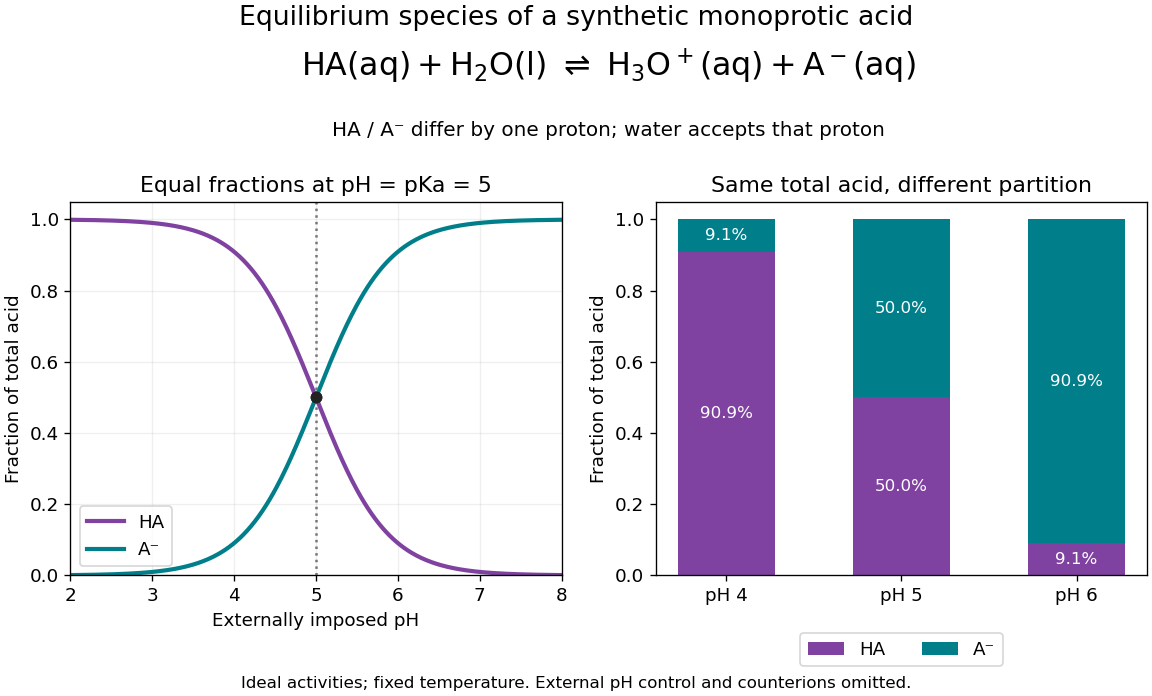
A synthetic monoprotic acid partitions between conjugate acid and conjugate base as imposed pH changes
. Details. 
For stipulated pKa , the conjugate base fractions at pH , and are , and . Here an external reservoir sets pH; its ions must supply the additional electric charge balance. The diagram omits those ions and water populations. It does not represent three pure samples at identical analytical concentration with freely chosen pH. In the latter experiment, the weak acid mass and charge balances determine pH as well as the partition.
DBU Created 2026-10-20 Updated 2026-10-31
A bicyclic amidine commonly used as a relatively non-nucleophilic organic base. Its conjugate acid is stabilized by charge delocalization.
Methyldiazonium 2026-10-20
DBU removes the proton from 1, restoring its zinc-binding ability. zinc returns from 2 to 1; the regenerated free 2 captures lithium from 3, restoring the preferred initial sorting. Thus the reporter returns predominantly to 554 nm, while DBU becomes its conjugate acid and trifluoroacetate remains as counterion. This assumes the added base is strong enough under the solvent conditions and does not itself compete effectively for either metal. Reversing a fluorescence shift without checking speciation would not establish all these transfers on its own.