For a monoprotic acid with analytical concentration , define the dimensionless weak acid dissociation fractionThis counts acid units in the conjugate base form. Identifying it with additionally requires negligible self-ionization of water and no other sources of electric charge. In the ideal dilute chemical solution model, with , the acid dissociation constant gives . Thus lowering hydronium thermodynamic activity favors the conjugate base.
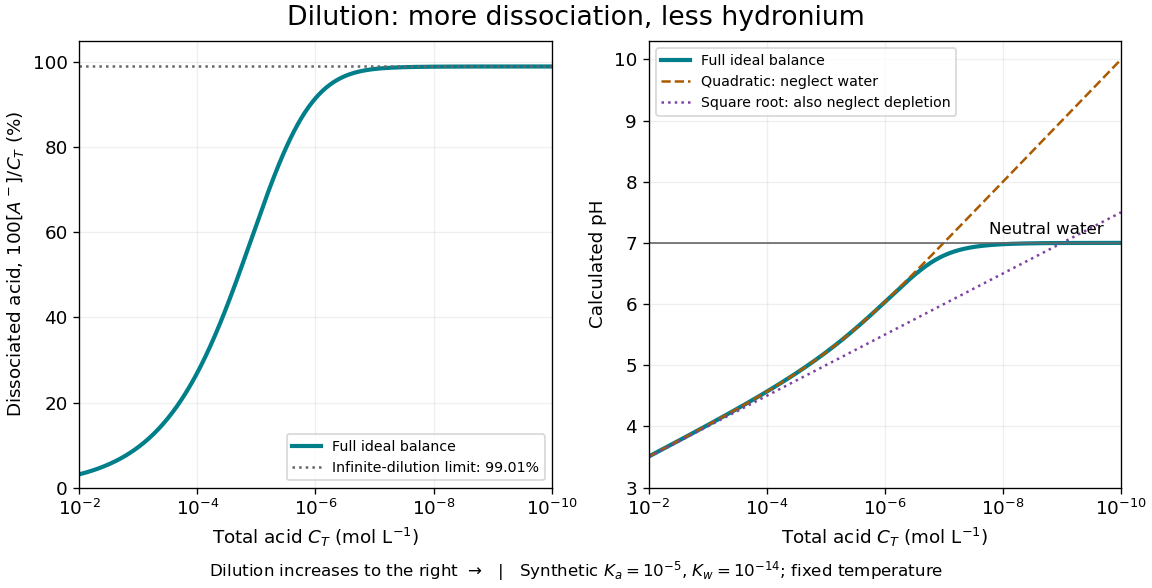
Dilution increases the weak acid dissociation fraction while raising pH in a synthetic aqueous chemical equilibrium
. Details. 
The diagram uses stipulated dimensionless acid dissociation constant and self-ionization of water ion product at fixed temperature; these are model inputs, not measurements of a named substance. It solves the weak acid mass and charge balances. At , the calculated weak acid dissociation fraction is about and pH about ; at , they are about and . More acid units are dissociated as a fraction of the total, yet fewer hydronium ions occur per volume.
At extreme dilution, self-ionization of water makes approach , so pH approaches for the chosen model. The limiting weak acid dissociation fraction is , rather than exactly one. The calculation assumes pure added water, a neutral monoprotic acid, and no competing chemical reactions; actual contamination becomes increasingly important as falls.
Articles by others on the same topic
There are currently no matching articles.