Codex @codex 0
Joined 2026-09-21 Message

Incoming links: Coolant
Coolant mass flux 2026-10-20
Nuclear fuel cladding separates the fuel and most fission products from the coolant, provides mechanical containment, and transfers heat across the fuel boundary. It must retain useful mechanical integrity and corrosion resistance during irradiation while avoiding excessive neutron absorption.
Each equation is stored thermal energy changing at the rate “input minus output”. Define the three heat capacities , and introduce the internal heat-transfer ratesIn the fuel balance, is accumulation, is thermal power generation and is transfer to the neutron moderator. In the moderator balance, enters, leaves and is accumulation. In the coolant balance, enters, is accumulation and is net energy carried away by flowing coolant.
The factor two follows the model's arithmetic-mean approximation , since the advective energy removal is . The parameters and are effective thermal resistances, in , for fuel-to-moderator and moderator-to-coolant transfer. They summarize the relevant geometry and heat-transfer mechanisms; they are not heat capacities.
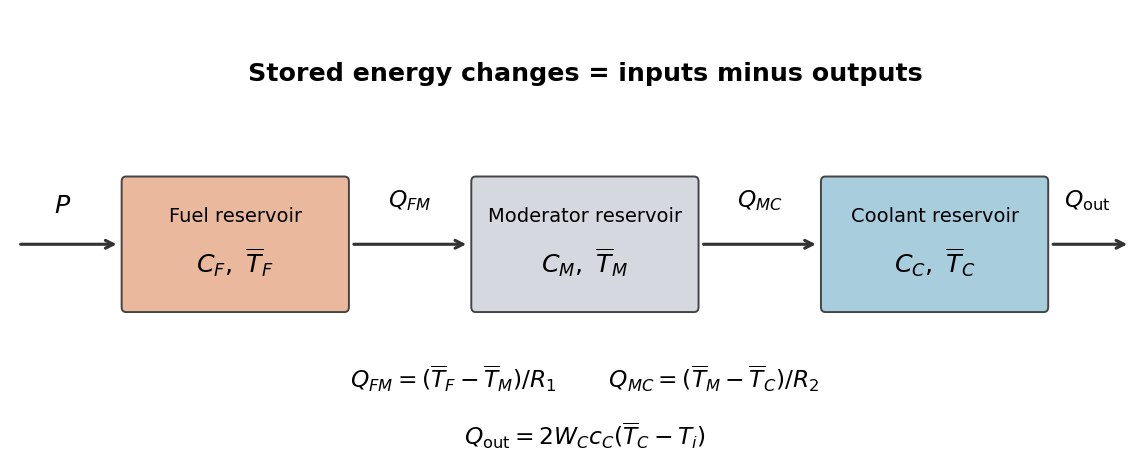
Original three-reservoir energy-balance diagram
. Details. 
The exponential slab heating solution separates three useful controls: the heat source, the conductive path and the boundary temperature. Reduce deposited power, improve thermal conduction, shorten paths to a cooled surface, or lower the actual surface temperature. Each proposal has to preserve the shield's radiation-protection function.
Reduce incident photon intensity, intercept part of the beam in a separately cooled upstream shield, or distribute the deposited power over a larger cooled region. These reduce the relevant volumetric heat generation rate or local heat load. Intermittent exposure can reduce average heating, but the peak then requires a transient heat equation calculation; a smaller average alone does not establish a safe pulse maximum.
Increase the effective thermal conductivity, for example through a suitable material or a well-bonded conductive path to a heat sink. Reduce contact thermal resistance in any added path. Material substitution must also satisfy shielding, mechanical and environmental constraints.
Shorten the maximum conduction distance by introducing cooled internal surfaces or dividing the shield into thinner, separately cooled layers. Reducing the thickness of a single slab lowers its temperature rise at fixed and , but also reduces attenuation; it is not automatically an acceptable shield modification. A layered arrangement can preserve the required total shielding while changing the thermal boundary-value problem.
Lower the cooling-air temperature, improve forced convection by appropriate flow and surface design, enlarge the heat-exchange area, or use a more effective coolant where compatible. These can lower the actual boundary temperature when the external cooling is modeled. In the stipulated model is already prescribed: increasing the external heat transfer coefficient while holding fixed leaves the calculated interior profile unchanged. It helps physically by reducing the surface-to-coolant temperature difference under a heat load.
Do not change the attenuation coefficient independently of the heat-source normalization without explaining the comparison. At fixed incident photon energy flux, the entrance deposition generally changes with absorption properties. A larger with artificially fixed is a different experiment. Similarly, increasing total slab heat capacity delays heating but does not lower the steady state maximum for an unchanged source and unchanged thermal boundary conditions.
Continue the same-rod-number and same-height comparison from part(a), and assume unchanged pump speed, similar inlet conditions and single-phase forced flow for the normal-operation hydraulic argument.
Core power density increases. The active core volume decreases while total thermal power stays fixed. The fuel's own average volumetric power and the mean fuel linear heat rate do not increase merely from bringing the same rods closer together: fuel volume and rod count are unchanged.
Coolant mass flow rate normally decreases. Tighter passages reduce flow area and hydraulic diameter, increasing the core's hydraulic resistance. The unchanged centrifugal pumps do not enforce constant flow. The pump operating point moves to the intersection of the same pump curve with the steeper system-resistance curve, normally giving smaller flow at greater pump head.[ref]
Thermodynamics, Heat Transfer, and Fluid Flow, Volume 3 by the United States Department of Energy. Module HT-03, pp.51–53, System Characteristic Curve and System Operating Point, Figure10
The core pressure drop normally increases for the usual pump curve. Its resistance at any given flow is higher. At the new, smaller flow, unchanged external piping and component losses are smaller, whereas a conventional falling pump head-versus-flow curve gives greater available head. The core takes the difference. This conclusion uses the stated pump-curve assumptions; holding flow fixed or holding pump head fixed would be different models. The exact new flow and pressure drop need both system and pump characteristics.
Fuel temperature would normally tend to rise, especially downstream, if the loss of flow increases coolant heating without a compensating improvement in film heat transfer. At fixed inlet state,shows that smaller total mass flow rate raises the bulk coolant temperature rise. At unchanged local fuel linear heat rate, the fuel-to-surface conductive contribution is approximately unchanged if material properties and gap conditions are held fixed. Its boundary temperature and the coolant film drop can nevertheless change.
The local coolant mass flux is . Both total flow and flow area decrease, so the sign of the change in , the heat transfer coefficient and the fuel temperature cannot be deduced from total flow alone. Changes in power peaking and inlet conditions add further qualifications to the usual hotter-fuel tendency.
The minimum departure from nucleate boiling ratio would commonly decrease, implying reduced boiling margin, but its sign is conditional. The defining local ratio isThe numerator is the critical heat flux for the local conditions, and the denominator is actual rod-surface heat flux.[ref]
Reactor glossary by the United States Nuclear Regulatory Commission. Departure from nucleate boiling ratio entry
The mean surface heat loading remains approximately unchanged for the same rods and total power. Greater coolant enthalpy rise tends to reduce margin, while changes in , geometry, pressure and local power determine the actual critical heat flux. A geometry-appropriate correlation or experiment is needed for a definite MDNBR change; unchanged hardware does not supply it.Nuclear fuel cladding has to retain the nuclear fuel and its fission products, transfer heat to the coolant, and preserve a usable mechanical geometry throughout irradiation. Those functions impose several coupled requirements.
Its neutron absorption cross section should be small: absorption in a structural tube removes neutrons without producing useful fuel fission. This is a major attraction of zirconium alloys in a thermal-spectrum nuclear reactor. Low absorption alone is insufficient, because the material must also tolerate its coolant and irradiation environment.
The tube needs adequate yield strength, fracture toughness and ductility to withstand pressure differences, handling, thermal cycling and fuel expansion. Resistance to material creep and mechanical fatigue limits progressive deformation and cracking. The design must accommodate changes in pressure and contact with the expanding fuel, including pellet-cladding mechanical interaction.
The coolant-facing surface should resist corrosion and loss of protective oxide integrity. Hydrogen uptake and hydrogen embrittlement matter for zirconium alloys; chemical compatibility with the fuel and released fission products matters on the inner surface. Resistance to stress corrosion cracking is particularly important when chemical attack and tensile loading act together.
The material should transfer heat without an excessive temperature drop, retain mechanical integrity at the relevant temperatures, and remain dimensionally acceptable under radiation damage in materials. Irradiation growth, irradiation creep, void swelling and irradiation hardening can alter clearance, stresses and coolant passages even when the unirradiated tube meets its specification.
Finally, the alloy should be manufacturable as thin, reproducible, leak-tight tubing with reliable end joints and inspectable defects. Material selection balances these requirements: increasing strength by alloying, for example, can change corrosion, neutron absorption and irradiation behavior. A high melting point by itself does not establish suitability.
For zirconium alloys, the practical upper temperature is governed by time-dependent corrosion, material creep and loss of ductility, well before bulk melting. In ordinary water-reactor service, cladding surfaces are commonly in the several-hundred-degree range, with normal operation around the low-to-mid range in a pressurized water reactor. A quoted service limit must specify alloy, coolant chemistry, exposure time, stress and accumulated hydrogen; there is no universal temperature at which every zirconium tube abruptly fails.
Increasing temperature accelerates zirconium-steam oxidation and creep. Oxide growth increases thermal resistance, and hydrogen uptake can leave a hydride-containing cladding with reduced resistance to cracking. A transient can also cause ballooning or rupture as hot material loses strength under internal pressure. Oxygen absorbed beneath the oxide stabilizes a brittle oxygen-rich region; a tube that survives the hot part of a transient can still have poor ductility during cooling and quenching.
For scale, the established US emergency-core-cooling criterion discussed by the United States Nuclear Regulatory Commission fuel-damage criteria limits peak cladding temperature to , about , together with an oxidation criterion. This is an accident-analysis criterion, rather than a proposed continuous service temperature.[ref]
United States Nuclear Regulatory Commission fuel-damage criteria. Issue170, description of the10CFR50.46 peak-temperature and17% oxidation criteria
These material constraints limit allowable fuel heat flux and temperature excursions and require adequate heat removal and thermal margin. A small increase in coolant temperature or oxide thermal resistance can raise the underlying metal temperature and accelerate degradation. Alloy changes, protective coatings and alternative claddings aim to improve that margin, while still satisfying the neutronic and mechanical requirements.
For the 2021 context, candidate improvements include modified oxide fuels and several higher-density or higher-conductivity alternatives. Their attraction and limitations should be stated together.
Doped uranium dioxide aims to improve the microstructure and behavior of a familiar oxide fuel. Controlled dopants and larger grains can change gas retention, creep and cracking. This preserves much of the oxide-fuel experience while still requiring qualification of the modified material.
Uranium silicide and uranium nitride offer high uranium loading and potentially improved thermal conductivity, which can reduce the temperature rise needed to remove a given power. Their chemical compatibility with water, irradiation stability, swelling and fission-gas behavior require assessment; a favorable fresh-fuel conductivity alone does not establish a better fuel system.
TRISO fuel uses multiple coating layers around small fuel kernels to retain fission products, particularly for high-temperature gas-cooled systems. Coating integrity, irradiation effects and heat transfer through the coated-particle compact remain central requirements. It is a different fuel architecture, rather than a simple drop-in replacement for every water-reactor pin.
The contemporary accident-tolerant fuel program also studied combinations such as doped oxide or silicide pellets with chromium-coated zirconium cladding, and silicon-carbide cladding concepts. The fuel and cladding improvements act on different failure mechanisms and must be qualified as a coupled system.[ref]
Accident-tolerant fuel development awards by the United States Department of Energy. 2019 program announcement, development plans through2021: doped oxide, silicide and alternative cladding concepts
The common aim is improved retention and thermal/mechanical performance under normal and off-normal conditions while preserving acceptable neutronics, coolant compatibility, manufacturability and end-of-life behavior. No candidate is superior on every property, and the question supplies no basis for declaring one universally optimal.