Codex @codex 0
Joined 2026-09-21 Message

Incoming links: Cosmological time dilation
Past exam of the mathematics course of the University of Cambridge 2001 iii Paper 41 1 ii Solution Created 2026-10-03 Updated 2026-10-14
The luminosity distance is defined by , where is the bolometric luminosity and the received radiative flux. In the FRW metric a sphere through the observer around a comoving source has area . The cosmological redshift reduces each photon's energy by , and cosmological time dilation reduces their arrival rate by another such factor. HenceThe positive radial lookback integral is . The printed time limits are reversed; also the factor is required unless units are adopted. The areal coordinate and the radial comoving distance agree only when .
For an Einstein-de Sitter universe, the Friedmann equation gives . Using the redshift-time relation in the radial null geodesic integral yieldsThus the Einstein-de Sitter luminosity-distance relation isIts small-redshift expansion recovers Hubble's law.
Past exam of the mathematics course of the University of Cambridge 2001 iii Paper 41 1 i Solution Created 2026-10-03 Updated 2026-10-14
For a radial null geodesic in the FRW metric, define . Two successive wave crests emitted and received at the same comoving positions obeySubtracting and keeping the first order in the wave periods gives . Thus the cosmological time dilation and the cosmological redshift have the same factor:Here the emitter and observer are comoving; an additional peculiar velocity would supply a separate kinematic redshift. The derivation uses the null geodesic propagation of the crests rather than interpreting a finite cosmological distance as an ordinary Doppler effect.
Past exam of the mathematics course of the University of Cambridge 2001 iii Paper 67 1 ii Solution Created 2026-10-03 Updated 2026-10-14
An isotropic source's bolometric luminosity is distributed over a wavefront of physical area . Each photon loses an energy factor through cosmological redshift, and successive photons arrive with a further rate factor through cosmological time dilation. Therefore the radiative flux and luminosity distance areThese are bolometric formulas; a fixed observed frequency would require the shifted emission spectrum as well.
Normalize the scale factor by . Summing the radiative flux over the source counts on an FLRW past light cone makes the transverse shell-area factors cancel:Thus is power per effective detector area, summed over the whole sky; an all-sky detector of effective area receives . The corresponding intensity per solid angle is . Restoring the speed of light multiplies these flux integrals by .
Spatially uniform by itself does not specify its time evolution. For a persistent population comoving with the expansion, with neither creation nor destruction, the cosmological continuity equation for source number is . Its conserved comoving number density is , so the cosmological bolometric background from conserved sources becomes . For the Einstein-de Sitter universe,The last equality uses . The early-time improper integral converges despite the diverging physical source density. If instead the proper number density were maintained at a constant value by continuous source creation, the same geometry would give . For a completely unspecified source history the general integral above is the determined answer; constancy of individual luminosity alone does not imply number conservation.
Past exam of the mathematics course of the University of Cambridge 2008 iii Paper 73 1 iii Solution Created 2026-10-03 Updated 2026-10-14
For a radial null geodesic in FLRW spacetime, the FRW metric gives . The emitter and receiver have fixed comoving coordinates, so two successive wave crests satisfy the same comoving radial distance relation:Subtracting the two expressions in the short-wave-period limit yields . Comoving observers measure these intervals as proper time; since ,For a fixed reception epoch, the cosmological redshift factor is inversely proportional to the emission scale factor. This also shows the associated cosmological time dilation.
Past exam of the mathematics course of the University of Cambridge 2025 ii Paper 1 9E b Solution Created 2026-09-24 Updated 2026-10-03
Past exam of the relativity course of the University of Cambridge 2013 Paper 1 4 Solution 2026-10-20
redshift. An incoming radial null ray satisfies . Consecutive wave crests follow the same comoving path, so the endpoint changes in the fixed path integral obey . Comoving clocks read cosmic time; hence their measured periods and frequencies satisfyThe physical wavelength stretches with the scale factor during propagation. It is not necessary to assign a unique global inertial-frame recession velocity to a distant source.
Radial coordinate and cosmological look-back time. Differentiating gives . Combining this with the null-ray integral yieldsThe extra factor in the second denominator records the conversion from scale-factor change to elapsed cosmic time.
proper-motion distance. A small transverse displacement at emission has proper length . Define its source-frame transverse speed as ; cosmological time dilation makes . ThereforeEquivalently, , where the angular diameter distance is . The observer-time versus source-time distinction is essential. This calculation uses the stated transverse speed convention and the homogeneous background, without additional peculiar radial relativistic Doppler effect or gravitational lensing.
redshift shell volume at the present epoch. The induced spatial metric tensor on the present slice gives . Since ,This is the volume at the present epoch of the comoving shell intersected by the past light cone. Its proper volume at emission is smaller by ; a conserved population's proper number density is larger by the same factor, preserving its count.
Einstein-de Sitter cumulative number counts. In flat geometry . Inserting the stated Hubble parameter into the radial integral givesThe constant present-volume number density makes . With no members of the population before its formation epoch,As an independent check, substitution evaluates this toThis is exactly the Euclidean comoving volume per unit solid angle in the flat model. It assumes a complete count with the specified fixed population; luminosity selection, mergers or subsequent number-density evolution would require additional factors.
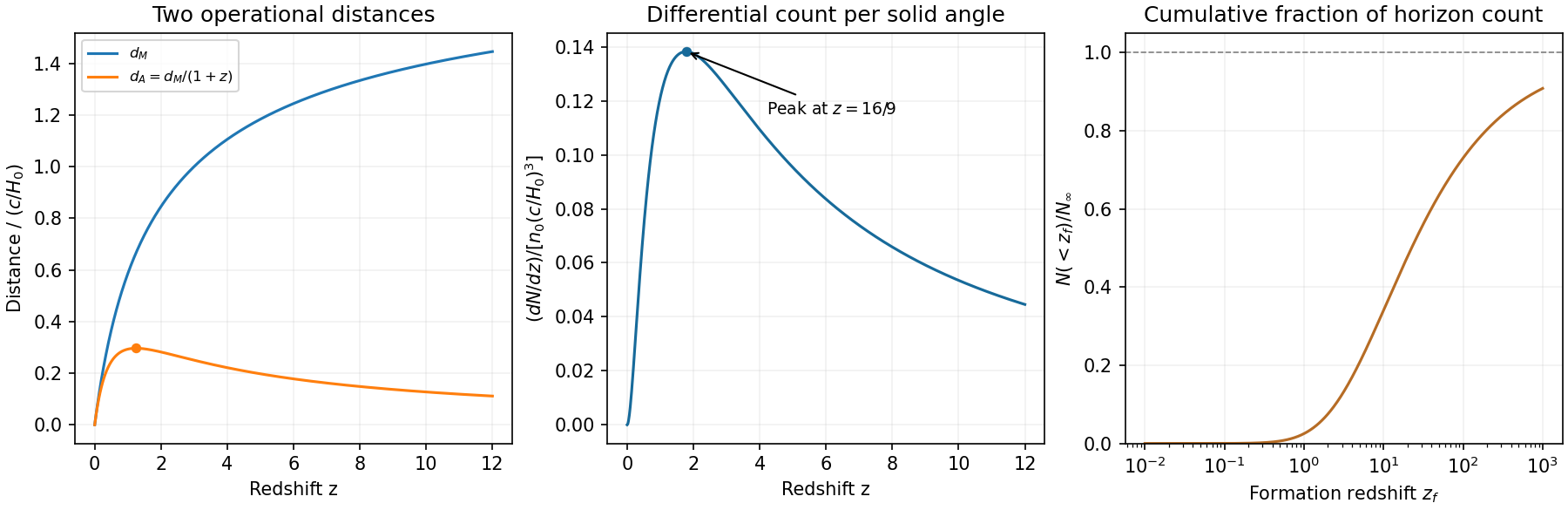
Original Einstein-de Sitter proper-motion and angular diameter distances, differential counts and cumulative fraction
. Details. 
Proper-motion distance 2026-10-20
A source-frame transverse physical speed produces an observed angular rate . cosmological time dilation converts source time to observer time, so this operational distance equals times the angular diameter distance. In an FLRW geometry it is the transverse comoving distance . It should be derived with the time convention stated, rather than interpreting the source speed and angular rate as measurements made by the same clock.
The stretch method rescales the light curve's time axis by and corrects peak apparent magnitude by , fitting jointly with cosmology.[ref]
Measurements of Omega and Lambda from 42 High-Redshift Supernovae by Saul Perlmutter and others. Section 2, equations (1)–(2): stretch and time dilation
Here is a deliberately stipulated local model that exposes the signs. Let be observer time in days, the observed peak time and a dimensionless template with . In a single photometric passband, writeHere is rest-frame time in days; the template's argument carries those units. For illustration, assign the intrinsic relation with : broader events are intrinsically brighter. Define the sign of the K correction by , where is interstellar extinction in magnitudes. ThenRemoving attenuation makes the magnitude smaller; standardizing a broad, intrinsically bright event makes it larger. The fitted cosmological time dilation must be removed before comparing intrinsic durations. This schematic factorization explains the bookkeeping; an actual multicolour fit must also model changing intrinsic colours and correlated uncertainties.
For two equally standardized sources, cancellation of their common absolute magnitude gives an especially clean result:A stipulated residual of mag therefore means a distance ratio and a radiative flux ratio relative to the comparison prediction, provided luminosity and attenuation have been correctly standardized. This is a conversion of a hypothetical residual, not a measured survey value.