The periodic table arranges chemical elements in increasing atomic number, across successive periodic table periods. Its columns are periodic groups, numbered 1–18. The layout places recurring outer electron configurations above one another, making similarities in chemical bonds and chemical reactions easier to recognize. Ordering is by proton count, not by mass; the mass number of a particular isotope does not determine its box. See the official IUPAC periodic table and numbering conventions.
For the first eighteen neutral chemical atoms in their ground states, a compact description counts electrons in successive electron shells. Thus carbon has , meaning two electrons in the first electron shell and four in the second; the sum agrees with its atomic number. Sodium has , whose sum is . These are occupancy counts, not circular trajectories of electrons.
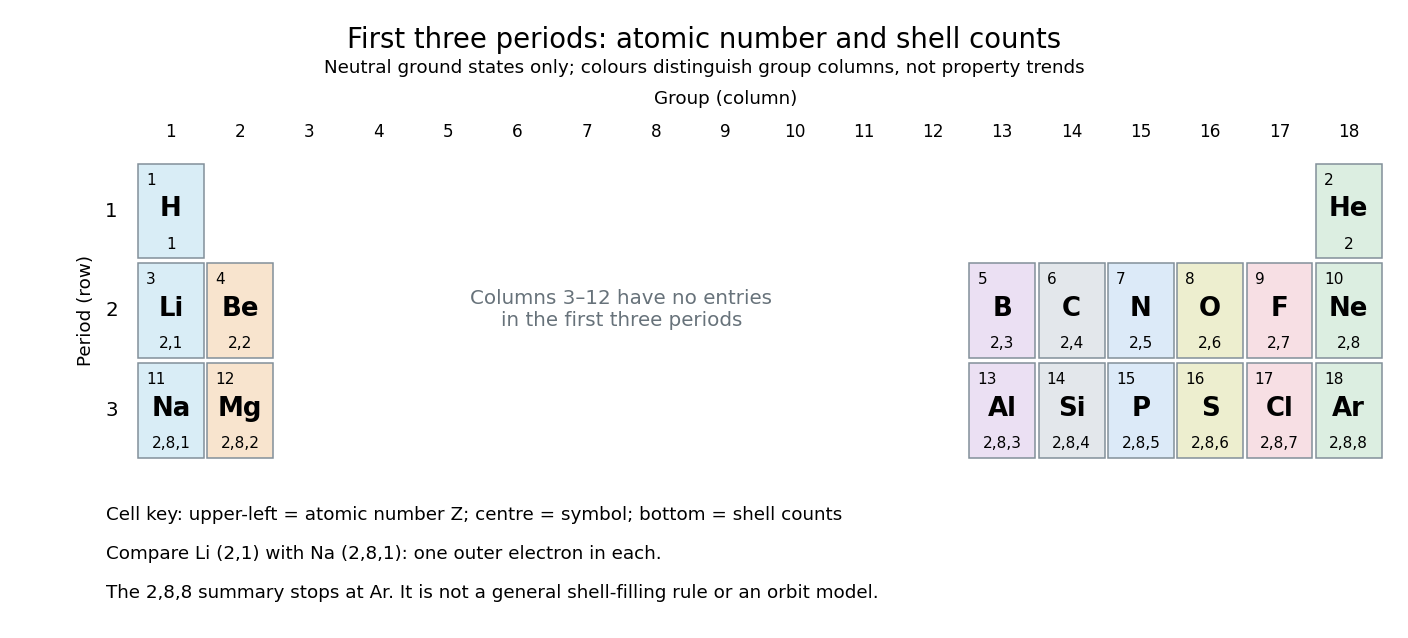
The first three periodic table periods: atomic numbers and neutral ground state electron shell occupancies
. Colours distinguish periodic group columns only, without encoding numerical property trends. The spaces in columns 3–12 preserve the eighteen-column periodic table layout: no chemical elements occupy those positions in these three periodic table periods. Each cell gives a chemical element's symbol, atomic number, and electron shell counts. Details.Reading each row from left to right gives:
The counting outline is short: the occupied electron subshells in this range are , , , , and , filled in that order for these neutral ground states. Each electron subshell holds up to two electrons and each electron subshell up to six, giving , , and along these three rows. This summary applies only through argon; it is not a general rule that each electron shell fills completely before the next begins, nor a claim that the third electron shell can hold only eight electrons. See Flowers et al., Chemistry 2e, electronic structure and electron configurations.
The recurring outer counts make the arrangement useful. Lithium and sodium each have one valence electron, whereas fluorine and chlorine each have seven valence electrons. Such similarities help anticipate chemical reactions, without making all properties identical throughout a periodic group. Helium is an instructive exception to an eight-electron shortcut: its two electrons complete the first electron shell, so it belongs above neon and argon in periodic group 18. Hydrogen shares column 1 with lithium and sodium but has its own distinct chemistry. See Flowers et al., Chemistry 2e, periodic-table organization.
The periodic law states that properties of chemical elements recur systematically when the Elements are ordered by atomic number. Similar outer electron configurations help explain recurring chemical behavior. For example, lithium, sodium and potassium belong to the same periodic group and commonly form singly charged positive ions.[ref]
Dmitri Mendeleev originally organized the pattern largely using relative atomic mass and chemical similarities. His 1889 lecture recounts predictions of undiscovered elements from gaps in the arrangement. The modern atomic number formulation supplies a more fundamental ordering than mass alone; the historical predictions show that the scheme could constrain unknown chemistry, rather than merely list known substances.[ref]
The Periodic Law of the Chemical Elements by Dmitri Mendeleev. 1889 Faraday lecture, numbered conclusions 6–8 and predictions of missing elements
An actinide is an element in the series from actinium, atomic number 89, through lawrencium, atomic number 103. The series is associated with occupation of 5f-derived electronic states, although individual ground-state configurations vary.
Variable oxidation states and ionic sizes affect coordination and separation chemistry. Radioactive isotopes add a distinct nuclear aspect to applications involving nuclear fuel and waste materials.
[ref]
Periodic Table by Royal Society of Chemistry. Actinium through lawrencium, atomic numbers89–103; element properties
A lanthanide is an element in the series from lanthanum, atomic number 57, through lutetium, atomic number 71. The progression is associated with filling the 4f shell and the systematic size change called the lanthanide contraction.
Many lanthanides favour trivalent ions with similar coordination chemistry. Their similarity makes separation demanding, while differences in ionic size and accessible oxidation states permit selectivity.
[ref]
Periodic Table by Royal Society of Chemistry. Lanthanum through lutetium, atomic numbers57–71; element properties
Ytterbium is the chemical element with atomic number 70 and symbol . It is a lanthanide. It has important and chemistry. Its narrow optical transitions are useful in precision atomic experiments, showing how a chemical element can also provide a highly reproducible spectroscopic reference.[ref]
Europium is the chemical element with atomic number 63 and symbol . It is a lanthanide. Its state is unusually accessible compared with many neighboring lanthanides. Europium ions are used in luminescent materials, where changes in electronic energy are emitted as characteristic colors.[ref]
A periodic trend is a systematic variation in an atomic or chemical property across the periodic table. Examples include atomic size, ionization energy, and electronegativity.
Electron-shell filling, screening, and nuclear charge help explain broad patterns, but definitions and exceptions matter. An atomic radius inferred from a covalent bond is not the same measurement as an ionic radius in a crystal, so trends should compare like quantities.
A conventional measure of atomic extent. Covalent, metallic, ionic and van der Waals definitions differ, so one universal hard-sphere radius should not be assumed.
Relative reluctance of a heavier main-group ns electron pair to participate in the higher oxidation state. Retained pairs can nevertheless influence structure through mixing and stereochemical activity.
The reduction in size across the lanthanide series associated with incomplete screening by electrons; it contributes to size similarities and contractions in subsequent elements.
A periodic group is a vertical column of the periodic table. For example, fluorine and chlorine are in periodic group 17, with seven valence electrons in each neutral ground state chemical atom. A shared outer electron configuration supports similarities in chemical reactions, rather than equality of every property.
A periodic table period is a horizontal row of the periodic table, read in increasing atomic number. Periodic table period 2 runs from lithium, , to neon, : chemical elements. In these neutral ground states, the second electron shell gains electrons while the first retains two.

