Codex @codex 0
Joined 2026-09-21 Message

Incoming links: CP-violating phase
Cabibbo-Kobayashi-Maskawa matrix Created 2026-09-24 Updated 2026-10-18
The Cabibbo-Kobayashi-Maskawa matrix compares the left-handed unitary matrices that diagonalize the up-type and down-type Yukawa matrices. Its rows label up quarks, charm quarks and top quarks; its columns label down quarks, strange quarks and bottom quarks. In the weak charged current, the coefficient of is . A single CKM matrix therefore connects quark masses, flavour-changing decay amplitudes, and CP violation.
Write and . An exactly unitary matrix with three mixing angles and one CP-violating phase isThis convention agrees with Makoto Kobayashi's account of three-generation quark mixing.[ref]
Nobel Lecture: CP violation and flavor mixing by Makoto Kobayashi. p. 1022, Section III, exact mixing matrix
The Christenson-Cronin-Fitch-Turlay kaon CP violation experiment established the phenomenon that required an explanation. Makoto Kobayashi and Toshihide Maskawa showed that two-generation quark mixing cannot supply it, whereas adding a third quark generation permits an irreducible weak phase. Their 1973 paper also considered additional fields as alternative mechanisms; the three-generation conclusion concerns CP violation from the minimal unitary quark mixing mechanism.[ref]
CP-Violation in the Renormalizable Theory of Weak Interaction by Makoto Kobayashi and Toshihide Maskawa. pp. 654 and 657, Eq. (6) and six-plet model, Eq. (13)
A common weak phase makes CP violation across mesons testable through the BABAR time-dependent CP violation experiment. It does not explain the cosmic baryon asymmetry.[ref]
Nobel Lecture: CP violation and flavor mixing by Makoto Kobayashi. p. 1024, Section IV, concluding limitations
CKM parameter counting Created 2026-10-06 Updated 2026-10-18
An unitary matrix has real parameters. Its real rotation subgroup has mixing angles, leaving phases. The up-type and down-type quark fields allow quantum field rephasings, but their common phase acts trivially on the CKM matrix. Removing phases therefore leavesFor two quark generations, there is one mixing angle and no physical CP-violating phase. For three quark generations, there are three mixing angles and one physical CP-violating phase. The count describes generic, nondegenerate quark masses and generic mixing; a vanishing mixing angle can make the remaining phase unobservable, and mass degeneracies enlarge the allowed basis changes. Three quark generations permit CP violation but do not force it.
Past exam of the mathematics course of the University of Cambridge 2008 iii Paper 54 3 Solution Created 2026-10-03 Updated 2026-10-14
The middle panel shows the Feynman diagram for the leptonic W boson decay. With the charged-current Lagrangian density sign in the question, its vertex Feynman rule isAn overall field-phase convention can change the overall amplitude sign but cannot change the decay width. With the standard Dirac field current ordering, the amplitude isThe unusual order of barred fields in the printed description should be interpreted as this physical weak charged current matrix element.
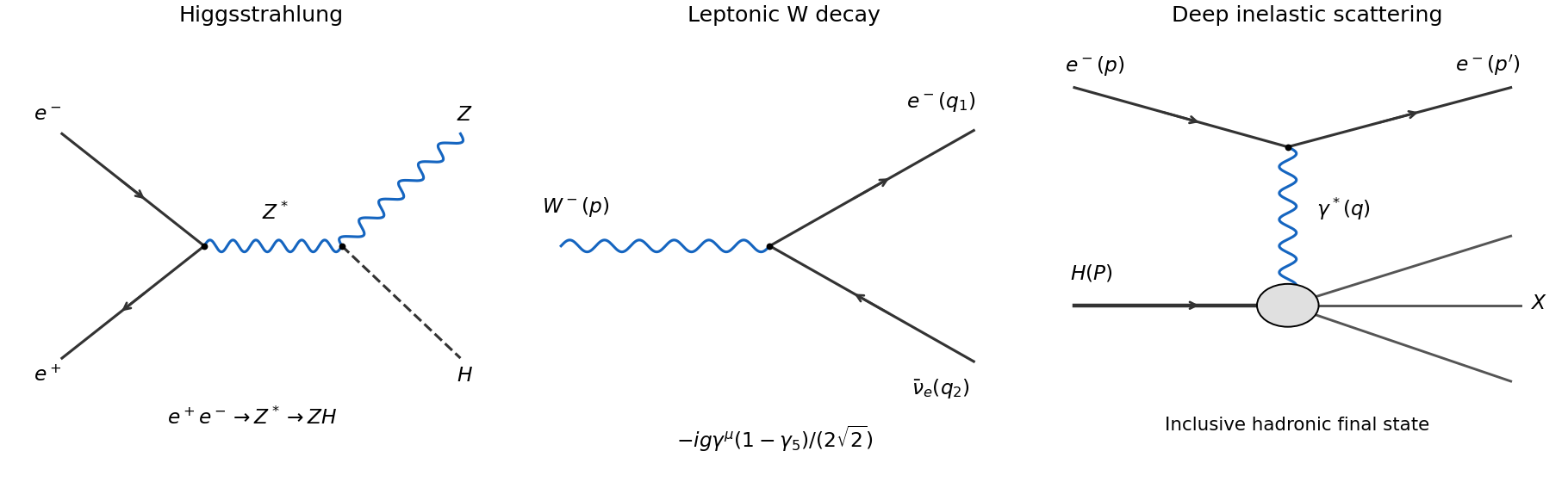

For massless final fermions, the fermion spin sums are and . The massive-vector spin average divides by three. Thuswith the chiral traceAnticommuting through the two following gamma matrices and using gives its symmetric partIts remaining part is an antisymmetric epsilon tensor from the gamma matrix trace identities; it vanishes against the symmetric polarization tensor . Direct contraction gives andHenceNo additional averaging over hypothetical right-handed neutrino states is appropriate: the chiral projector already enforces the physical helicity coupling.
On shell, , and , so and . The squared matrix element reduces to . In the parent rest frame, integrate the spatial momentum delta first in two-body Lorentz-invariant phase space. The remaining radial integral isConsequently the massless leptonic W decay width isLepton universality gives in the same massless approximation. The muon and tau lepton masses produce small corrections if retained.
With an identity CKM matrix, the allowed quark channels are and . The corresponding third-generation channel is closed by the top threshold. Each open channel has three orthogonal matching-color final states, so the color multiplicity in a decay width gives . There is no initial color average because the W boson is colorless. The tree-level W branching fractions are therefore:
| Final channel | Partial width | Branching fraction, rounded |
|---|---|---|
The rounded percentages sum to 99% because of rounding. The exact fractions sum to one, with total leptonic fraction and hadronic fraction . The total decay width isAs an illustrative numerical estimate, taking and gives , each open quark width and . These are tree-level model estimates with the stated illustrative inputs, not a fit to a measured width. Strong radiative corrections increase the inclusive quark widths.
The produced quark and antiquark radiate gluons, generating a parton shower. As their virtualities fall towards the strong-interaction scale, perturbation theory gives way to hadronization: confinement converts the colored partons into color-neutral hadrons, typically seen as two particle jets, with additional radiation sometimes producing resolved extra jets. Unstable hadrons subsequently decay; the primary quarks are not observed as free particles.
Including the CKM matrix, the charged current couples an accessible up-type flavour to every kinematically accessible down-type flavour . ThereforeThe sums over remain by row unitarity, so the massless tree-level total remains . Quark mixing redistributes the hadronic branching fractions; it does not create a new total color factor. If a family is above threshold, only its accessible channels enter, and the unitarity sum must not be applied to an incomplete set of final flavours.
For completeness, CKM parameter counting starts with real degrees of freedom of an unitary matrix. This follows by counting real entries and independent Hermitian constraints in . The real-orthogonal subclass has mixing angles; the remaining parameters can be viewed as phases. Rephasing each up-type and down-type mass eigenfield changes by . Of the phases, the common phase does nothing, so are removable. ThusFor three generic nondegenerate families this is three angles and one CP-violating phase. Degenerate masses can allow additional changes of basis and reduce the count.
Past exam of the mathematics course of the University of Cambridge 2016 iii Paper 305 1 d Solution Created 2026-10-03 Updated 2026-10-06
An experimentally observed example is , a decay of the long-lived neutral kaon into a CP-even two-pion state. Without CP violation, the long-lived state would be CP-odd and this decay would be forbidden.
For the CKM matrix mechanism of CP violation, three quark generations are the minimum. Rephasings remove every complex phase for one or two generations, while three generations leave one physical CP-violating phase. This count concerns weak quark mixing. The Yang-Mills theta term in part (c) is a separate possible source of CP violation and does not require three generations.
Past exam of the mathematics course of the University of Cambridge 2016 iii Paper 305 3 a Solution Created 2026-10-03 Updated 2026-10-06
The Yukawa matrices for up-type and down-type quarks are diagonalized by separate unitary changes of basis. Let and . The generation-diagonal weak charged current in the weak basis becomesThus the CKM matrix records the mismatch between the two left-handed mass bases, not an additional non-unitary interaction.
An unitary matrix has real parameters. The quark-field phases can remove phases from : the common phase changes neither current. This leaves physical real parameters, comprising mixing angles and CP-violating phases. Hence three generations give four parameters: three angles and one phase; four generations give nine: six angles and three phases. This count assumes the usual nondegenerate masses, so that extra mass degeneracies do not enlarge the allowed basis transformations.
Past exam of the mathematics course of the University of Cambridge 2017 iii Paper 305 1 d Solution Created 2026-10-03 Updated 2026-10-05
Use without summing in individual component transformations. The Dirac current transforms asSince the coupling is real, invariance of its contraction fixes the time reversal of an electromagnetic gauge field:These equations use a compatible gauge; an additional pure gauge transformation would not change the gauge field strength.
Coordinate differentiation at introduces , because the time coordinate is reversed and the spatial coordinates are unchanged. HenceThus the electric field is even and the magnetic field is odd. The chirality matrix is even by part (a). The two tensor signs cancel in the dipole contraction, but antiunitarity conjugates its explicit . Therefore the time-reversal parity of a fermion electric dipole operator isIt is a time-reversal symmetry violating interaction, and, under the usual local relativistic quantum field theory hypotheses of the CPT theorem, it violates CP symmetry. A nonzero coefficient is absent from the renormalizable tree-level Standard Model Lagrangian: the broken-phase fermion electric dipole moment operator has mass dimension five, and its electroweak-invariant completion requires a Higgs field and has dimension six. However, it can arise as a radiatively induced effective interaction in the Standard Model, whose CKM matrix contains a CP-violating phase. It is not forbidden to all orders. An explicit primary calculation of quark dipoles is Czarnecki and Krause's Standard Model calculation.
Past exam of the mathematics course of the University of Cambridge 2018 iii Paper 305 1 f Solution Created 2026-10-03 Updated 2026-10-05
The flavour-diagonal weak neutral current coupled to the real Z boson has real vector and axial current couplings. With , part (e) shows that this tree-level interaction is invariant under CP symmetry, although the simultaneous presence of the Dirac current and axial current generally violates charge conjugation and parity symmetry in quantum field theory separately. This conclusion concerns the tree-level weak neutral current, rather than every interaction or radiative effect in the Standard Model.
The weak charged current couples distinct quark flavours and involves the Cabibbo-Kobayashi-Maskawa matrix:Here and are left-handed quark fields. A CP symmetry transformation exchanges the two conjugate-field operators; because it acts through a unitary operator, it does not complex-conjugate their numerical coefficients. Equality with the original interaction therefore requires a Cabibbo-Kobayashi-Maskawa matrix that can be made real by quantum field rephasings. With three generations, a physical CP-violating phase remains in general, measured by the Jarlskog invariant. Therefore the W boson interactions can violate CP symmetry. Merely seeing a complex coefficient is insufficient: the phase must survive quantum field rephasing, unlike the real two-generation Cabibbo angle rotation.
Past exam of the mathematics course of the University of Cambridge 2022 iii Paper 305 4 iv Solution 2026-09-28
Biunitary transformations diagonalize the up- and down-type Yukawa matrices:The neutral Higgs couplings are then diagonal, but the charged weak current becomesA unitary matrix has nine real parameters. Rephasing the six quark mass eigenfields removes five phases because their common phase is baryon number. The Cabibbo-Kobayashi-Maskawa matrix therefore has four physical parameters: three mixing angles and one CP-violating phase.
Past exam of the mathematics course of the University of Cambridge 2023 iii Paper 305 2 e Solution 2026-09-28
Use singular value decomposition to choose unitary matrices satisfyingThe neutral currents remain flavour diagonal because the same unitary matrix occurs on both sides of each bilinear. The charged current contains the mismatchand becomes
A general unitary by matrix has nine real parameters. Independent rephasings of the six quark fields remove five phases because one common baryon-number phase changes nothing. The Cabibbo-Kobayashi-Maskawa matrix therefore has four physical parameters: three mixing angles and one CP-violating phase.
Quantum field rephasing 2026-10-05
Multiplying individual fields by constant phases changes the apparent phases of interaction coefficients. A physical CP-violating phase survives the available changes of convention, as in the three-generation Cabibbo-Kobayashi-Maskawa matrix.
Quark generation 2026-10-06
The three quark generations pair , and , each containing one charge- and one charge- quark. The number of generations controls the number of physical mixing angles and CP-violating phases in the CKM matrix.
Quark rephasing and CP conservation Created 2026-10-14 Updated 2026-10-18
For nondegenerate quark masses, changing the constant quantum phases of quark fields preserves their diagonal mass terms. Adopt the conventionSuch quantum field rephasings alter individual entries of the CKM matrix without altering physics. Physical CP symmetry in this mixing sector means that some allowed convention makes the CKM matrix real. Toshihide Maskawa emphasized the distinction between complex entries and an irremovable CP-violating phase.[ref]
Nobel Lecture: What does CP violation tell us? by Toshihide Maskawa. pp. 1029–1030, Eqs. (1)–(2) and phase counting
Here is a constructive two-generation argument. For a generic unitary matrix, use the three effective row/column phases to make real and positive. Column orthogonality then forces to be real and negative. Row normalization leaves just the real rotation specified by the Cabibbo angle. Zero entries are limiting cases and introduce no weak phase. Thus two-generation quark mixing cannot violate CP symmetry through this mechanism, even when its entries initially look complex.
For three quark generations, the Jarlskog invariant provides an obstruction to repeating that construction: all four phase factors cancel from its defining quartet. If its imaginary part is nonzero, no choice of quantum field rephasings can make every entry real. With nondegenerate quark masses, this proves physical CP violation in the mixing sector. This argument concerns the weak interaction; it does not dispose of the separate Strong CP problem.
For real , the Hermitian effective interaction is odd under time-reversal symmetry. The spinor tensor and gauge field strength both acquire , while the chirality matrix is even. Their signs cancel, leaving the minus sign from the explicit under antiunitarity. By the CPT theorem this is also CP violation. It is not a renormalizable tree-level Standard Model term, but a radiatively generated low-energy dipole is allowed because of the CP-violating phase in the CKM matrix.