For a unit-speed curve , the unit tangent is and the curvature is . It measures the rate at which the tangent direction turns.
For a twice continuously differentiable regular curve in the plane, unsigned curvature is the absolute value of its signed curvature:The nonvanishing velocity vector makes the denominator positive. For a graph of a function , this reduces to ; omitting the absolute value gives the signed curvature of a plane graph for increasing .
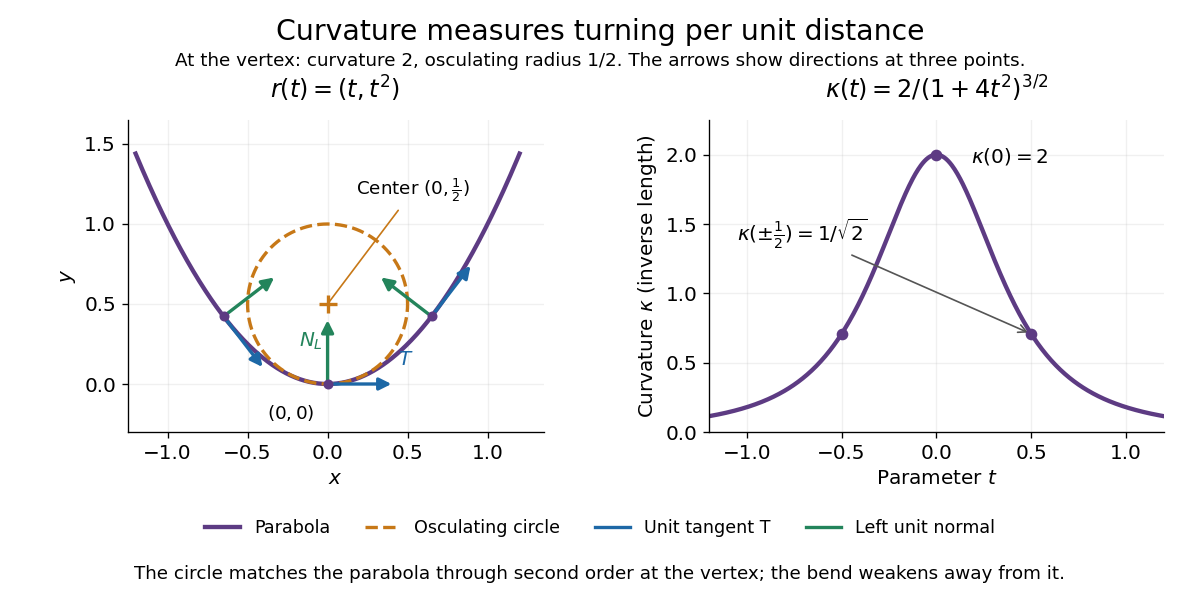
For the parabola , the derivatives are and . ThereforeThe curvature is greatest at the vertex , where and the radius of curvature is . At the curvature is , so the parabola bends less sharply despite its larger speed .
Its unit tangent vector and left unit normal areSince , is also its principal normal vector. At the osculating circle consequently has center and equationThe lower branch has value , derivative , and second derivative at , matching the parabola through second order. Away from the vertex the two curves separate: an osculating circle describes a local bend, not the whole curve.

Vanishing curvature at one point does not imply a straight segment. The graph of a function has signed curvature , which vanishes at its inflection point and changes sign across it. By contrast, if curvature vanishes throughout a connected regular interval, throughout that interval: the constant unit tangent vector forces the image to lie on a straight line.
At a point of a twice continuously differentiable regular curve with positive curvature , its osculating circle has radius and center , where is the principal normal vector. It matches the point, tangent line and curvature. For a space curve, it lies in the plane spanned by the unit tangent vector and principal normal vector. The parabola example under curvature of a plane curve gives center and radius at the origin.
Where a regular curve has positive curvature , its radius of curvature is the radius of its osculating circle. A sharper bend has a smaller radius. At zero curvature there is no finite radius; writing is a limiting convention rather than an ordinary real reciprocal of zero.
If a regular plane curve has positive curvature and a particle moves with speed in the chosen time units, its elapsed time is , the total curvature traversed. On a logarithmic spiral , both and equal . Hence and every complete turn takes time , regardless of its radius.
At a regular planar level set of a twice differentiable function, its oriented curvature with normal is . Zero curvature at a point gives second-order contact with the tangent line, not a whole straight segment. For example the regular zero level line of has zero curvature at the origin but is curved nearby.
Given a smooth function , setThen is unit speed and has signed curvature . This gives the existence part of the fundamental theorem of plane curves.
The total curvature of a regular curve isIt equals the length traced by the unit tangent on the unit sphere, so lifting a planar circle into a helix can reduce total curvature even when both curves make one revolution around the same axis.
Every closed regular space curve has total curvature at least . Equality holds exactly for convex plane curves traversed once. Here curvature is unsigned and integration is with respect to arc length.
For a unit-speed curve with nonzero curvature, torsion is , measuring rotation of the osculating plane.
All derivatives of a planar curve lie in one fixed two-dimensional vector plane, so and its torsion vanishes wherever defined.
Articles by others on the same topic
There are currently no matching articles.