Protein denaturation is the loss of a protein's native spatial organization, often with loss of biological function. Changes in temperature, pH or surroundings can disrupt protein secondary structure, protein tertiary structure or protein quaternary structure. Protein denaturation ordinarily preserves the peptide bonds and protein primary structure; it is different from cutting the chain. Recovery by protein folding is possible in some cases, but removing the denaturing conditions does not guarantee that every protein recovers. See Clark, Douglas and Choi: denaturation, environmental conditions and loss of function.
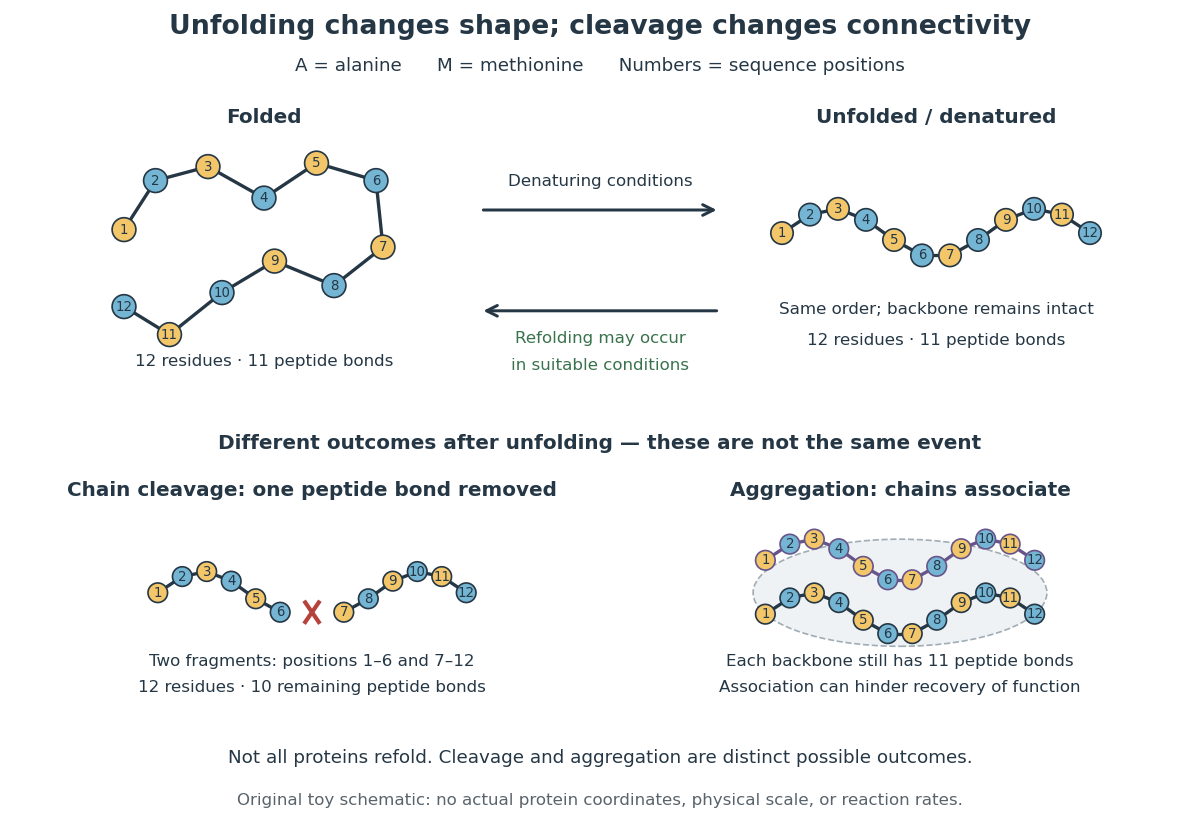

In the diagram, unfolding preserves all eleven peptide bonds. Cleaving the connection between positions 6 and 7 leaves two six-residue fragments: each contains five peptide bonds, so there are in total. Simply cooling or otherwise restoring suitable conditions cannot recover the original chain by protein folding alone; the missing covalent bond would have to be remade. Conversely, protein aggregation can impede recovery without breaking any peptide bond. These distinctions explain why loss of function does not by itself reveal whether a protein unfolded, associated with other chains, or suffered chemical damage.
Articles by others on the same topic
There are currently no matching articles.