Use a closed two-level system with spontaneous emission population decay . Here is a decay rate in inverse seconds and also the full width at half maximum of the natural linewidth expressed in angular frequency. The corresponding full width in hertz is ; the angular half width is . These conventions determine every factor of two and below.
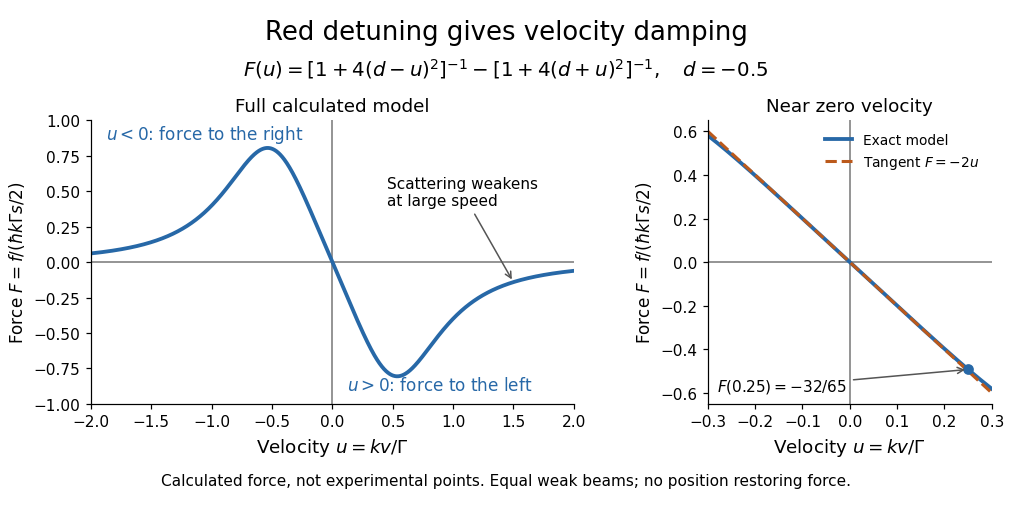
Let be the on-resonance saturation parameter of each beam, with total excitation weak enough that saturation and coherent coupling between beams can be neglected. The independent-beam scattering rates and net force areThe force is the photon momentum per absorption multiplied by the difference in absorption rates. With dimensionless laser detuning and dimensionless velocity , writeFor the example and , the positive and negative beam factors are respectively and . Thus : the atom is moving right and the net force points left. All values in this example are dimensionless.
Subtracting the two fractions gives an especially useful sign check:For red detuning, the force opposes nonzero throughout this ideal model; its useful magnitude eventually falls at large . Near zero, a Taylor series gives dampingAt , and . For blue detuning the sign reverses and the small-velocity motion is amplified; at exact resonance the opposing mean forces cancel in this symmetric model. Its derivation assumes weak excitation, a closed two-level system, equal beam intensities and nonrelativistic velocities; real multilevel atoms need additional physics.

Articles by others on the same topic
There are currently no matching articles.