Methods for preparing and probing chemical atoms in atomic physics.
Optical pumping redistributes populations among internal quantum states by selective photon absorption followed by spontaneous emission. It can prepare atoms for measurement and participate in sub-Doppler cooling.
Laser cooling uses laser light to reduce the random velocities of chemical atoms, and therefore their translational temperature. The striking ingredient is selective photon absorption: an atom moving towards a beam sees a Doppler shift that can make it absorb more strongly. Each absorbed photon transfers momentum along the beam; repeated absorption and spontaneous emission can then remove kinetic energy. Doppler cooling makes this selection with the atom's motion, while sub-Doppler cooling also exploits its internal quantum states.
Cooling makes chemical atoms move slowly enough for longer interrogation in atomic clocks and atom interferometry, and easier loading into an optical trap. The same radiation pressure that pushes an atom can cool it: with suitably tuned opposing beams, whichever direction the atom moves, it receives the stronger push against that motion.
Consider equal opposing laser beams along the axis and an atom with velocity . Let be their angular frequency, the atomic resonance angular frequency, their wavenumber, and the laser detuning. Red detuning means . To first order in , the atom seesFor small positive , the beam travelling towards negative is closer to resonance and causes more photon absorption; its momentum kicks point against . The beam travelling towards positive is further from resonance. Reversing exchanges the roles of the two beams. This is a Doppler effect on the absorption rates, rather than a need to follow each atom with a moving beam.
An absorbed photon gives the atom momentum , where is the reduced Planck constant. Subsequent spontaneous emission gives a recoil opposite to the emitted photon. For an emission pattern symmetric under reversal of direction, that recoil has zero expected value, but nonzero variance. Its mean therefore leaves the directional absorption force intact, while its randomness adds recoil energy. Random absorption times and choices of beam add further momentum fluctuations. Zero mean recoil does not mean zero heating.
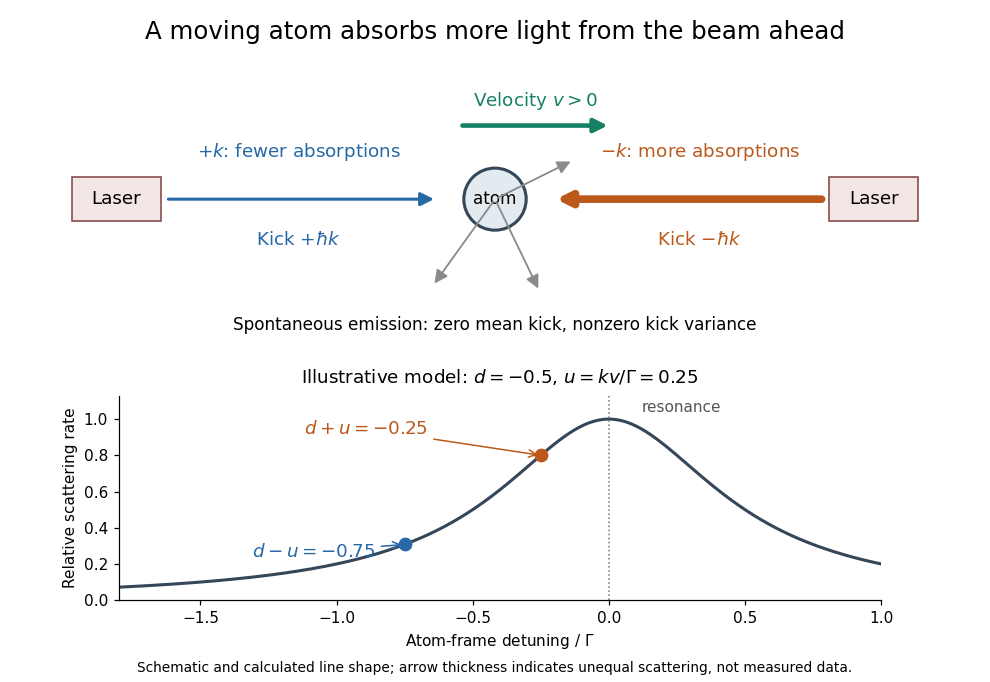
Opposing beams and Doppler-selective photon absorption
. An original schematic for an atom moving right. Both beams have the same red detuning in the laboratory. The calculated weak-field line shape below shows their different atom-frame scattering rates for and ; it is not experimental data. Details.
Use a closed two-level system with spontaneous emission population decay . Here is a decay rate in inverse seconds and also the full width at half maximum of the natural linewidth expressed in angular frequency. The corresponding full width in hertz is ; the angular half width is . These conventions determine every factor of two and below.
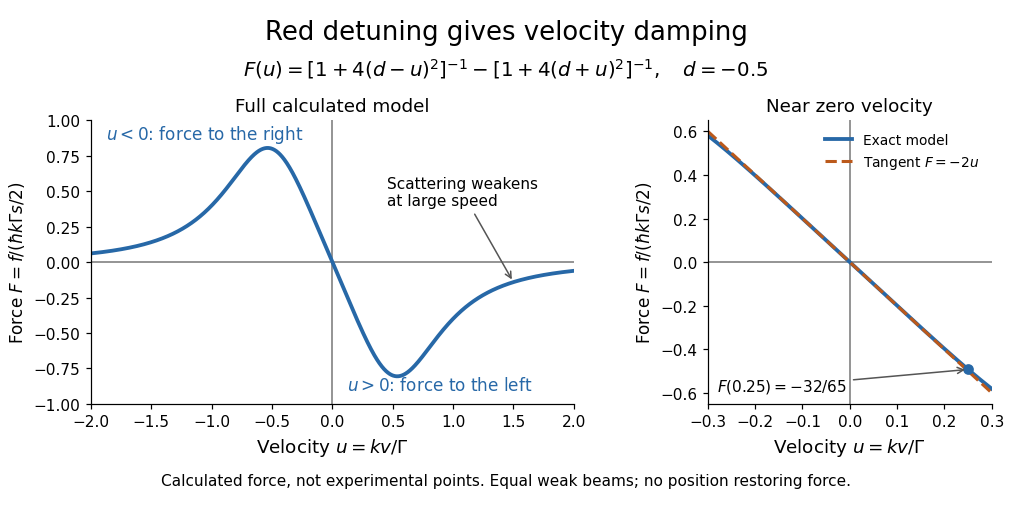
Let be the on-resonance saturation parameter of each beam, with total excitation weak enough that saturation and coherent coupling between beams can be neglected. The independent-beam scattering rates and net force areThe force is the photon momentum per absorption multiplied by the difference in absorption rates. With dimensionless laser detuning and dimensionless velocity , writeFor the example and , the positive and negative beam factors are respectively and . Thus : the atom is moving right and the net force points left. All values in this example are dimensionless.
Subtracting the two fractions gives an especially useful sign check:For red detuning, the force opposes nonzero throughout this ideal model; its useful magnitude eventually falls at large . Near zero, a Taylor series gives dampingAt , and . For blue detuning the sign reverses and the small-velocity motion is amplified; at exact resonance the opposing mean forces cancel in this symmetric model. Its derivation assumes weak excitation, a closed two-level system, equal beam intensities and nonrelativistic velocities; real multilevel atoms need additional physics.

Damping removes random kinetic energy, but the discrete photon kicks cause diffusion in momentum. Their balance gives a nonzero temperature. Define the momentum diffusion coefficient by the noise contribution . With atom mass and linear damping coefficient ,at stationary balance, where is the Boltzmann constant and mean momentum is zero.
For ideal three-dimensional optical molasses with three identical independent beam pairs and isotropic spontaneous emission, the -pair absorption rate at rest is . Absorption from that pair contributes to the noise growth of . Emission from all three pairs contributes the same amount: its total rate is and each emitted photon has mean squared -momentum . Hence . Using the Doppler cooling force coefficient givesPut . Then , with equality at . The ideal weak-field Doppler cooling limit is therefore at . It is the minimum of this specified diffusion-and-damping model, rather than a universal lower bound for laser cooling. The diffusion approximation also assumes recoil energy much smaller than . In a one-pair geometry, emission patterns and transverse recoil change the diffusion bookkeeping. [ref]
Nobel Lecture: Laser cooling and trapping of neutral atoms by William D. Phillips. William D. Phillips, Nobel Lecture: Laser cooling and trapping of neutral atoms, 1998, pp. 729–730, Eqs. (1)–(2): recoil heating, linewidth convention and ideal three-dimensional temperature limit
.Optical molasses surrounds slow chemical atoms with opposing red-detuned laser beams, usually three pairs along perpendicular axes. In the elementary Doppler cooling picture, each pair damps one component of velocity. The result resembles viscous drag, even though the atoms are moving through a vacuum rather than a liquid.
Uniform balanced optical molasses supplies velocity damping, without a restoring force towards a chosen position. An atom at rest has zero mean force wherever it sits within the uniform illuminated region. Without noise or external forces, givesThe atom approaches a position determined by its initial condition, not the beam intersection. Recoil-driven diffusion and gravity eventually remove atoms from finite beams. A long residence time in optical molasses is therefore compatible with the absence of position trapping. An optical trap provides spatial confinement by a different force mechanism; a magneto-optical trap adds a position-dependent magnetic field and suitable beam electromagnetic polarization to create a restoring force.
Steven Chu's Bell Laboratories team prepared sodium atoms by pulsed-laser evaporation of a pellet. A frequency-swept opposing beam slowed them before six crossed laser beams supplied optical molasses. The vacuum chamber used a shield coated with graphite and cooled with liquid nitrogen as a pump. Fluorescence provided the readout; the initial beams were aligned as closely counterpropagating as possible. [ref]
The manipulation of neutral particles by Steven Chu. Steven Chu, The manipulation of neutral particles, 1998 publication of his Nobel lecture, pp. 687–690, Figs. 3–4 and footnote 5: sodium source, precooling, vacuum apparatus, beam geometry and fluorescence detection
.After equilibration, the team switched off the cooling light for a variable interval, then restored it. Faster atoms escaped during the dark interval; slower atoms were recaptured. The recaptured fraction versus delay constrained the velocity distribution and hence temperature. The inference depended on the initial cloud shape and recapture volume: Steven Chu later acknowledged adjusting a geometry correction towards the expected Doppler cooling limit. Delay was the scanned variable, and the cooling beams themselves supplied the release/recapture control; visible fluorescence alone could not establish temperature. [ref]
The manipulation of neutral particles by Steven Chu. Steven Chu, The manipulation of neutral particles, p. 688, release-and-recapture paragraph: measurement sequence and retrospective account of the geometry correction
.Real atoms have multiple internal quantum states. Optical pumping and spatially varying electromagnetic polarization can remove kinetic energy by additional mechanisms, producing sub-Doppler cooling below the ideal Doppler cooling limit. In polarization-gradient cooling, state-dependent energy shifts from the Stark effect and delayed optical pumping make atoms repeatedly climb potential energy hills. This mechanism needs the internal-state structure omitted by the independent-beam two-level system above. [ref]
Nobel Lecture: Laser cooling and trapping of neutral atoms by William D. Phillips. William D. Phillips, Nobel Lecture: Laser cooling and trapping of neutral atoms, pp. 733–734 and Fig. 18: multilevel polarization-gradient cooling
.William D. Phillips's team tested unexpectedly cold sodium molasses with time-of-flight atom detection. A probe above the cloud initially saw no atoms; deliberately heating them verified that the detector worked. Moving the probe below the cloud produced arrival signals consistent with temperatures below the Doppler cooling limit. Independent release/recapture checks used sharply apertured beams and included gravity; uncertain cloud and probe geometry still limited the inferred temperature. These controls tested the thermometer as well as the cooling theory. [ref]
Nobel Lecture: Laser cooling and trapping of neutral atoms by William D. Phillips. William D. Phillips, Nobel Lecture: Laser cooling and trapping of neutral atoms, pp. 731–732, Figs. 15–16: probe reversal, deliberate heating, geometric uncertainties and independent thermometry
.Polarization-gradient cooling uses spatial variation in electromagnetic polarization together with optical pumping between internal quantum states to cool moving chemical atoms.
A magneto-optical trap combines laser cooling with a position-dependent magnetic field and suitable beam electromagnetic polarization to produce a restoring force. Its spatial confinement is additional to the velocity damping of uniform optical molasses.
Articles by others on the same topic
There are currently no matching articles.