Consider equal opposing laser beams along the axis and an atom with velocity . Let be their angular frequency, the atomic resonance angular frequency, their wavenumber, and the laser detuning. Red detuning means . To first order in , the atom seesFor small positive , the beam travelling towards negative is closer to resonance and causes more photon absorption; its momentum kicks point against . The beam travelling towards positive is further from resonance. Reversing exchanges the roles of the two beams. This is a Doppler effect on the absorption rates, rather than a need to follow each atom with a moving beam.
An absorbed photon gives the atom momentum , where is the reduced Planck constant. Subsequent spontaneous emission gives a recoil opposite to the emitted photon. For an emission pattern symmetric under reversal of direction, that recoil has zero expected value, but nonzero variance. Its mean therefore leaves the directional absorption force intact, while its randomness adds recoil energy. Random absorption times and choices of beam add further momentum fluctuations. Zero mean recoil does not mean zero heating.
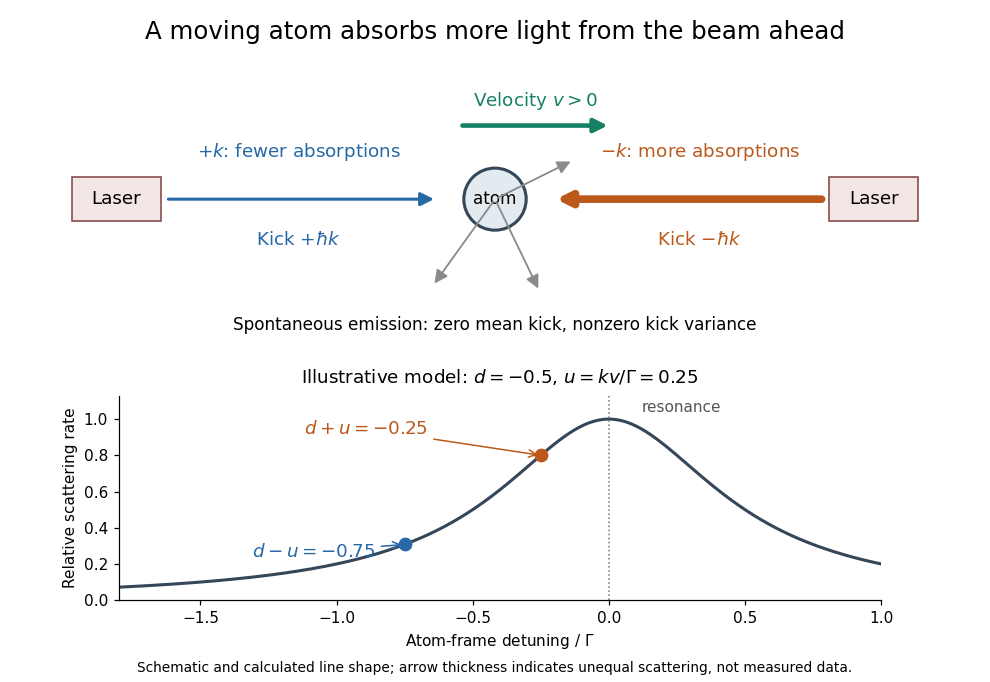
Opposing beams and Doppler-selective photon absorption
. An original schematic for an atom moving right. Both beams have the same red detuning in the laboratory. The calculated weak-field line shape below shows their different atom-frame scattering rates for and ; it is not experimental data. Details. Articles by others on the same topic


Doppler cooling is a technique used in atomic and molecular physics to reduce the temperature of a sample, typically of atoms or ions, by using the principles of the Doppler effect. It is particularly effective for cooling atoms to very low temperatures, near the absolute zero threshold, which allows for the study of quantum phenomena and precision measurements. The technique relies on the interaction between laser light and atoms.