For release from rest relative to the building, take , . The exact solution of the stated coupled linear differential equations isIndeed and , so . In the slowly rotating coordinates, the ellipse has semiaxes and . A bob released from rest therefore does not describe a perfectly straight line even in this ideal linear model. Replacing the bracket by gives the familiar leading approximation but introduces a spurious initial transverse velocity . The exact expression keeps the initial condition and separates that tiny orbit width from the slow rotation of its long axis.
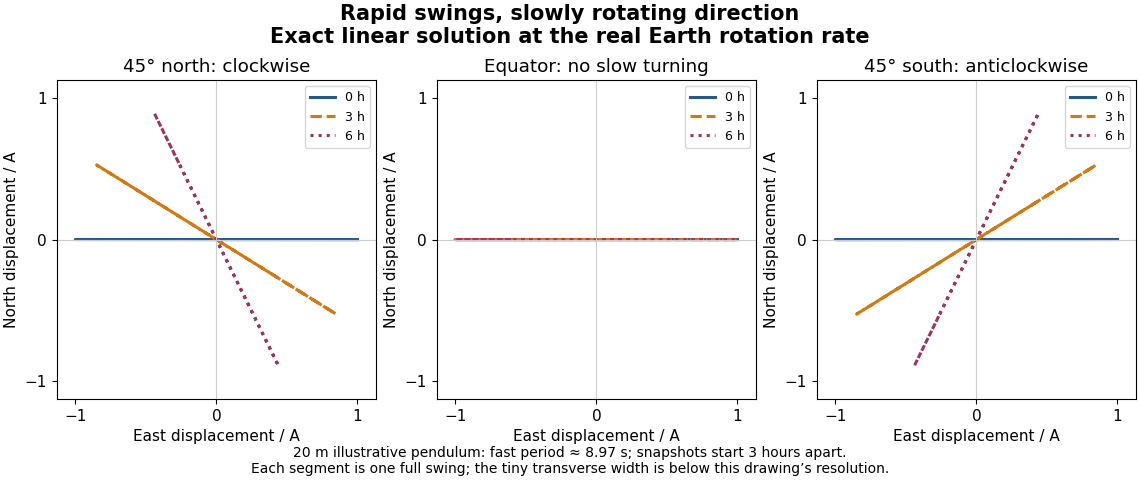
Exact trajectories of the linear Foucault pendulum equations at the actual Earth rotation rate, showing one swing near zero, three, and six hours at northern, equatorial, and southern latitudes
. Details. 
For the illustrative and , the fast period is approximately . At north, : the transverse semiaxis is too small to distinguish at the figure's scale. Nevertheless the long-axis orientation changes by about in six hours. Changing the sign of geographical latitude conjugates the entire solution, reflecting the trajectory across the eastward axis; setting gives exactly. These are stronger checks than merely drawing a rotating line.
The coupled equations give an additional independent constraint. Multiplying them by and and adding cancels the Coriolis force's contributions:This is mechanical energy per unit mass in the reduced model; precession does not require a loss of mechanical energy. Also, direct differentiation givesFor this release the constant is . The exact trajectory satisfies both identities. They test the coupled dynamics separately from the visible slow rotation and express the fact that the Coriolis force does no work.
Articles by others on the same topic
There are currently no matching articles.