The contrast between Pauling electronegativity and Mulliken electronegativity becomes clearer by following the measurements into the formulas. A Pauling bond-energy excess compares three compatible bond-dissociation energies; Mulliken electronegativity takes the arithmetic mean of an ionization energy and an electron affinity. The former asks how much stronger an unlike-atom chemical bond is than a stipulated baseline; the latter combines two different isolated-species energy gaps.
Actual readouts precede those model choices. In the nitrogen dissociation threshold from fragment images, fitted squared image radii versus assigned excitation energies reveal a threshold after accounting for the product quantum states. In the chlorine photodetachment threshold experiment, mass-selected anions overlap a tunable laser, and neutral-atom counts reveal the onset of Electron detachment. Opposite laser directions control the Doppler shift. That second threshold supplies an electron affinity, not an electronegativity; the Mulliken scale still needs an independent ionization energy.[ref]
Accurate measurements of the bond dissociation energies of 14N2, 14N15N and 15N2 by Liya Lu and others. §1, recoil-energy/image-radius equation; §3.2, Figure 5, squared image sizes versus term energies; §3.2, threshold channel assignment
[ref]For an original arithmetic comparison, stipulate isolated-species and positive attachment-release for fictitious species . Their Mulliken electronegativities are . The largest ionization energy belongs to , while the largest Mulliken electronegativity belongs to : accepting an Electron matters as well as retaining one. Using signed attachment energies in gives exactly the same results.
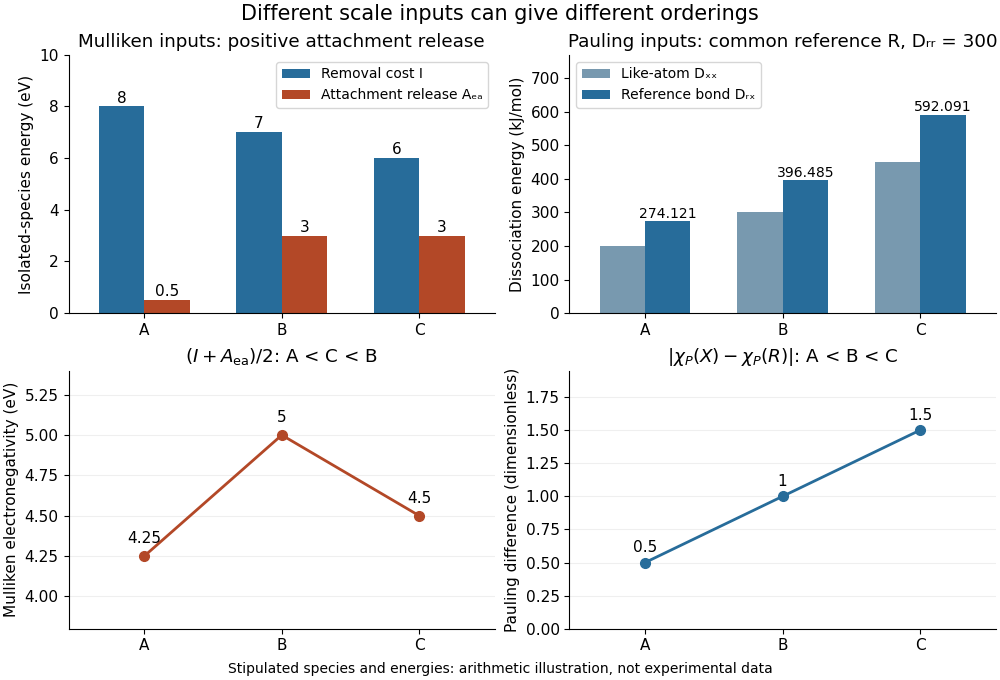
Stipulated inputs to Mulliken electronegativity and arithmetic-baseline Pauling electronegativity: different energies, units and orderings
. Details. 
Independently stipulate and for , with unlike-atom valuesThus , and the Pauling scale differences from are . If all three fictitious species are placed above on that scale, their ordering is , whereas the stipulated Mulliken scale gives . The bond-dissociation energies and isolated-species energies were invented independently: this demonstrates what the formulas do, not a measured disagreement for actual chemical elements. A unit conversion cannot force these two input models to agree.
Articles by others on the same topic
There are currently no matching articles.