Electron affinity measures how strongly an isolated neutral species binds an additional electron. In the spectroscopic convention used here, it is the positive energy required to detach that electron from a bound anion. With the free electron at rest assigned zero energy,The quantum states of and must be specified, usually their ground states. Positive means that attachment lowers the energy; a signed attachment energy is then negative. This convention agrees with the IUPAC definition and with the atomic tables used for Mulliken electronegativity.[ref]
For chlorine, a published photodetachment threshold is , approximately per chemical atom. Here is the Planck constant, the speed of light, and the inverse-length unit expresses an energy through a spectroscopic wavenumber. The parentheses give the reported uncertainty in the last digits, not a range of possible sign conventions.[ref]
Isotope shift in the electron affinity of chlorine by U. Berzinsh and others. §2.3, printed pp. 6–7: reported threshold 29138.59(22) inverse centimetres
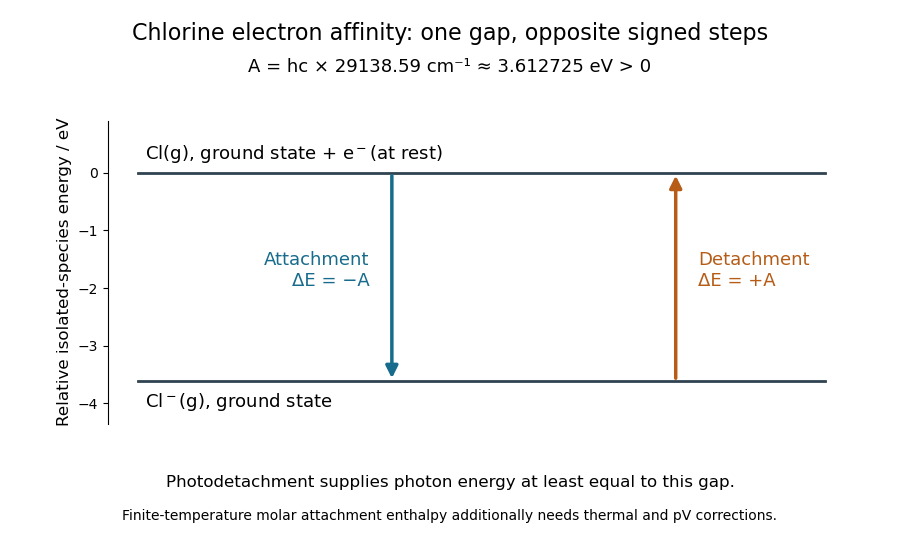
Electron affinity of chlorine: positive detachment energy and negative attachment energy connect the same isolated-species levels; a finite-temperature electron attachment enthalpy needs additional corrections
. Details. An electron affinity is neither an electronegativity nor a lattice energy. The first describes a specified isolated-species energy difference, electronegativity compares attraction for electron density in a chemical bond, and lattice energy refers to an entire ionic crystal and separated gaseous ions. A stable anion can therefore help explain ionic bonding without describing the full energy balance for making a salt.
An electron attachment enthalpy is the signed molar enthalpy change for a stated attachment reaction,For favourable attachment such as chlorine's first attachment, the electron attachment enthalpy is negative. Its leading isolated-ground-state energy contribution is , where is the Avogadro constant. At finite temperature, consistent thermal populations, translational contributions and the term in enthalpy must also be included, together with the same gaseous-electron reference used in the corresponding ionization energy term. Consequently a measured spectroscopic electron affinity is not automatically an exact attachment enthalpy with a minus sign. A Born-Haber cycle must use compatible enthalpies throughout.
Photodetachment removes an electron from an anion using a photon. For chlorine, the reaction is . Measuring the minimum photon energy for the specified final quantum state gives a photodetachment threshold and hence an electron affinity.
In the published chlorine experiment, negative ions were accelerated and mass-selected, then overlapped with a tunable laser beam. A downstream electric field deflected charged ions; neutral chemical atoms continued to a plate, whose secondary electrons were counted. Scanning the laser frequency produced an onset in this neutral-atom signal. The apparatus therefore inferred an electron affinity from a threshold, rather than measuring the heat of attachment.[ref]
Isotope shift in the electron affinity of chlorine by U. Berzinsh and others. §2, printed pp. 2–4, Figure 1: ion preparation, deflectors, neutral-atom secondary-emission detector and threshold fitting
Reversing the laser direction and averaging the two thresholds corrected the first-order Doppler shift. A Fabry–Pérot interferometer and reference spectral lines calibrated the frequency. Finite laser bandwidth, unresolved quantum state splitting and shifts of the calibration lines limited the inference; the authors included these effects in fitting and the error estimate. The level diagram shows only the extracted gap, not a measured signal curve.[ref]
Articles by others on the same topic


Electron affinity is the amount of energy released or absorbed when an atom or molecule gains an electron to form a negative ion. It is a measure of the tendency of an atom to accept an electron. In more technical terms, the electron affinity of an element is defined as the change in enthalpy (ΔH) that occurs when one mole of electrons is added to one mole of atoms in the gas phase, forming anions.