An observation interval of finite duration is not an infinitely sharp frequency selector. Combine the lock-in quadratures intoFor unwanted electric potential difference , where is an angular frequency offset and , expansion into complex exponentials gives the exact responseThe sinc function formula follows by integrating the exponential function and factoring ; its value at zero follows from a limit. The first term changes slowly after multiplication; the second oscillates at the sum frequency. It vanishes at exact matching when is an integer number of reference cycles, each lasting one period of a function, but cannot generally be discarded in a short-window calculation.
For and many reference cycles, the first term usually dominates: its modulus is and its complex argument includes . Thus gives almost no rejection. A longer observation separates closer frequencies, with the first zeros of this term at . Those zeros are not a brick-wall cutoff: the sinc function has nonzero lobes beyond them. At a synchronized contribution remains however large becomes.
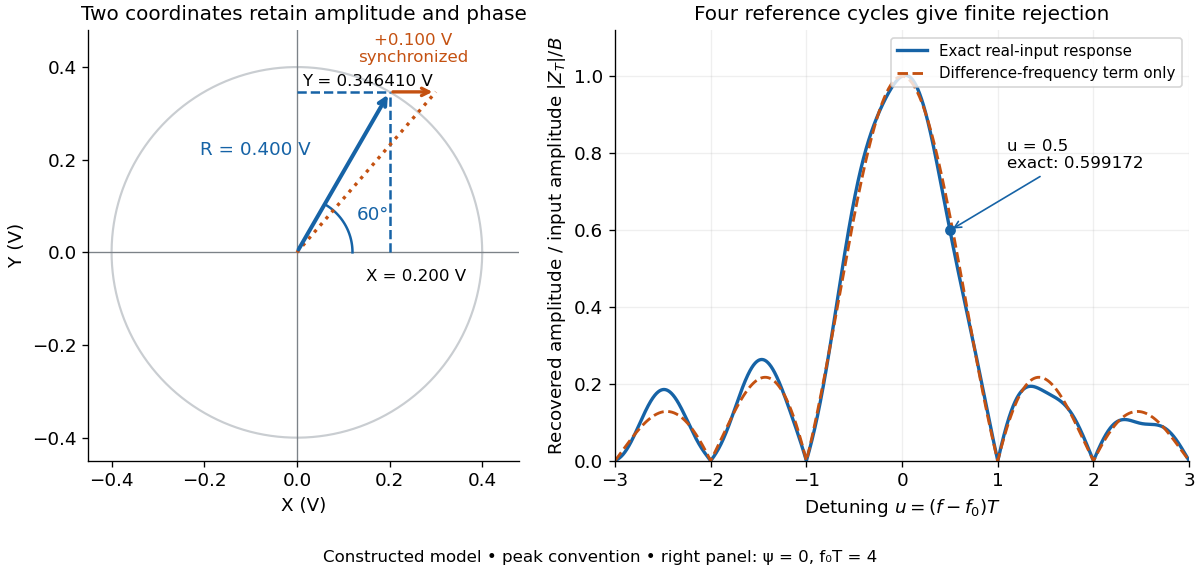

For a numerical check, use , , and an unwanted frequency . Then and the exact expression giveswhereas the difference-frequency term alone gives . An interference amplitude therefore contributes to in this constructed example. A nearby frequency can survive strongly even though the three-times-frequency component in lock-in harmonic rejection cancels exactly.
A practical lock-in amplifier's low-pass filter weights past products differently from this rectangular observation interval. Its time constant and roll-off determine near-reference rejection and settling time; narrowing detection slows the response.[ref]
Model SR830 DSP Lock-In Amplifier manual by Stanford Research Systems. Model SR830 DSP Lock-In Amplifier manual, printed p. 3-2, “Narrow band detection”; pp. 3-11–3-12, time constants and filter roll-off
Articles by others on the same topic
There are currently no matching articles.