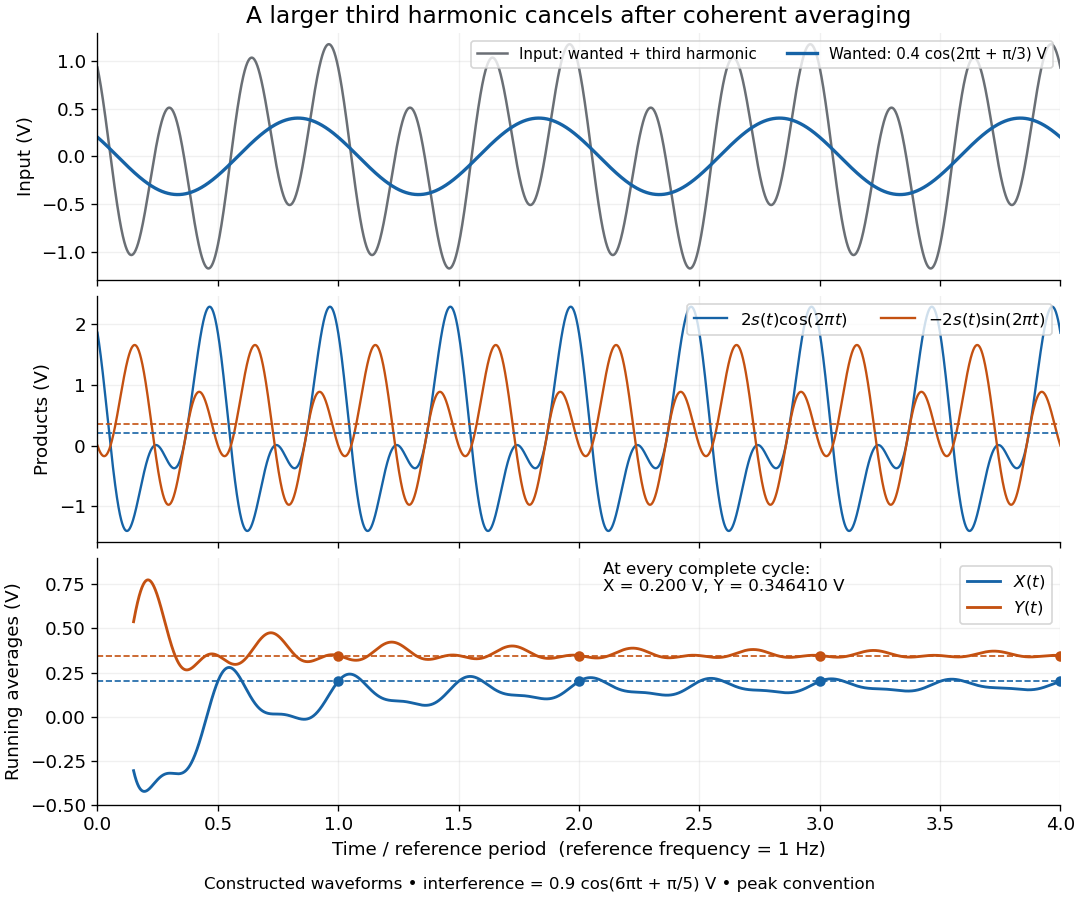
Consider this original constructed input electric potential difference, with in seconds and :The unwanted component has three times the reference frequency and more than twice the wanted peak amplitude. Nevertheless, the lock-in quadratures over are exactlyso and . This is a peak amplitude calculation, not an SR830 display prediction.
To see why the larger component vanishes, multiply by each reference:Each sinusoid has zero average value of a function over a whole reference cycle. More generally, a component with integer gives products at and , whose integrals vanish over any integer number of reference cycles. This is the orthogonality behind selecting a Fourier coefficient with sinusoidal references. A nonsinusoidal reference can contain additional frequencies and need not have the same rejection property.

An unwanted component at the reference frequency survives. If is added to the input, its coordinate vector adds to the wanted one:For example, adding with to the wanted component gives , , , and phase difference . Longer averaging cannot separate these two synchronized contributions.
Articles by others on the same topic
There are currently no matching articles.