An enzyme accelerates particular chemical reactions, with catalytic selectivity arising from recognition and from the relative ease of the subsequent chemistry. Strong binding alone does not guarantee fast conversion. Nor does catalysis change the chemical equilibrium for an unchanged net chemical reaction. These distinctions explain how enzymes can direct the flow of material without creating an extra source of free energy.[ref]
Chemistry 2e by Paul Flowers and others. §12.7, opening paragraphs and Enzyme Structure and Function: alternative mechanisms, regeneration and specificity
For an original model of competing routes, let a substrate become either a desired reaction product or another reaction product :The labels represent hypothetical chemical species with the same elemental composition, not molecular structures. Assume fixed volume, irreversible first-order reactions, constant effective rate constants, and initially of with neither reaction product present. The model approximates a limited operating regime; real enzyme kinetics can include saturation and reverse reactions.
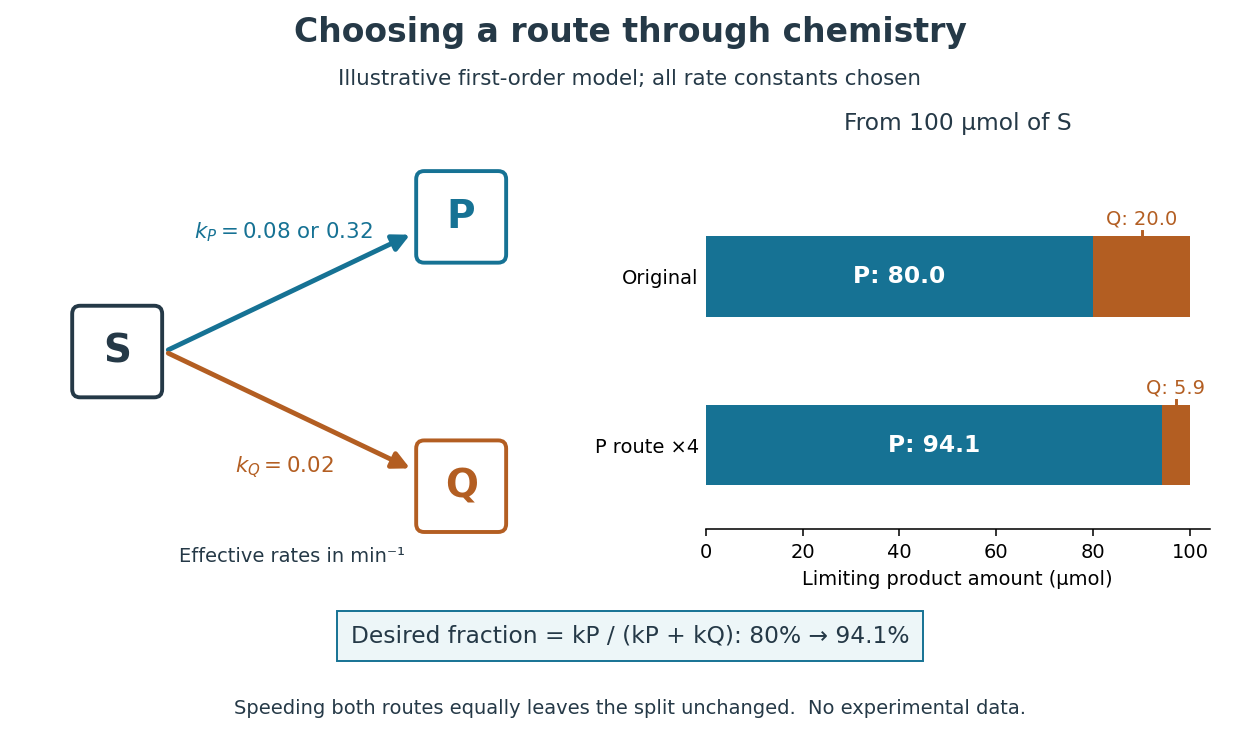
Selective acceleration changes the split between competing biochemical reaction products
. Original illustrative chemical reaction network and limiting product amounts from of hypothetical . Chosen effective rate constants are or and . The boxes label chemical species; they are not molecular structures. The bars are model limits, not experimental data. Details.
The reaction-rate equations give , and , where denotes amount of substance. Consequently,With and , the eventual split is of and of . At ten minutes, the calculated amounts are approximately , and for , and . Selectively increasing fourfold changes the eventual desired fraction to . Increasing both rate constants fourfold instead preserves the split and only shortens the conversion time. Speed and selectivity answer different questions.
The bookkeeping matters independently of that model. In ideal alcoholic fermentation, complete conversion of of glucose yields each of ethanol and carbon dioxide. Of the initial of carbon chemical atoms, remain in ethanol and enter carbon dioxide. This is a chosen material-balance example using the net stoichiometry explained under Saccharomyces cerevisiae; it gives neither an observed yield nor the mechanism of the individual steps. Equal amounts of the two reaction products also do not mean equal masses.
Articles by others on the same topic
There are currently no matching articles.