For Electrons directed normally toward an ideal planar collector, a retarding electric potential difference imposes the barrier . Write its transfer as , where is the Heaviside step function and the positive elementary charge. Thus a perfectly sharp loss need not produce a sharp drop in electric current: the drop also depends on where the outgoing energy lies relative to the barrier. For an oblique incident Electron at angle to the normal, the same planar model instead tests ; angular scattering can change collection even at unchanged total kinetic energy.
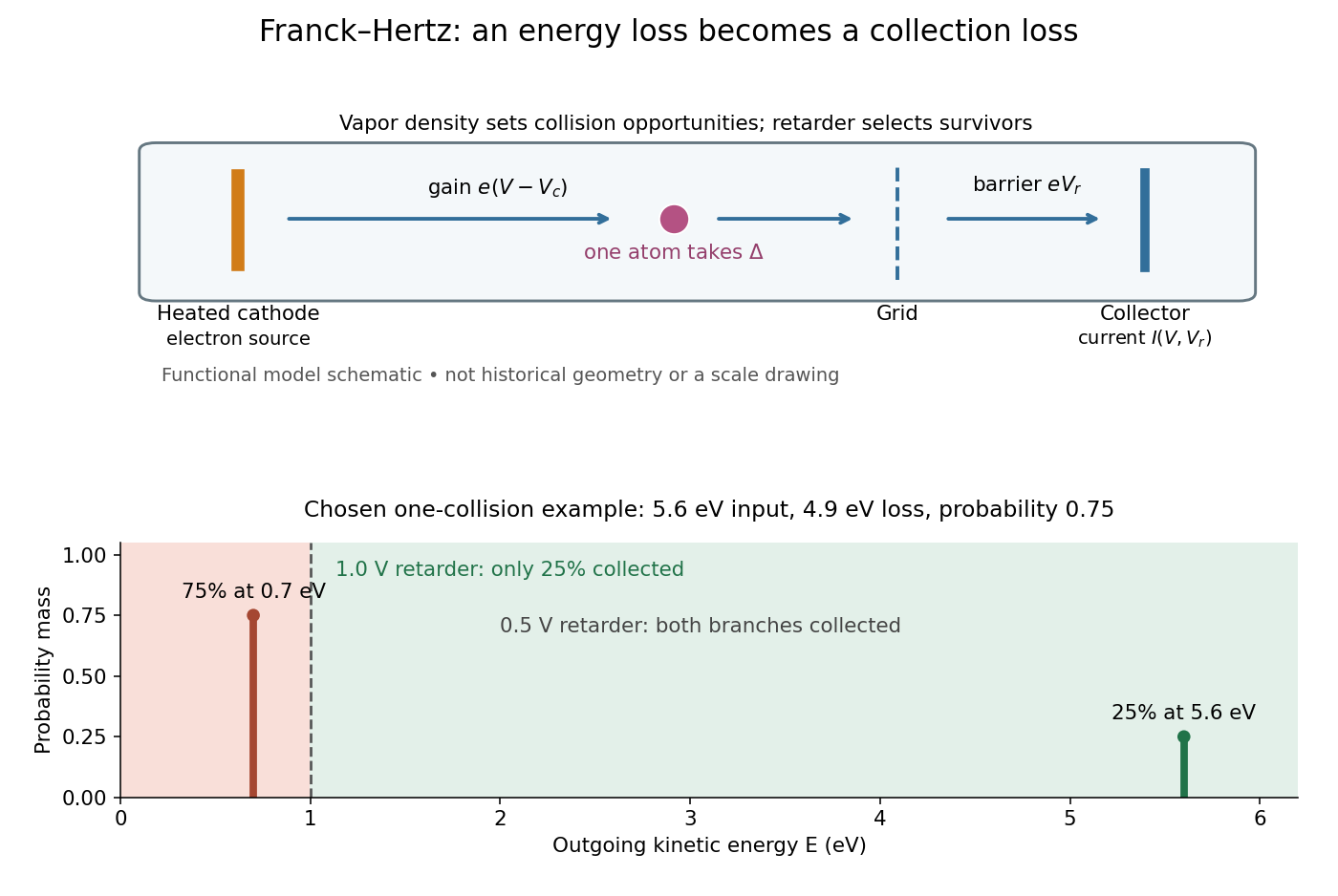
Franck-Hertz energy-loss model: separate acceleration, loss and collection
. Original functional schematic, not a scale reconstruction of a historical tube. The lower panel applies an ideal normally incident retarder to the explicitly chosen one-collision example. Equal vertical strokes mark outgoing energies; their labeled weights give probabilities. Source. Details.
For example, choose a monoenergetic incoming beam with , and . After one encounter, have and have . A retarder collects only , whereas a retarder collects ; here is the incident electric current with fixed geometrical acceptance and no background. The mean outgoing kinetic energy is , independently checked by . These are chosen inputs and calculated fractions, not historical measurements.
More generally, let be the normalized outgoing probability density function at a fixed accelerating electric potential difference , for the normally incident idealization. A retarding scan givesThe second equation follows by differentiating the lower integration limit, with Dirac delta functions understood for sharp beams. It explains why an integrated collector readout can reveal an energy distribution. With angles present it probes the distribution of normal kinetic energy; finite instrumental resolution smooths it, and numerical differentiation amplifies noise. Keep the incoming beam fixed during this scan. A scan of changes itself and cannot be differentiated by the same inversion formula.
Articles by others on the same topic
There are currently no matching articles.