For the stipulated Klein-Gordon packet velocities, take the original normalized spectral amplitudewith and . Here is the width of the spectral amplitude, not the standard deviation of its squared magnitude. Initially , a Gaussian function multiplying a carrier wave. Taking gives a real solution of the Klein-Gordon equation with the corresponding initial velocity. The tiny negative- tail is retained in this exact integral; the statement that it is mainly right-going is a narrow-spectrum approximation, not a claim of strictly positive wavenumbers.
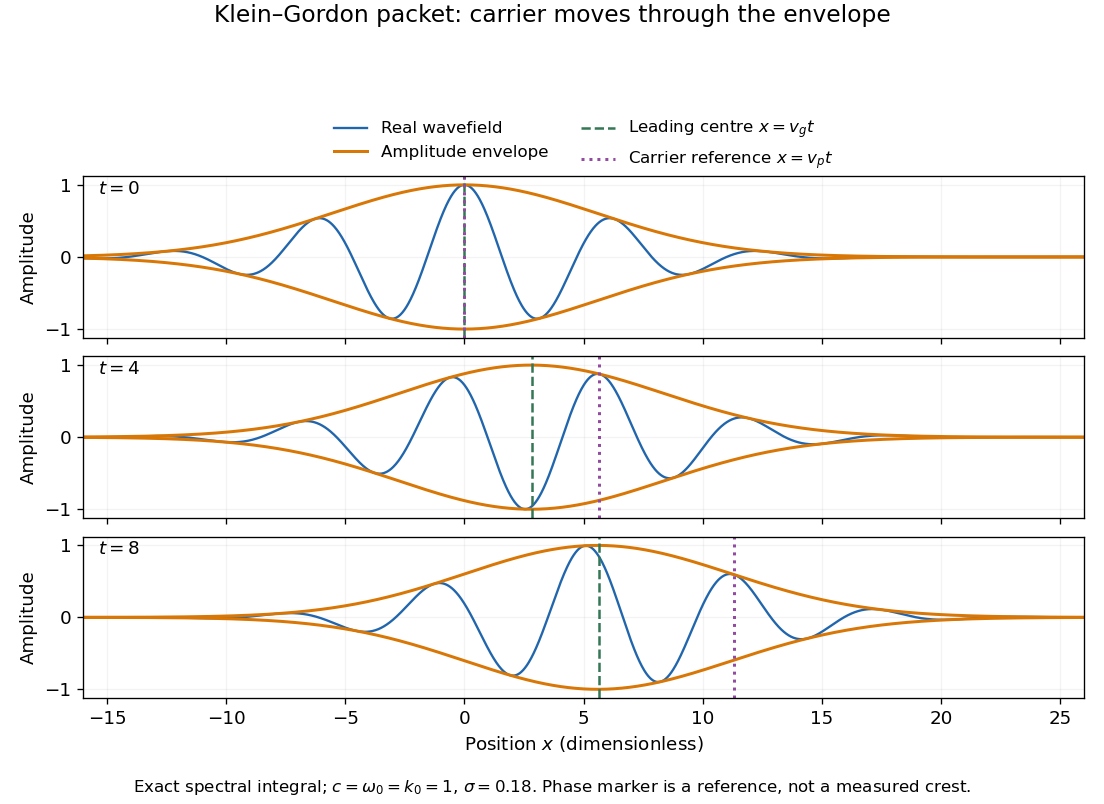
Original Klein-Gordon packet evolution: exact spectral integral, slower envelope and carrier phase reference
. Details. 
The dimensionless figure uses and at . Blue curves are , orange bounds are , and the marked carrier wave reference is ; it need not be a crest of the full wavefield. The dashed envelope-centre reference is a leading approximation. These are calculated curves, not experimental records. The exact dispersion relation makes the packet slightly asymmetric; a quadratic approximation predicts symmetric broadening about .
The first-order Taylor expansion translates the initial wave envelope without changing its shape. Retaining curvature instead givesThe distinction between translation and curvature-driven spreading is the same one exposed by the Gaussian pulse calculation in Pulse Propagation by Richard Fitzpatrick (equations 9.8–9.18). Its first-order approximation is not an assertion that a dispersive packet keeps its shape indefinitely.
Evaluating the quadratic Gaussian integral gives the original approximationand henceHere is the amplitude width: the standard deviation of the normalized intensity is . The peak falls as the packet widens, while stays constant. This conserved integral is not the complete physical wave energy of the Klein-Gordon equation.
Rigid translation requires . The quadratic approximation can allow that quantity to be order one, but still requires the accumulated neglected cubic wave phase to be small over the appreciable spectrum, for example . This sufficient check controls only the stated three-width spectral window; the Gaussian tails must also be negligible at the required accuracy. Higher derivatives or very long times require returning to the exact spectral integral. The width is therefore a controlled local approximation; it neither predicts front velocity nor establishes a universal identity between group velocity and information velocity.
Articles by others on the same topic
There are currently no matching articles.