Hamming distortion is zero for a correctly reconstructed symbol and one for a mismatch. Its expected distortion is the symbol-error probability:For strings of length , separable distortion divides their Hamming distance by . Thus reconstructed as has Hamming distance one and average Hamming distortion . Counting only whether the whole string is correct would give a different criterion.
Let be independent fair bits. The encoder sends their majority bit: zero when at least two inputs are zero, and one otherwise. The decoder reconstructs or by repeating that received bit three times. This is lossy compression: different original strings deliberately share a reconstruction.
There are eight equally likely inputs. The strings and have zero Hamming distance from their reconstructions; each of the other six has Hamming distance one. One transmitted bit represents three source symbols, soEvery input has average Hamming distortion at most , whereas the population average is . The actual block code therefore obeys , but does not reach the optimal long-block rate.
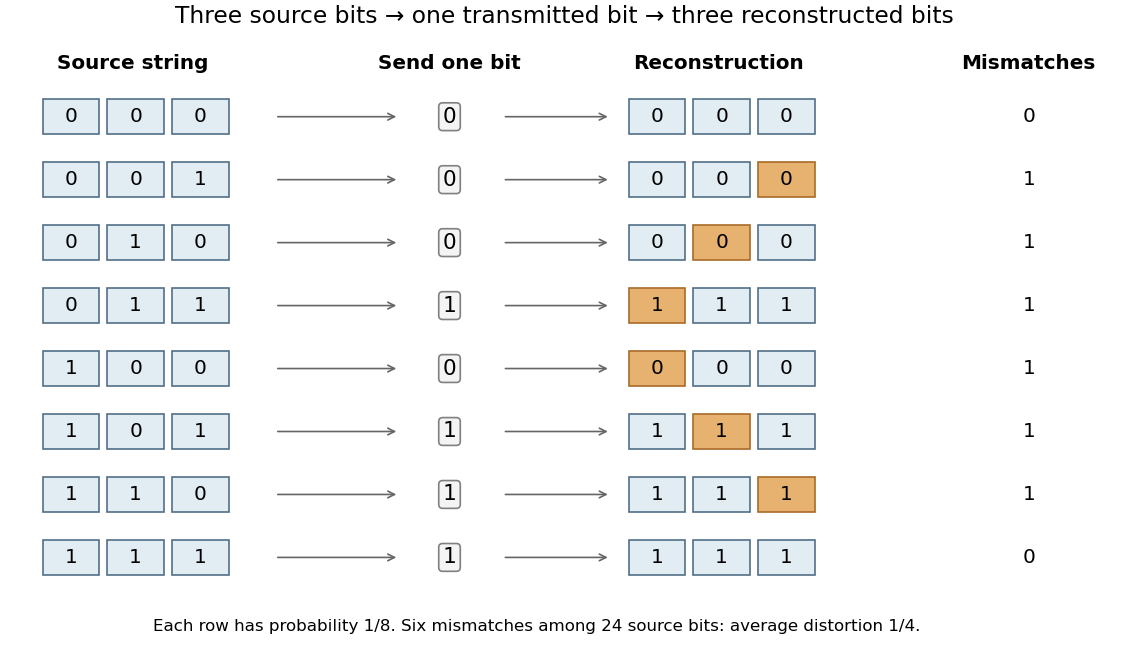

This construction uses the same reconstruction strings as the threefold binary repetition code, but the tasks differ. An error-correcting encoder expands one source bit into three transmitted bits; this lossy compression example compresses three source bits into one transmitted bit. The source distribution and the direction of the mapping matter.
For a stationary source of independent and identically distributed fair bits, with Hamming distortion and binary reconstruction alphabet,The binary entropy convention is . Once , always reconstructing zero meets the distortion constraint without sending any bits. The formula must not be extended to : a looser constraint cannot increase the required rate.[ref]
Chapter 25: Evaluating R(D). Lossy Source-Channel Separation. §25.1.1, Bernoulli Source, printed p. 255
The short argument identifies both sides of the optimum. For any feasible binary reconstruction, put , using exclusive or. Knowing makes and determine one another, so the conditional entropy obeyswhen . The last step uses the increase of binary entropy on that interval. Hence . Conversely, choose with an independent Bernoulli random variable of parameter . This binary symmetric channel has expected distortion and mutual information , attaining the bound.
Articles by others on the same topic
There are currently no matching articles.