The Hill reaction couples light-driven Electron transfer from water to an added electron acceptor with molecular oxygen release in an isolated photosynthetic preparation. The chloroplast dye-reduction experiment uses DCPIP.[ref]
Investigating the light dependent reaction in photosynthesis at Practical Biology. Investigating the light dependent reaction in photosynthesis, introductory and Teaching notes: artificial acceptor assay
In 1937, Robin Hill's Oxygen Evolved by Isolated Chloroplasts described a spectroscopic molecular oxygen measurement in illuminated isolated chloroplasts: oxygenation of muscle hemoglobin provided the indicator. This was an oxygen-binding readout. The publicly accessible first paragraph establishes that method; it does not specify enough preparation or control details to reconstruct the entire historical experiment here.[ref]
Oxygen Evolved by Isolated Chloroplasts by Robin Hill. Hill, Nature 139, 881–882 (22 May 1937), public first-paragraph preview: hemoglobin oxygenation and spectroscopic saturation measurement
The experimental idea is powerful because isolation asks how much of photosynthesis remains functional outside an intact biological cell. Breaking a chloroplast envelope does not logically imply destroying every internal thylakoid membrane. Conversely, finding an active preparation cannot establish that its chloroplast envelope remains intact. Activity and structural integrity require different evidence.
The Practical Biology protocol uses cold sucrose in buffer solution, ground green leaves, muslin filtration, centrifugation and cold pellet resuspension. A lamp illuminates extract plus DCPIP from –; a red-filter colorimeter monitors blue-color loss.[ref]
Investigating the light dependent reaction in photosynthesis at Practical Biology. Apparatus and Chemicals; Technical note 2; Procedure a–k; Sample results, Using a bench centrifuge: EEL colorimeter with red filter
Compare extract plus dye in darkness, illuminated dye without extract, extract without dye, and supernatant plus dye: controls for light, extract dependence, background color and incomplete separation. Green supernatant can remain active; a centrifugation pellet establishes neither purity nor intact chloroplasts.[ref]
Investigating the light dependent reaction in photosynthesis at Practical Biology. Procedure i–k, five-tube table; Teaching notes; Questions 1–3 and answers: control interpretations and green-supernatant limitation
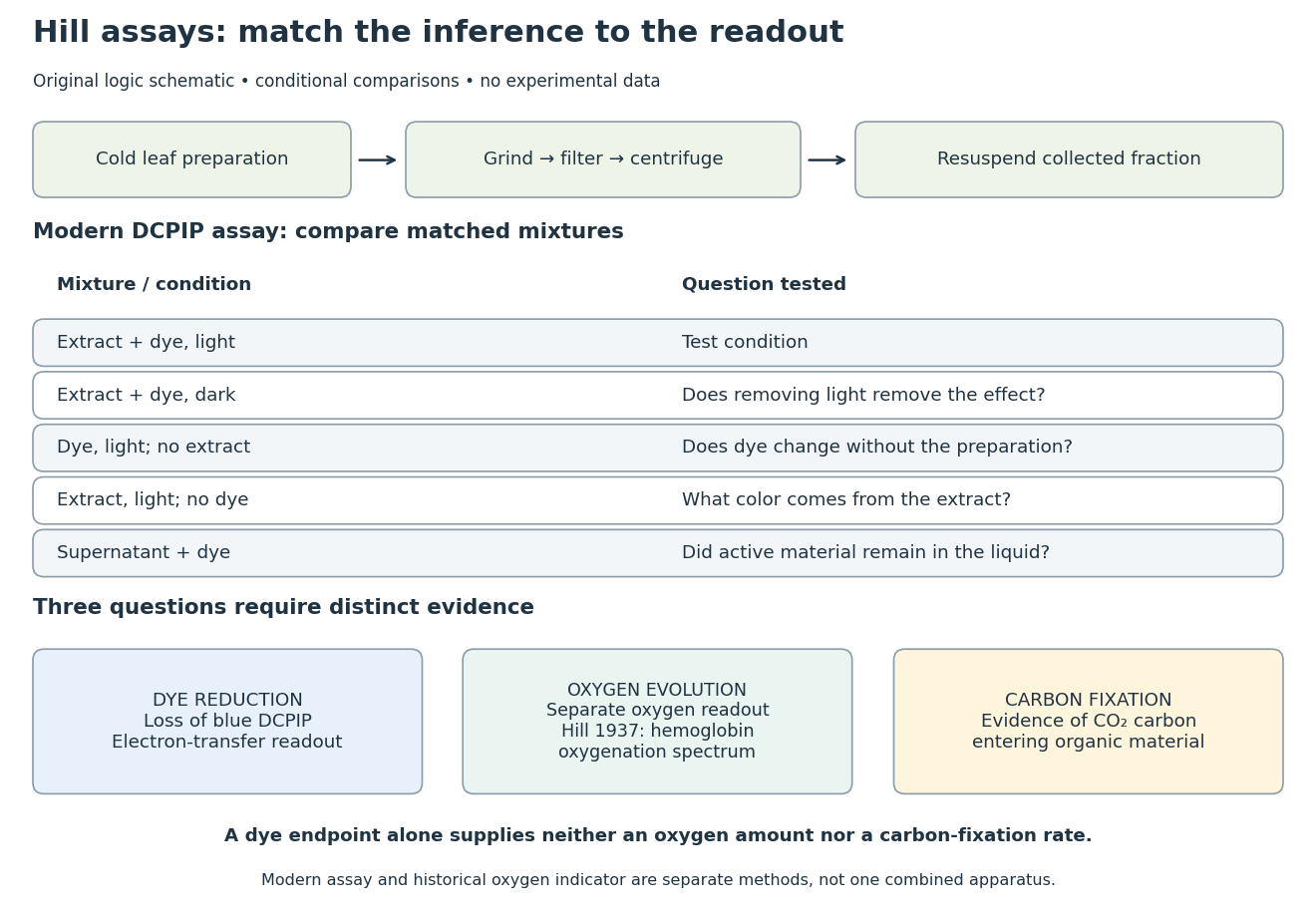
Hill reaction: preparation, comparisons and distinct readouts
. Original experimental-logic schematic. Control outcomes are conditional interpretations, not invented observations. The modern dye assay follows the inspected Practical Biology protocol; the separate historical branch denotes hemoglobin oxygenation. No measured time course, apparatus photograph or published figure is reproduced. Details.
Here is an original logical check of the controls. Suppose only the illuminated extract-plus-dye condition loses blue color, while the dark mixture and illuminated dye-only mixture retain it. Removing light or removing extract each removes the effect in those comparisons. That supports a joint requirement under the tested conditions. If the dye-only mixture also loses blue color, the proposed attribution to extract has failed its control; a faster change in the extract mixture would require a quantitative comparison before attribution. These are conditional cases, not experimental results.
Even the favorable case leaves three distinct questions. Dye reduction demonstrates delivery of Electrons to an artificial electron acceptor. An independently calibrated molecular oxygen readout is needed to measure molecular oxygen evolution. Demonstrating carbon fixation additionally requires evidence that carbon dioxide becomes incorporated into organic material. None of the latter quantities is supplied by a blue-color endpoint alone. An absorbance change also needs background and scattering controls before it can be treated as dye concentration; Beer-Lambert law states the relevant assumptions.
In particular, two hypothetical preparations can give the same dye endpoint while differing in whether their stromal Calvin cycle is functional. Observing only the dye discards that distinction. The counterexample establishes why dye decolorization cannot alone prove complete photosynthesis, carbon fixation, or an intact chloroplast. Temperature, extract loading and illumination must also be matched when comparing rates: a lamp can alter both light exposure and heating.
Articles by others on the same topic
There are currently no matching articles.