For emission take integers . Applying conservation of energy to the model's internal energy difference, while neglecting the much smaller whole-atom photon recoil, givesThus Johannes Robert Rydberg's Rydberg formula is a difference of two energy levels expressed as a spectroscopic wavenumber. The same constants determine every line; there is no new parameter for each electronic transition. With the chosen inputs, . All wavelengths below are calculated in vacuum, not air, and are rounded model predictions rather than historical measurements.
The conventional names commemorate Theodore Lyman and Johann Jakob Balmer. Fixing produces the ultraviolet Lyman series, beginning with the Lyman-alpha line; fixing produces the Balmer series. As , the wavelength approaches : at the Lyman limit and for the Balmer series. Crowding follows directly from . Discreteness therefore coexists with a series limit.
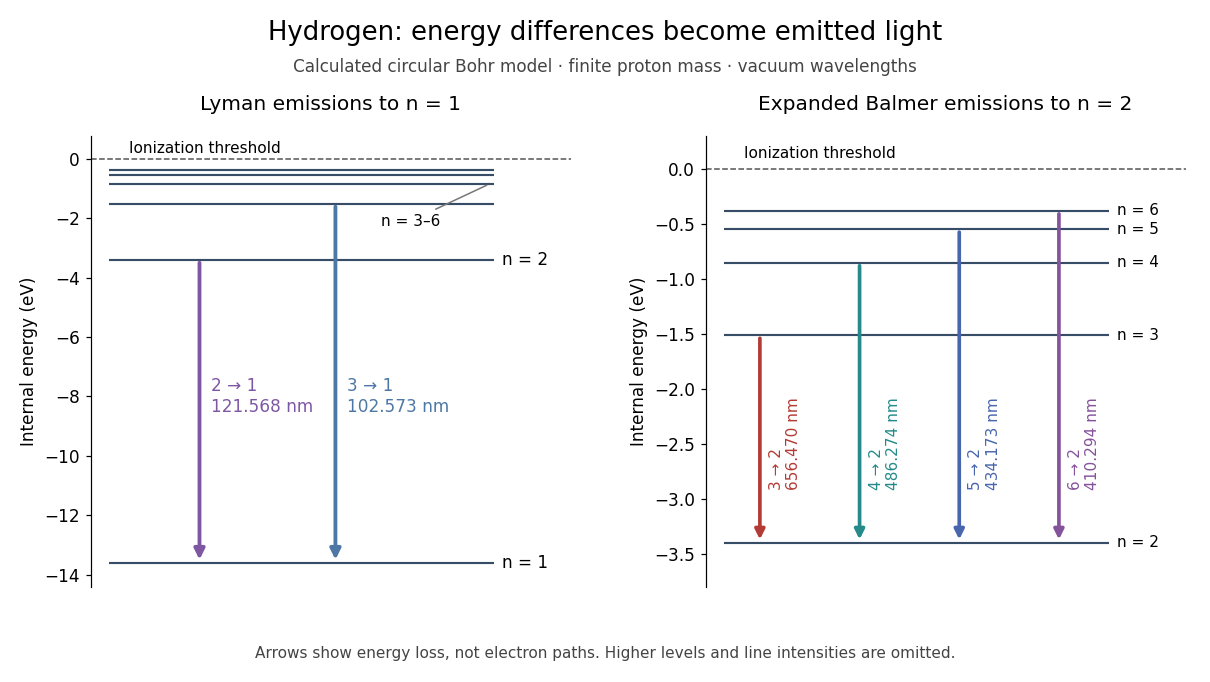

Correct line positions do not give wave intensities, lifetimes or electric-dipole selection rules for hydrogen. Those require a theory of the wavefunctions and their coupling to electromagnetic radiation. The circular model also omits spin, relativistic corrections and the Lamb shift. Its successful gross energy levels do not make its assumed orbits modern atomic orbitals.
Articles by others on the same topic
There are currently no matching articles.