Let the possible numerical outcomes be , and give the reference law uniform distribution on a finite set: . We want a law with expected value . Write the three probabilities in outcome order as . The mean constraint is , while normalization requires .
These conditions leave a whole line of possible probability distributions:For example, and both have the required mean. The constraint alone does not choose between them. Information projection selects the point on this line with the smallest relative entropy from the reference.
Exponential tilting gives weights proportional to . Set and multiply these weights by to obtain . Enforcing the mean givesThe positive root is , henceThe most favored outcome becomes , but all three remain possible. This is an exact constructed example with a stipulated reference law and constraint, not a fitted distribution from measurements.
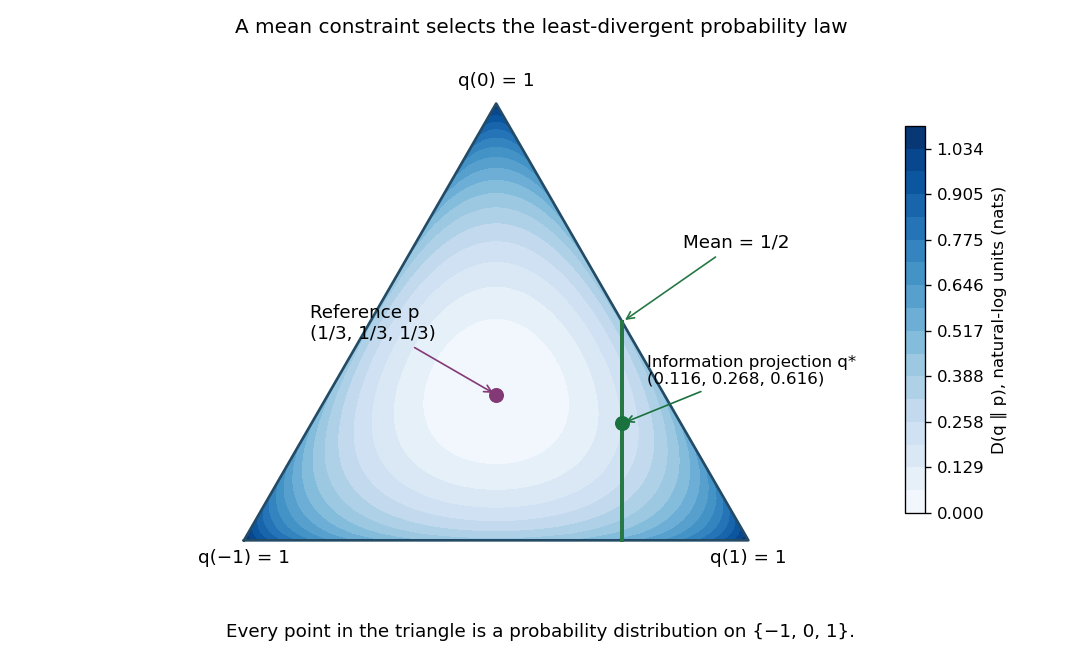

The word "projection" does not mean ordinary perpendicular projection in the plotted Euclidean space. For the same reference and mean constraint, minimizing the squared Euclidean distance in the three probability coordinates instead givesThus the Euclidean minimizer is , whereas the information projection has . The squared Euclidean objective at its own minimum is ; its relative entropy is approximately nats, larger than the optimum nats. Both distributions satisfy the same constraint.
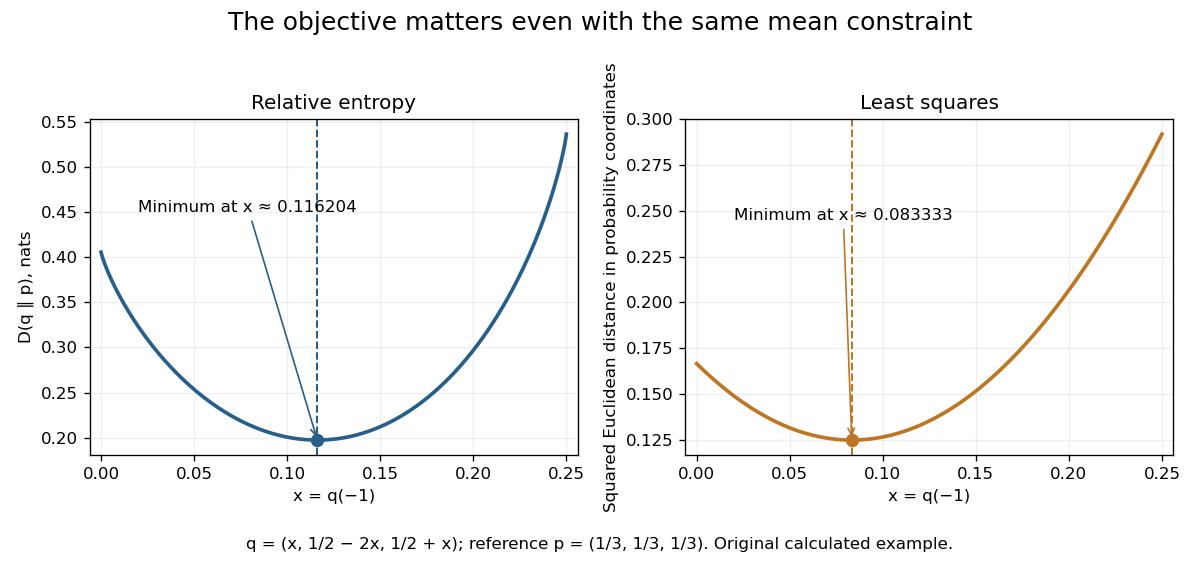

The reference and objective encode what "least change" means. Relative entropy is asymmetric and is not a metric; its minimization answers a different question from linear least squares. The useful geometric analogy comes from a Pythagorean inequality for information projection, rather than from an assertion that the colored contours are circles.
Articles by others on the same topic
There are currently no matching articles.