
Ideal solution 2026-10-18
An ideal solution is a chemical solution whose component chemical potentials depend on composition throughHere is an amount of substance, its mole fraction, the molar gas constant, and the pure-component liquid reference at the same temperature and pressure . This model applies to every component across the composition range; it is stronger than an approximation valid only near a pure solvent.[ref]
With this pure-liquid standard state convention, the thermodynamic activity satisfies , so an ideal solution has , or activity coefficient .[ref]
ideal mixture. IUPAC Compendium of Chemical Terminology, fifth edition (Gold Book) by International Union of Pure and Applied Chemistry; Ideal mixture, definition: activities equal mole fractions, equivalently unit activity coefficients; I02938, online version 5.0.0
This statement concerns the liquid. Assuming that a coexisting vapor is an ideal gas mixture is an additional approximation. Its mole fractions generally differ from the liquid mole fractions .For an original two-component example, stipulate and pure-component vapor pressures and . A and B are invented distinguishable components; these numbers are chosen model inputs, not material data. Combine an ideal solution with an ideal gas vapor, neglect the pure-liquid reference's pressure correction, and exclude other gases. At liquid mole fractions and , Raoult's law and addition of partial pressures giveThus the coexisting vapor contains about A by amount of substance, although the liquid contains only . The total pressure is neither pure-component vapor pressure, and cannot be substituted for . This enrichment is the basis of distillation.
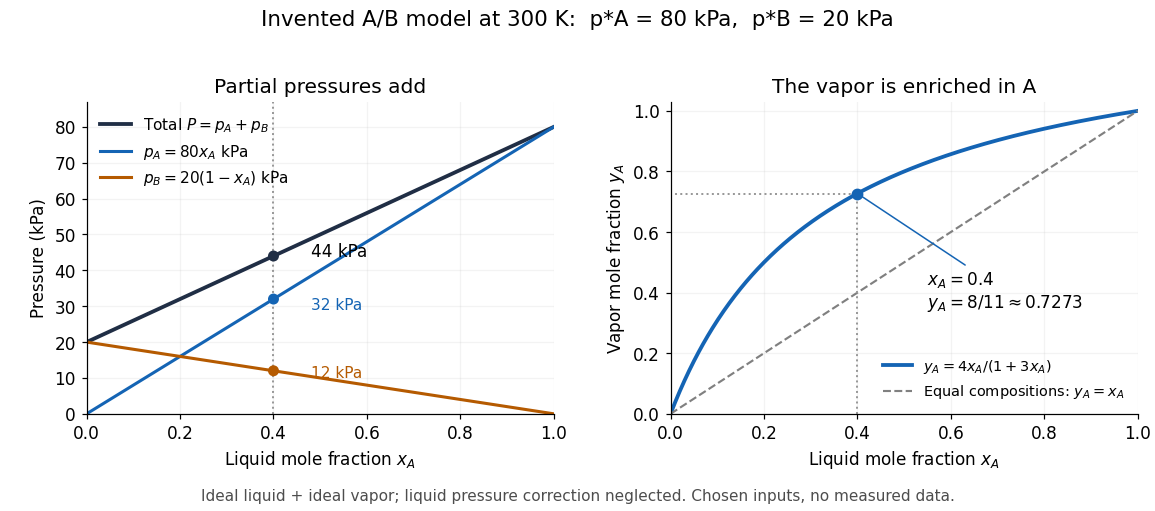

The usefulness of the ideal solution is that one composition law connects chemical potentials, vapor-liquid equilibrium, entropy of mixing and Gibbs free energy of mixing. Its liquid components can interact strongly: the defining condition is their composition dependence, rather than the absence of all interactions as in an ideal gas model.