The delete-one form of jackknife resampling recalculates a statistic after deleting each observation in turn. It uses one observed statistical sample to investigate how sensitive an estimator is to its individual observations, and supplies both a jackknife variance estimator and jackknife bias correction. The calculations are deterministic once the data are fixed: no random draws are needed.
In the basic setting, are independent and identically distributed random variables, with sample size . Let be the observed values and a scalar estimator of an estimand . Apply the same estimation rule to each reduced statistical sample, using its new sample size wherever the rule requires it:Every index is deleted exactly once; an unusual value is treated by the same rule as every other value. The mean summarizes the deletion estimates. They overlap in observations, so they are generally not independent random variables representing fresh repetitions of the original experiment. Cosma Shalizi's [ref]
https://stat.cmu.edu/~cshalizi/490/23/2023-11-29-jackknife.pdf. Carnegie Mellon jackknife notes, Sections 1–3 and 5
explain this construction and its scaling.For a concrete sample mean, use the data , whose full sample mean is . The five deletion sample means, in observation order, areDeleting raises the sample mean by , while deleting lowers the sample mean by . Thus has the largest deletion effect in this statistical sample. This is a descriptive sensitivity calculation, not a rule for removing that observation: the full sample mean remains .
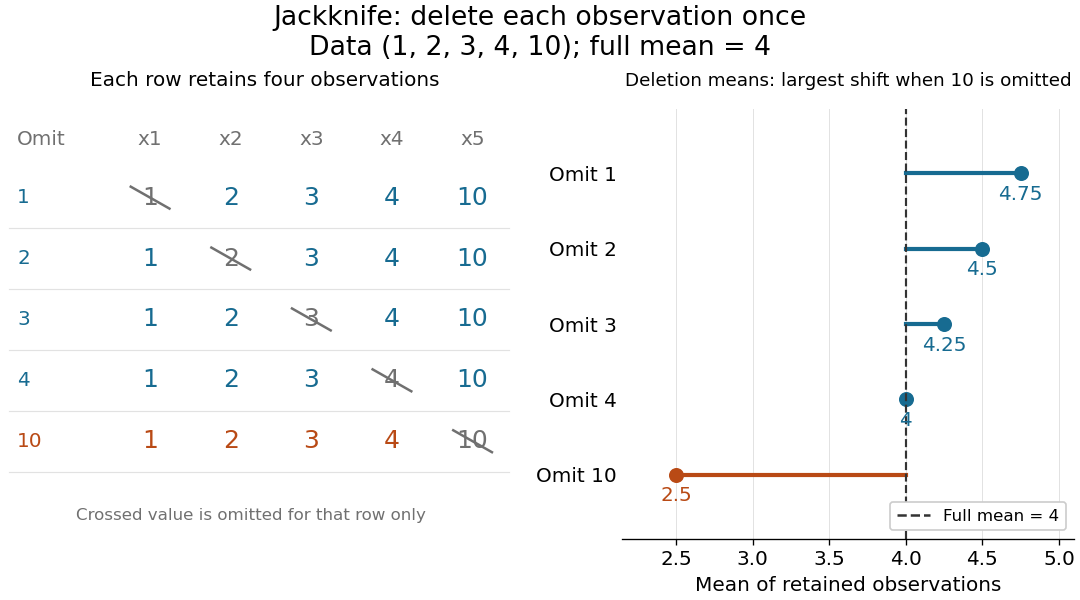
Delete each observation once and recompute the sample mean
. The left panel shows all five reduced statistical samples from ; each crossed entry is omitted only for that row. The right panel shows their sample means against the full sample mean . The orange row makes the deletion effect of visible. Details.Early literature includes M. H. Quenouille's [ref]
https://academic.oup.com/jrsssb/article/11/1/68/7026551. Approximate Tests of Correlation in Time-Series, JRSS B 11(1), 68–84 (1949)
and John W. Tukey's one-paragraph abstract [ref]https://www.jstor.org/stable/2237363. Bias and Confidence in Not-Quite Large Samples, Annals of Mathematical Statistics 29(2), 614 (1958)
, within the issue's collected abstracts. Shalizi's [ref]https://stat.cmu.edu/~cshalizi/490/23/2023-11-29-jackknife.pdf. historical notes and bibliography
discuss the later development of jackknife bias correction and the jackknife variance estimator. Articles by others on the same topic


Jackknife resampling is a statistical technique used to estimate the bias and variance of a statistical estimator. It involves systematically leaving out one observation from the dataset at a time and calculating the estimator on the reduced dataset. This process is repeated for each observation, and the results are then used to compute the overall estimate, along with its variance and bias. ### Key Steps in Jackknife Resampling: 1. **Original Estimate Calculation:** Calculate the estimator (e.g.