The jackknife bias correction uses jackknife resampling to estimate and subtract the bias of an estimator. Here denotes the original estimator, its version after deleting observation , and the mean of those versions. For sample size , defineThe sign matters: a negative estimated bias increases the corrected value. The original estimator and all deletion versions must target the same estimand and use the same estimation rule at their respective sample sizes. The definition alone does not make an unbiased estimator.
For an exact worked example, take the empirical varianceOn , the sample mean is and . Each deletion empirical variance is recomputed around its own deletion sample mean, with divisor , givingFor instance, deleting leaves , whose sample mean is and whose empirical variance is . The correction on the full statistical sample isThe same data thus give a jackknife variance estimator of for the sample mean, and a corrected empirical variance of ; these are different estimands.
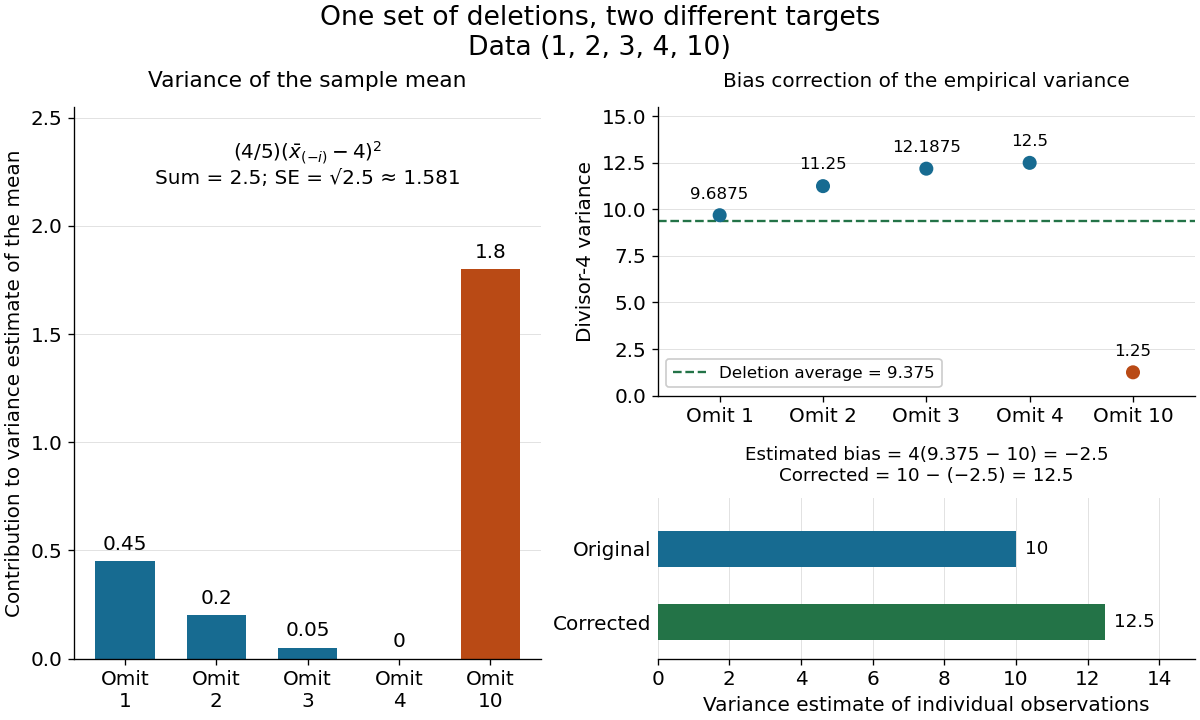

The exact equality with the usual sample variance is not an accident of these numbers. For any data with , write . Removing changes this sum to , soFor independent and identically distributed random variables with finite second moment and population variance , the expectation is . Its bias is exactly ; jackknife bias correction removes it exactly in this example. Thus is an unbiased estimator of under these assumptions, including where each deletion empirical variance is zero.
More generally, suppose the bias has a regular expansion at both sample sizes and , with coefficients independent of :Under independent and identically distributed sampling, each deletion estimator has the same expectation as . Hence the corrected bias isThe leading term cancels; the remaining bias need not vanish. The notation is big O notation. This argument presumes the expansion, rather than proving it for every statistic; the regularity conditions discussed for the jackknife variance estimator and statistical dependence still require care. Shalizi's [ref] develop the cancellation argument and cite Quenouille's [ref]
https://academic.oup.com/biomet/article-abstract/43/3-4/353/345190. Notes on Bias in Estimation, Biometrika 43(3–4), 353–360 (1956)
.For observations , the unbiased sample variance isFor independent identically distributed observations with finite variance , it converges in probability to .
Articles by others on the same topic
There are currently no matching articles.